Elizabeth Smith-Stanley, Countess Of Derby
| Name | Elizabeth Smith-Stanley, Countess Of Derby |
| Title | English peeress (1753-1797) |
| Gender | Female |
| Birthday | 1753-01-26 |
| nationality | Great Britain |
| Source | https://www.wikidata.org/wiki/Q4725 |
| pptrace | View Family Tree |
| LastUpdate | 2025-11-26T23:29:18.232Z |
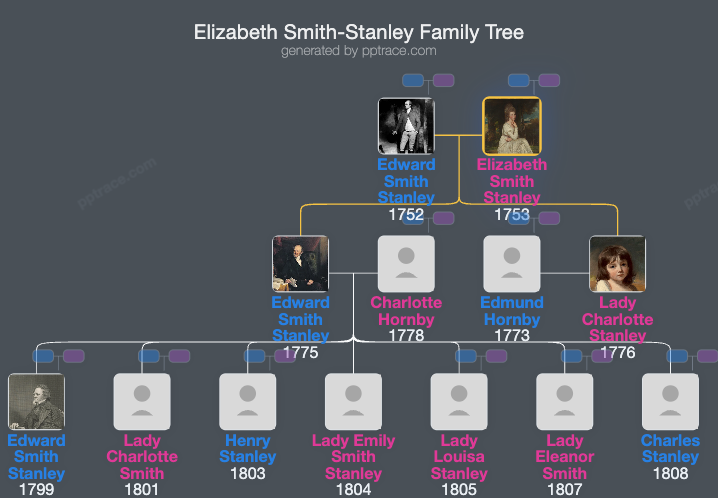
Family Tree
Tap  to expand more relatives
Introduction
Elizabeth Smith-Stanley, Countess of Derby (née Hamilton), was born on 26 January 1753. She was the eldest daughter of James Hamilton, 6th Duke of Hamilton, and Elizabeth Gunning. She had two younger brothers. Her father died in early 1758, and her mother remarried in 1759 to John Campbell, Marquess of Lorne, who later became Duke of Argyll. Through this marriage, she gained three half-brothers and two half-sisters.
In her youth, Elizabeth Hamilton was considered an eligible society figure. During her first London season, her name was linked to numerous noblemen. In 1773, Edward Smith-Stanley, Lord Stanley, paid court to her, culminating in a series of elaborate social events. They married on 23 June 1774, in a ceremony hosted by playwright John Burgoyne, which included dancers, opera singers, acrobats, and a mock wedding attended by nymphs and Lady Elizabeth at the altar.
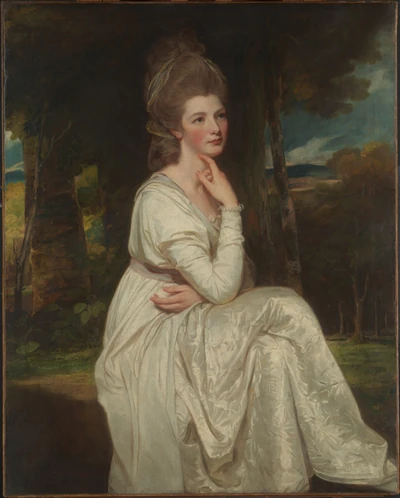
Following her marriage, Elizabeth became the Countess of Derby upon her husband's succession to the title of Earl of Derby in 1776. She was associated with fashionable society, alongside figures such as the Duchess of Devonshire. She organized a notable upper-class women's cricket match around 1777. Diplomas from artists Angelica Kauffman and George Romney feature portraits of her and her family. One of Kauffman’s family paintings is held at the Metropolitan Museum of Art, while Romney’s portrait is displayed at the National Portrait Gallery.
Lady Derby bore three children: Edward Smith-Stanley, born 21 April 1775, who later became the 13th Earl of Derby; Lady Charlotte, born 17 October 1776, who married her cousin Edmund Hornby; and Lady Elizabeth Henrietta, born 29 April 1778, whose paternity is attributed by some sources to her mother's affair with John Sackville, 3rd Duke of Dorset. Lady Elizabeth Henrietta married Thomas Cole and had issue; her biological paternity remains a matter of some speculation.
In early 1778, rumors surfaced of an extramarital affair between Lady Derby and the Duke of Dorset. These rumors, later confirmed by press reports, caused a scandal. Her mother accompanied her to the theatre in an attempt to dispel the rumors, but by August 1778, Lady Derby was living apart from her husband in the countryside amidst gossip of legally seeking a divorce. Society ostracized her, and her social standing diminished. Her husband's refusal to divorce her and prevent her from seeing her children resulted in her isolation. From this point, she became a "chronic invalid," lived abroad, and avoided London society until approximately 1783.
During her separation, Lord Derby engaged in a high-profile, unconsummated relationship with actress Elizabeth Farren. By 1784, Lady Derby began to reappear in society, attending events with figures such as the Duchess of Devonshire. Her social status was believed to be influenced by her estranged husband's declining social capital. No reconciliation between the couple occurred; instead, Lord Derby and Miss Farren anticipated her death to facilitate remarriage.
Elizabeth Smith-Stanley died of tuberculosis on 14 March 1797. Her husband married Elizabeth Farren shortly afterward, less than two months later, following her retirement from the stage. Some commentators suggest her social transgression was not her association with the Duke but her departure from her marriage, while others emphasize the lack of privacy surrounding her affair.