
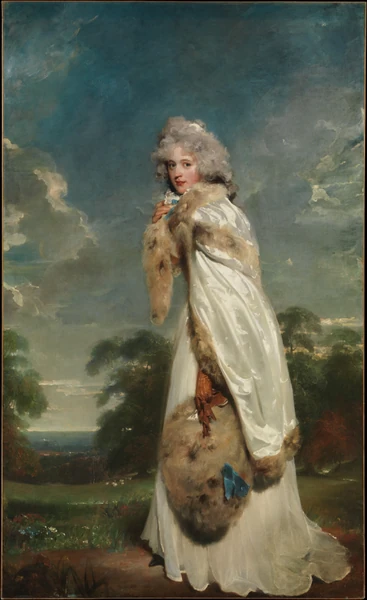
Elizabeth Farren
| Name | Elizabeth Farren |
| Title | English actress |
| Gender | Female |
| Birthday | 1759-01-01 |
| nationality | United Kingdom of Great Britain and Ireland |
| Source | https://www.wikidata.org/wiki/Q5362754 |
| pptrace | View Family Tree |
| LastUpdate | 2025-11-26T23:29:32.431Z |
Family Tree
Tap  to expand more relatives
Introduction
Elizabeth Stanley, Countess of Derby (circa 1759 – 23 April 1829), born Elizabeth Farren in Cork, Ireland, was an actress active in the late 18th century. She was the daughter of George Farren, a surgeon and apothecary, and his wife, née Wright, from Liverpool. She had a sister named Margaret Farren, who was also an actress.
In her early years, Elizabeth performed in juvenile roles at Bath and other locations. By 1774, she was acting alongside her mother and sisters in Wakefield, under Tate Wilkinson's opponent, Whiteley. At age fifteen, she played Rosetta in "Love in a Village" at Liverpool and later portrayed Lady Townly in "The Provoked Husband" by Colley Cibber.
Elizabeth Farren was introduced to the London stage in 1777 by George Younger, her Liverpool manager, making her debut at the Haymarket Theatre on 9 June 1777 in the role of Miss Hardcastle in "She Stoops to Conquer." Her performance was favorably received, leading to subsequent roles including Maria in Murphy's "Citizen," Rosetta, and Miss Tittup in Garrick's "Bon Ton." She also originated the role of Nancy Lovel in Colman's "Suicide" on 11 July 1778. That same year, she appeared at Drury Lane and succeeded Frances Abington as a leading actress in London.
Throughout her career, she performed primarily at Drury Lane and the Haymarket Theatre, with sporadic appearances in provincial theatres and Covent Garden. Her repertoire included over 100 characters, such as Berinthia in Sheridan's "Trip to Scarborough," Belinda in Murphy's "All in the Wrong," Angelica in "Love for Love," and roles in Shakespearean plays including Hermione in "The Winter's Tale," Portia in "The Merchant of Venice," Olivia in "Twelfth Night," and Juliet.
Elizabeth Farren created few original roles; notable among them were Lady Sash in Sheridan's "The Camp," Mrs. Sullen in Colman's "Separate Maintenance," Cecilia in Miss Lee's "Chapter of Accidents," Almeida in Pratt's "The Fair Circassian," and the heroine in Holcroft's "Force of Ridicule" in December 1796. Her final stage appearance was on 8 April 1797 as Lady Teazle. She was characterized by a slight figure, expressive face, blue eyes, and a cultivated voice. Her acting style and presence drew praise from critics and contemporaries, with notable remarks from Hazlitt, Cumberland, George Colman the younger, and Tate Wilkinson.
On 1 May 1797, Elizabeth Farren married Edward Smith-Stanley, the 12th Earl of Derby. They had three children: Lady Lucy Elizabeth Stanley (1799–1809), who died young; Hon. James Stanley (1800–1817), also died young; and Lady Mary Margaret Stanley (1801–1858), who married Thomas Egerton, 2nd Earl of Wilton. She reportedly had relationships with John Palmer and Charles Fox and was rumored to have had an affair with Anne Seymour Damer.
As Countess of Derby, she reportedly was treated with respect by her husband, which was considered notable given her previous acting career. Elizabeth Farren died at Knowsley Park, Lancashire, on 23 April 1829.
Portraits of her include a life-size work by Sir Thomas Lawrence, exhibited at the Royal Academy in 1790, and another housed in the Garrick Club's collection.
