
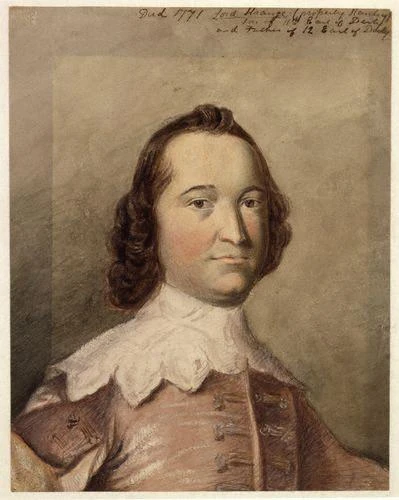
James Smith-Stanley, Lord Strange
| Name | James Smith-Stanley, Lord Strange |
| Title | British politician |
| Gender | Male |
| Birthday | 1716-00-00 |
| nationality | Great Britain |
| Source | https://www.wikidata.org/wiki/Q11716794 |
| pptrace | View Family Tree |
| LastUpdate | 2025-11-26T23:29:28.860Z |
Family Tree
Tap  to expand more relatives
Introduction
James Smith-Stanley, Lord Strange (1716–1771), was an English nobleman and politician. He was commonly referred to by this courtesy title, although neither he nor his father had a legitimate claim to it. He was the eldest son of Edward Stanley, 11th Earl of Derby. The titles associated with the name Lord Strange, which are baronies by writ, had historically been associated with the heirs of the earldom’s predecessors. However, those baronies had descended to daughters when the earldom passed to the male heir, resulting in the title Lord Strange being used informally in this context without official inheritance rights.
In 1737, James Stanley married Lucy Smith, the daughter and coheir of Hugh Smith of Weald Hall, Essex. Upon his marriage, he adopted the additional surname Smith, becoming James Smith-Stanley. Their union produced several children, including Edward Smith-Stanley, who became the 12th Earl of Derby, and Thomas Stanley (1753–1779). James Smith-Stanley died in 1771 before his father, which led to the earldom passing directly to his son upon the death of the 11th Earl.
He attended Westminster School during his youth, where he developed a close friendship with John Burgoyne, who would later become a notable soldier, playwright, and politician. Burgoyne was involved in the American Revolutionary War and is known for his surrender at the Battle of Saratoga in 1777. As a young man, Burgoyne eloped with Lady Elizabeth Hamilton, Lord Strange’s sister. Burgoyne also authored a masque to celebrate the marriage of Edward Smith-Stanley to Lady Elizabeth Hamilton, who was the daughter of James Hamilton, 6th Duke of Hamilton.
In terms of public service, Lord Strange was a Member of Parliament for Lancashire from 1741 until his death in 1771. He held the position of Chancellor of the Duchy of Lancaster in the government of Lord North from 1762, at which time he was also appointed to the Privy Council. During the Seven Years' War, he served as Lord Lieutenant of Lancashire. In this role, he was responsible for calling out the Lancashire Militia, which had been disbanded since 1746. Although Lancashire's quota was only one regiment, and despite his enthusiasm, it was not until July 1760 that the regiment reached 60% of its full strength and was issued with arms. Subsequently, Lord Strange was commissioned as the regiment’s colonel on 15 July 1760. The regiment was formally embodied for active service on 23 December 1760.
In October 1761, King George III presented the regiment’s Colours and granted it the title "Royal Lancashire Militia"; the colonel’s own company became known as "the King’s Company." The regiment was disbanded in December 1762 as the war ended, but Lord Strange remained its colonel for the rest of his life. He is also mentioned by the historian Francis Parkman as a plenipotentiary to Paris and Choiseul, and an advisor to William Pitt during the negotiations and turbulence surrounding the Treaty of Paris in 1763.
**Ancestry** and further notes regarding his family background are available from historical records, but specific details are not provided in the current information.
