Frederick Hervey, 4th Earl Of Bristol
| Name | Frederick Hervey, 4th Earl Of Bristol |
| Title | British bishop (1730-1803) |
| Gender | Male |
| Birthday | 1730-08-01 |
| nationality | United Kingdom of Great Britain and Ireland |
| Source | https://www.wikidata.org/wiki/Q1452908 |
| pptrace | View Family Tree |
| LastUpdate | 2025-11-26T23:22:38.326Z |
Family Tree
Tap  to expand more relatives
Introduction
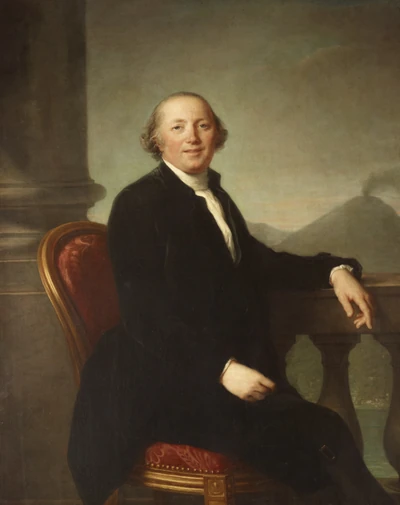
Frederick Augustus Hervey, 4th Earl of Bristol, was born on 1 August 1730 in Suffolk, England, and died on 8 July 1803 in Lazio, Italy. He was an Anglican bishop and a member of the Hervey family, which was associated with Ickworth House in Suffolk. His parents were related to the noble peerage, and he inherited the title of Earl of Bristol following the death of his elder brother, Admiral Augustus Hervey, the 3rd Earl, in December 1779.
Hervey attended Westminster School and later studied law at Corpus Christi College, Cambridge, where he earned a Master of Arts degree in 1754 and was awarded a Doctor of Divinity (DD) in 1770. He was accorded the courtesy title "The Honourable" after his father's death in 1743. He also inherited the Baron Howard de Walden title in 1799, which was called out of abeyance by the House of Lords in his favor, deriving from his grandmother's lineage.
In his ecclesiastical career, Hervey was ordained in 1754 as a Fellow of Corpus Christi College. He served as Clerk of the Privy Seal in 1756 and as Principal Clerk in 1761. He became a Royal chaplain in 1763. His early ecclesiastical appointments included being elected Bishop of Cloyne in 1767, a position secured with the support of his brother, who was Lord Lieutenant of Ireland. In 1768, he was translated to become Bishop of Derry, a position he held until his death in 1803. His ecclesiastical style was "Lord Bishop of Derry."
Hervey was known for his interests in architecture and art, designing mansions at Downhill and Ballyscullion, and filling them with artworks from Italy and elsewhere. His redevelopment plans for Ickworth House began in 1794; however, due to the scale of the project, only the Rotunda was completed during his lifetime, with his son Frederick further completing the estate in 1830.
Politically, Hervey favored religious equality and opposed the feudal system of tithes. He was involved with the Irish Volunteer Movement in 1782 and participated in a notable Irish nationalist convention in Dublin in 1783. His outspoken remarks about rebellion led to considerations of his arrest by the Dublin Castle administration. Later, he spent much of his time traveling in Europe and was imprisoned by the French in 1798 at Milan for suspected espionage, remaining in custody for eighteen months. He then traveled to Rome, where he died at Albano.
He was elected a Fellow of the Royal Society in 1782 and received the Freedom of the City of Dublin and of Derry in 1783. He was also a collector of art and had a reputation for materialistic opinions during his later years. Known for his flamboyant style and love of travel, Hervey notably walked in Rome wearing a broad-brimmed white hat, gold chains, and red breeches.
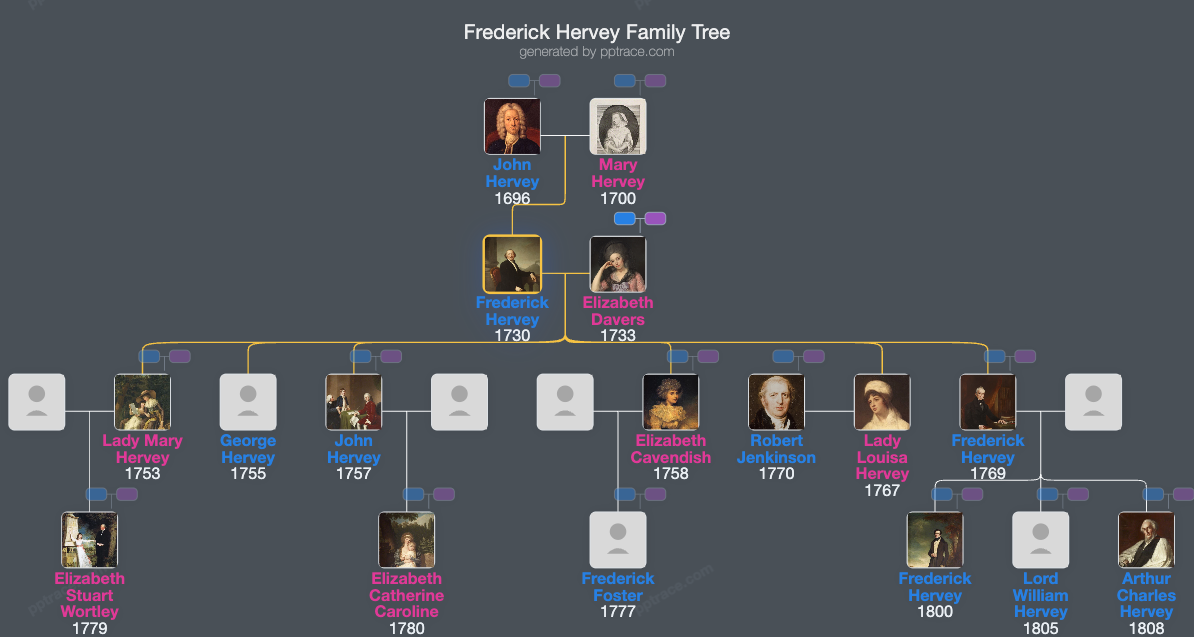
Hervey married Elizabeth Davers in 1752. They had four sons and three daughters, including Frederick Hervey, who succeeded him as the 5th Earl of Bristol, and Lady Louisa Hervey, who married the Prime Minister Robert Jenkinson, 2nd Earl of Liverpool. Hervey and Elizabeth separated after 30 years of marriage in 1782; they never saw each other again, though he maintained correspondence with his children. His remains were returned to England and reburied at Ickworth House.