Lady Louisa Hervey
| Name | Lady Louisa Hervey |
| Title | British noble (1767–1821) |
| Gender | Female |
| Birthday | 1767-02-00 |
| nationality | — |
| Source | https://www.wikidata.org/wiki/Q75285991 |
| pptrace | View Family Tree |
| LastUpdate | 2025-11-26T23:26:10.482Z |
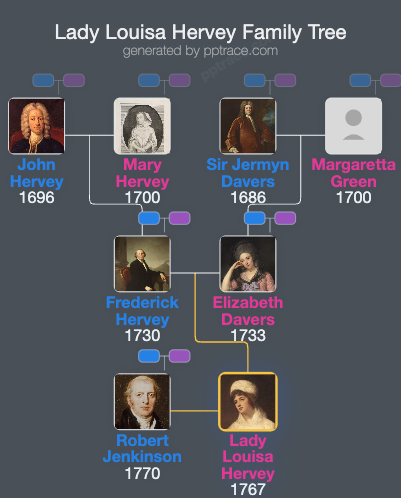
Family Tree
Tap  to expand more relatives
Introduction
Louisa Theodosia Jenkinson, Countess of Liverpool (née Hervey), was born in February 1767. She was the youngest daughter of Frederick Hervey, the 4th Earl of Bristol and Bishop of Derry, and Elizabeth Davers, Countess of Bristol. Her family included three brothers—John, Lord Hervey; Frederick, the 1st Marquess of Bristol—and two sisters, Lady Mary Erne and Elizabeth Cavendish, Duchess of Devonshire.
In 1777, her family traveled to Italy, during which she contracted severe malaria. She remained in convalescence until September 1779 and was formally Lady Louisa Hervey following her father's elevation to Earl of Bristol after the death of his brother in December 1779. At age 15, in 1782, her parents separated, and she lived with her mother at Ickworth in Suffolk, leading an isolated lifestyle with limited companionship of her own age. Her upbringing emphasized religious and moral instruction; for example, she crafted clothes for a poor girl at her school.
In 1785, Louisa and her mother relocated to London, broadening her social environment, and she maintained regular correspondence with her father. In 1793, she met Robert Jenkinson, then a Member of Parliament and the son of Lord Hawkesbury, who later became the 2nd Earl of Liverpool. Robert frequently visited her in Wimbledon, Surrey. By November 1794, an agreement to marry was reached. Her father consented to the marriage, promising a dowry of £10,000, but Robert’s father initially opposed the match, wishing his son to marry for a substantial fortune and delay marriage until age thirty. After intervention by William Pitt the Younger and the King, Lord Hawkesbury consented. Louisa and Robert married on 25 March 1795; Robert was 24 years old, and Louisa was 28.
Following their marriage, Robert Jenkinson pursued a political career, joining the cabinet in 1801 and serving in the House of Commons until 1803, when he was elevated to the House of Lords as Baron Hawkesbury. He succeeded his father as the 2nd Earl of Liverpool in December 1808. Louisa acquired the title of Countess of Liverpool upon this succession.
In June 1812, Robert was appointed Prime Minister, a position he held until after Louisa’s death in 1821. While she found some aspects of her role as a politician's wife exhausting, she was actively involved in social functions and supported her husband's political work. She occasionally assisted in his correspondence and was known to discourse on political matters, including expressing disapproval of George Canning, who succeeded Robert as Prime Minister.
The couple had no children. Louisa engaged in charitable activities motivated by her religious convictions, providing aid to the poor, infirm, and those suffering at the end of life. She expressed her desire that those she helped be instilled with religious duty and comfort.
The Liverpools lived at Fyfe House in Whitehall, London, from 1809, and maintained a country estate at Coombe House near Kingston upon Thames in Surrey. They employed architect John Soane for improvements at Coombe House, with Louisa serving as hostess to notable visitors, including the King in 1805 and Tsar Alexander I of Russia in 1814.
Lady Louisa experienced declining health over the years, often suffering from colds, headaches, and insomnia. Her health deteriorated notably after 1816. She was cared for by her sister Lady Erne at Coombe House starting in summer 1820. Louisa died on 12 June 1821 at Fyfe House in London, aged 54. Her funeral procession was attended by various nobility, including the Dukes of York and Clarence and the Duke of Wellington. She was interred in the Jenkinson family vault at the Church of St Mary, Hawkesbury, Gloucestershire.
Following her death, Robert Jenkinson was deeply affected and remarried in September 1822 to Lady Mary Chester. He retired from the premiership in April 1827 due to health issues and died on 4 December 1828, also at Hawkesbury. His remains were laid to rest in the same church.
Lady Louisa is memorialized with a seated marble statue by Sir Francis Chantrey in All Saints Church, Kingston upon Thames. The inscription notes her charitable acts, religious devotion, and her character as someone "who visited the fatherless and widows in their affliction and kept herself unspotted from the world."
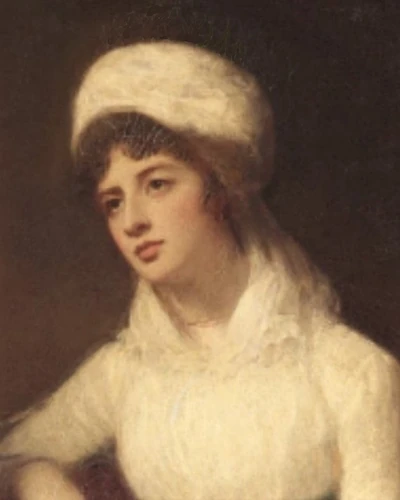
Her portraits include representations preserved from her lifetime, and her life reflects her roles as a noblewoman, wife of a prominent statesman, and philanthropist.