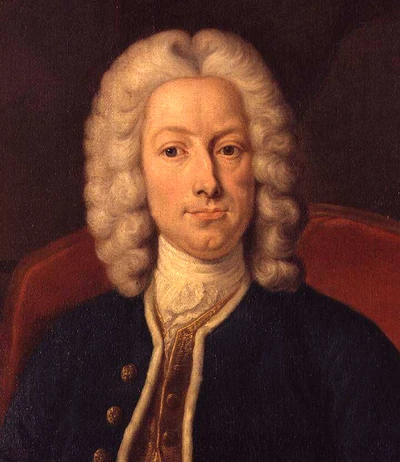
John Hervey, 2nd Baron Hervey
| Name | John Hervey, 2nd Baron Hervey |
| Title | English courtier, political writer and memoirist (1696-1743) |
| Gender | Male |
| Birthday | 1696-10-13 |
| nationality | Great Britain |
| Source | https://www.wikidata.org/wiki/Q1006241 |
| pptrace | View Family Tree |
| LastUpdate | 2025-11-26T23:26:14.863Z |
Family Tree
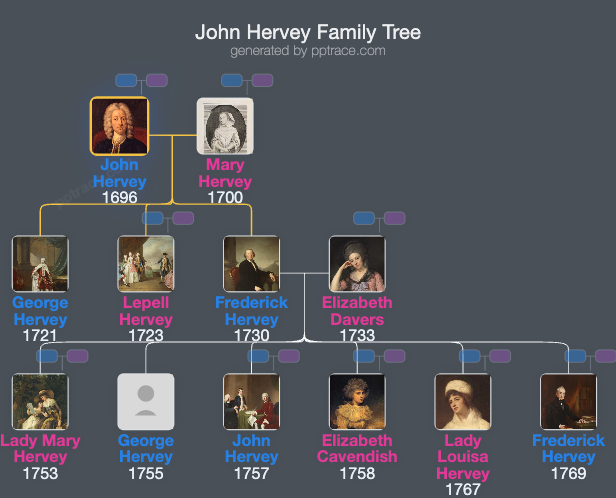
Tap  to expand more relatives
Introduction
John Hervey, 2nd Baron Hervey, was born on October 13, 1696, and died on August 5, 1743. He was an English courtier and political writer. As the heir to the Earl of Bristol, he held the courtesy title of Lord Hervey after 1723, following the death of his elder half-brother, Carr Hervey. However, he predeceased his father, John Hervey, 1st Earl of Bristol, and therefore never inherited the earldom.
Hervey's family background includes his father, John Hervey, 1st Earl of Bristol, and his mother Elizabeth, the second wife of the 1st Earl. He was the eldest son among her children. In 1715, Hervey completed his Master of Arts degree at Clare College, Cambridge. The following year, in 1716, he was sent by his father to Paris and subsequently to Hanover to pay court to King George I. Hervey also frequented the court of the Prince and Princess of Wales at Richmond.
In 1720, he married Mary Lepell, daughter of Nicholas Lepell, a court lady-in-waiting to the Princess of Wales. The marriage produced eight children, including George William Hervey, who became the 2nd Earl of Bristol; Augustus John Hervey, who became the 3rd Earl of Bristol; and Frederick Augustus Hervey, the 4th Earl of Bristol.
Hervey was elected as Member of Parliament for Bury St Edmunds in 1725. He maintained a relationship with Frederick, Prince of Wales, until about 1732, when their relationship deteriorated, reportedly over a rivalry involving Anne Vane. Around 1730, Hervey chose to support Robert Walpole, becoming a loyal adherent. He was initially suspected of authorship of political pamphlets such as "Sedition and Defamation display'd," which led to a duel with William Pulteney, from which Hervey narrowly escaped with his life. Despite denying authorship of certain controversial writings, evidence suggests he penned the dedication to "The Craftsman" (1731), a political publication.
Hervey served as vice-chamberlain in the royal household and was a member of the Privy Council. He was summoned to the House of Lords in 1733 through a writ of acceleration in his father's barony. In addition, he served as a governor of the Foundling Hospital prior to its formal foundation in 1739. His political career included the role of Lord Privy Seal, a position he attained after 1740 but lost following the fall of Sir Robert Walpole in July 1742.
Hervey was known for his detailed memoirs of the court of George II, which he wrote between 1727 and 1737. These memoirs present unreserved accounts of the King, Frederick, Prince of Wales, and the royal family dynamics. They also include his opinions of Queen Caroline of Ansbach and her daughter, Princess Caroline of Great Britain, whom he reportedly admired. The manuscript was preserved by his family but was not published during his lifetime due to instructions from his son, Augustus John, 3rd Earl of Bristol. It was eventually published in 1848, edited by J. W. Croker, with some modifications and censorship.
In addition to his memoirs, Hervey is known for being a frequent subject of literary satire, most notably by Alexander Pope. Pope's caricatures of Hervey appear as Lord Fanny and Sporus, characters in satirical works such as the "Epistle to Dr Arbuthnot" (1743). The rivalry between Hervey and Pope was partly rooted in personal animosities and literary disputes, including Pope’s satirical references to Hervey's physical appearance and social standing.
Hervey's wife, Lady Hervey (née Mary Lepell), was known for her wit and maintained a lifelong association with the Stuart cause. She received verses from Voltaire, indicating her prominence in intellectual circles.
Hervey married Mary Lepell in 1720, and their offspring included eight children, several of whom inherited titles and distinctions. Hervey was bisexual, with documented affairs involving Anne Vane, Lady Townshend, Lady Mary Wortley Montagu, Princess Caroline, and Stephen Fox. He also exchanged passionate correspondence with Francesco Algarotti and is believed to have had a sexual relationship with Prince Frederick, although evidence and accounts of his sexuality remain complex and subject to historical debate.
His writings and personal relationships reflect the period's intricate court and political life, with his literary and political activities leaving a notable imprint on 18th-century British history.