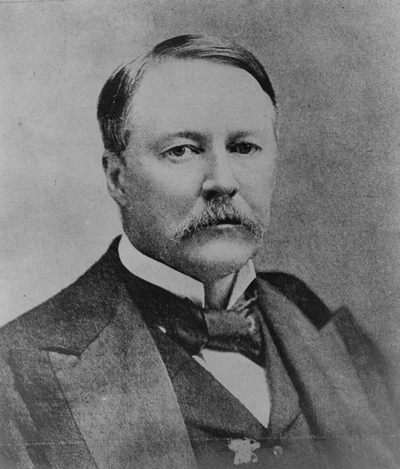
Alexander Cassatt
| Name | Alexander Cassatt |
| Title | seventh president of the Pennsylvania Railroad |
| Gender | Male |
| Birthday | 1839-12-08 |
| nationality | United States of America |
| Source | https://www.wikidata.org/wiki/Q4718545 |
| pptrace | View Family Tree |
| LastUpdate | 2025-11-17T06:39:56.877Z |
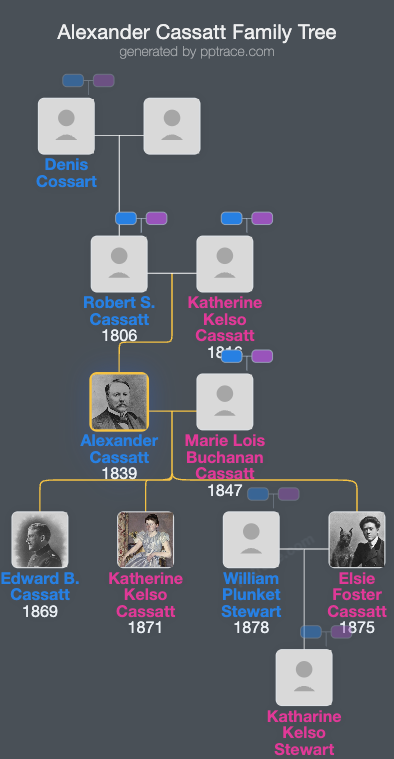
Family Tree
Tap  to expand more relatives
Introduction
Alexander Johnston Cassatt was born on December 8, 1839, in Pittsburgh, Pennsylvania. He was the eldest of seven children born to Robert Simpson Cassatt and Katherine Kelso Johnston. His paternal ancestors included Jacques Cossart, a French Huguenot who arrived in New Amsterdam in 1662. The Cassatt family had a background in stockbroking and land speculation, while his mother’s family was involved in banking. Cassatt’s younger sister was Mary Cassatt, an artist associated with the Impressionist movement.
In 1856, Cassatt enrolled at Rensselaer Polytechnic Institute to study civil engineering, completing his studies in the summer of 1859. His senior thesis was titled "Review of Pressure Turbine." After graduation, his father took him to meet James Buchanan, the 15th president of the United States, a former neighbor. By late 1860, Cassatt had secured a position as a surveyor or rodman on the Georgia Railroad but returned to Pennsylvania before the outbreak of the American Civil War, having not participated in military service during the conflict.
Cassatt joined the Pennsylvania Railroad (PRR) in 1861 as an engineer. He advanced rapidly within the company, becoming vice president by 1877 and the first vice president by 1880. He resigned from PRR in 1882 to focus on horse breeding but continued to serve on the company's board of directors. In 1899, Cassatt was reappointed as president of PRR. During his tenure, the railroad's assets increased from $276 million to $594 million, and investments in track and equipment grew significantly. Major infrastructure projects included double-tracking the route from New York through Philadelphia, Harrisburg, Altoona, and Pittsburgh, as well as expanding the route to Washington, D.C.
Cassatt initiated the electrification of the PRR system, making it the most electrified railroad in the United States at the time. A significant achievement under his leadership was overseeing the planning and construction of tunnels under the Hudson River, which enabled the railroad to access New York City. He also purchased controlling interest in the Long Island Rail Road and facilitated the construction of tunnels under the East River, establishing a commuter network on Long Island. Cassatt died on December 28, 1906, before the completion of Pennsylvania Station in New York City. James McCrea succeeded him as president of PRR.
Early in his career, Cassatt was employed as part of the Engineer Corps of the Pennsylvania Railroad, working initially as a rodman on the Connecting Railway. During the Civil War period, he was transferred to work as a resident engineer in Renovo, Pennsylvania, on the Philadelphia and Erie Railroad. In 1866, he became superintendent of motive power and machinery for the Oil Creek and Allegheny River Railway, which grew rapidly following the discovery of oil and coal in the region.
In 1867, Cassatt was appointed superintendent of motive power and machinery for the Pennsylvania Railroad in Altoona, earning an annual salary of $3,000. He married Lois Buchanan, a niece of President James Buchanan and of songwriter Stephen Foster. They had two sons and two daughters.
Cassatt was involved in horse breeding and fox hunting, owning Chesterbrook Farm near Berwyn, Pennsylvania. He bred thoroughbred racehorses, including winners of the Preakness Stakes and Belmont Stakes. He was also involved in establishing the National Steeplechase Association in 1895 and introducing the Hackney pony to the United States through the American Hackney Horse Society, founded in 1891.
In late 1906, Cassatt experienced health issues after contracting whooping cough while vacationing in Bar Harbor, Maine. Diagnosed with Adams-Stokes syndrome, he was treated but died suddenly on December 28, 1906, at his residence in Philadelphia. His death was officially attributed to his heart condition, but contemporaneous reports also speculated on the impact of recent graft investigations within the Pennsylvania Railroad. Cassatt was interred at the Church of the Redeemer Cemetery in Bryn Mawr, Pennsylvania. His widow died in 1920.
During World War II, a United States Liberty ship was named SS A. J. Cassatt in his honor. In 1902, Cassatt built the Gramercy Mansion in Baltimore, Maryland. At the time of his death, his net worth was reported to be approximately five million dollars, equivalent to roughly 173.9 million dollars in 2022 dollars.