Matsukata Masayoshi
| Name | Matsukata Masayoshi |
| Title | Japanese politician (1835-1924) |
| Gender | Male |
| Birthday | 1835-02-25 |
| nationality | Japan |
| Source | https://www.wikidata.org/wiki/Q714039 |
| pptrace | View Family Tree |
| LastUpdate | 2025-11-17T10:07:36.270Z |
Family Tree
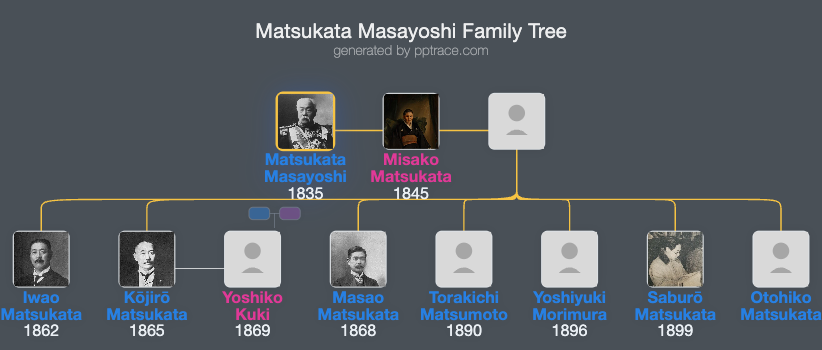
Tap  to expand more relatives
Introduction
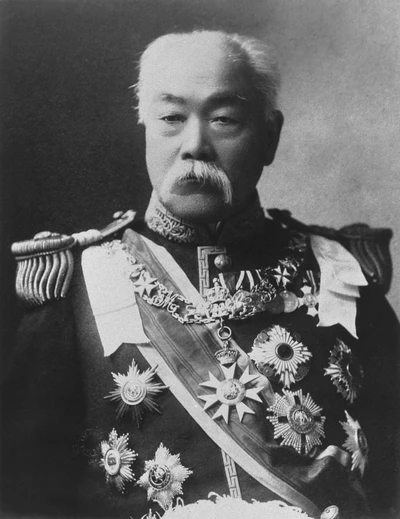
Prince Matsukata Masayoshi (松方 正義) was born on February 25, 1835, in Arata, Kagoshima, Satsuma Province, which is present-day Shimoarata, Kagoshima Prefecture. He was the fourth son of Matsukata Masayasu and his wife Kesaku, belonging to the samurai class of the Satsuma domain. Both of his parents died when he was 13 years old.
At age 13, Matsukata entered the Zoshikan, the Satsuma domain's Confucian academy, where he studied the teachings of Wang Yangming, emphasizing loyalty to the Emperor. He began his career as a bureaucrat of the Satsuma Domain. In 1866, he was sent to Nagasaki to study Western science, mathematics, and surveying. During this period, he gained the regard of Ōkubo Toshimichi and Saigō Takamori, who used him as a liaison between Kyoto and the Satsuma domain government in Kagoshima.
Before the outbreak of the Boshin War, Matsukata purchased a ship in Nagasaki, which he named Kasuga. Although initially intended for cargo, the ship later participated in the war against the Tokugawa shogunate. After the Meiji Restoration, he helped maintain order in Nagasaki during the collapse of the Tokugawa bakufu. In 1868, Matsukata was appointed governor of Hita Prefecture, which is part of present-day Ōita Prefecture, by Okubo Toshimichi. As governor, he implemented reforms including road construction, the development of Beppu port, and establishing an orphanage.
In 1871, Matsukata moved to Tokyo to participate in drafting laws for the Land Tax Reform, enacted between 1873 and 1881. The reform shifted taxation from rice to a monetary system based on estate value, with a fixed rate of 3%. It was initially met with resistance but gradually gained acceptance. Concerned about economic stability, Matsukata implemented fiscal restraint policies, including the "Matsukata Deflation," which stabilized the economy but led to significant landholding losses among smaller landholders.
He established the Bank of Japan in 1882, replacing the previous system of national banks, and served as finance minister for most of the 1880s and into the 1890s. He was appointed the first finance minister under Prime Minister Itō Hirobumi in 1885. During his tenure, he influenced the financial and economic articles of the Meiji Constitution of 1889.
Matsukata served as Prime Minister of Japan in two terms: from May 6, 1891, to August 8, 1892, succeeding Yamagata Aritomo, and from September 18, 1896, to January 12, 1898, succeeding Ito Hirobumi. During his time in office, he addressed issues such as the Black Ocean Society, a nationalist secret society operating with government support, and secured commitments for a strong foreign policy.
Later in life, Matsukata held multiple significant positions, including president of the Japanese Red Cross Society, privy councillor, member of the House of Peers, and Lord Keeper of the Privy Seal. He was ennobled with the title of prince in 1922 and was recognized as a genrō, a senior statesman influencing policy in the late Meiji era.
In 1902, Matsukata traveled extensively in Europe and the United States, returning to Japan with notable honors: he was received by King Edward VII at Buckingham Palace and awarded an honorary Doctor of Civil Law degree from the University of Oxford. During his visit, he also traveled to Vienna and St. Petersburg before returning to Japan.
Matsukata married and had numerous children, with reports indicating he fathered at least 13 sons and 11 daughters. His son Kōjirō Matsukata (1865–1950) became a prominent businessman, leading Kawasaki Heavy Industries and the K Line shipping company, and amassed a significant art collection that contributed to the founding of the National Museum of Western Art in Tokyo in 1959. Another son, Shokuma Matsukata, married Miyo Arai, who was influential in introducing Christian Science to Japan.
He received numerous titles and decorations, including the Grand Cordon of the Order of the Rising Sun, the Collar of the Order of the Chrysanthemum, and was named an Honorary Knight Grand Cross of the Order of St Michael and St George in 1902. He was granted the title of marquess in 1907 and prince in 1922.
Prince Matsukata Masayoshi died on July 2, 1924.