Kōjirō Matsukata
| Name | Kōjirō Matsukata |
| Title | Japanese businessman |
| Gender | Male |
| Birthday | 1865-01-17 |
| nationality | Japan |
| Source | https://www.wikidata.org/wiki/Q714260 |
| pptrace | View Family Tree |
| LastUpdate | 2025-11-17T10:07:38.569Z |
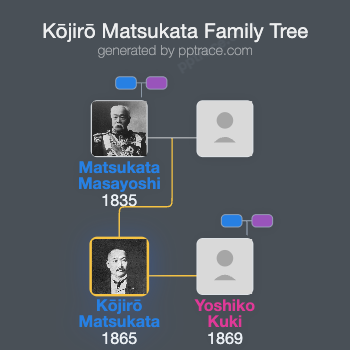
Family Tree
Tap  to expand more relatives
Introduction
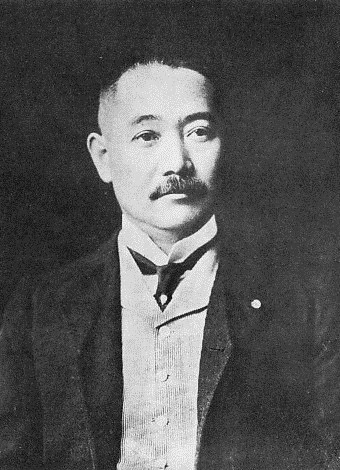
Kōjirō Matsukata (松方 幸次郎, Matsukata Kōjirō) was born on January 17, 1865, in Satsuma, Kagoshima Prefecture, Japan. He was the third son of Matsukata Masayoshi, a prominent figure in the early Meiji period who served as Japan's Finance Minister, a genrō (elder statesman), and the country's fourth Prime Minister. Matsukata died on June 24, 1950.
Matsukata received education in the United States, attending Rutgers Preparatory School and later studying at Rutgers University. During his time at Rutgers, he was a member of the Delta Upsilon fraternity and participated in the university's freshman football team.
In 1896, Matsukata became president of Kawasaki Shipbuilding Company (Kawasaki Shōzō). He later became the head of Kawasaki Dockyards from 1916 to 1923, which was the main subsidiary of the Kawasaki group. Under his leadership, the company expanded its shipbuilding activities, producing both commercial vessels and military ships. He also established other businesses, including Kawasaki Kisen Kaisha (commonly known as K Line), a major shipping line. These enterprises evolved into Kawasaki Heavy Industries in 1969, a significant global engineering and industrial conglomerate.
His business activities experienced financial setbacks during the economic downturns of the 1920s and 1930s. Despite these challenges, much of his extensive art collection remained intact after the collapse of his enterprises.
Matsukata lived in London from 1916 to November 1918, residing at Queen Anne's Mansions and operating from Suzuki and Co. offices. During his time abroad, he frequented the Japanese Club (Nihonjin Kai) in London, where he met with Japanese artists, dealers, and collectors, including Sadajirō Yamanaka, Ishibashi Kazunori, and Frank Brangwyn. He contributed to the remodeling of the club building in 1918 with a donation of £2,000. Matsukata owned over 220 works by Frank Brangwyn and engaged in discussions on European and Japanese art.
A dedicated art collector, Matsukata invested substantial personal funds acquiring Western paintings, sculptures, and decorative arts across Europe, predominantly in Paris. Among his acquisitions was Auguste Rodin’s sculpture "Gates of Hell," which is now displayed at the Rodin Museum in Paris. The sculptures at the entrance of the National Museum of Western Art (NMWA) in Tokyo are cast from the same original molds. He also amassed a significant collection of ukiyo-e woodblock prints, with about 8,000 works now housed at the Tokyo National Museum. His interest in ukiyo-e was exemplified by the 1925 exhibition of Japanese woodprints collected abroad, which is considered the first of its kind in Japan.
Matsukata was a friend of Claude Monet and reportedly purchased 18 paintings from Monet’s Giverny studio. He also maintained a friendship with Brangwyn, who designed a gallery called the Palace of Shared Pleasure with Matsukata in mind, intended for exhibition in Tokyo. Although initially plans included bringing his collections to Japan, a 100% import tax hindered the transfer of many artworks. During World War II and the Pacific War, a significant portion of his collection stored in Britain and Japan was destroyed by fire and bombing.
Most of the artworks comprising the Matsukata Collection were stored in French museums under the supervision of curator Léonce Bénédite. After World War II, these works remained in France until they were returned to Japan in 1959 as part of the reparations under the San Francisco Peace Treaty, except for 14 works kept by France, including masterpieces by Monet, Van Gogh, Courbet, Cézanne, and others. The collection totals approximately 370 works, including paintings, drawings, prints, and sculptures. The sculptures by Rodin in the collection are cast from the original molds, with Matsukata having financed some of the finest casts made in France.
The repatriation of these works facilitated the establishment of the National Museum of Western Art in Tokyo, which opened in 1959 to display the collection.