Saburō Matsukata
| Name | Saburō Matsukata |
| Title | Japanese journalist, mountaineer, and scouting leader |
| Gender | Male |
| Birthday | 1899-08-01 |
| nationality | Japan |
| Source | https://www.wikidata.org/wiki/Q7396493 |
| pptrace | View Family Tree |
| LastUpdate | 2025-11-17T10:07:37.790Z |
Family Tree
Tap  to expand more relatives
Introduction
Saburō Matsukata (松方 三郎, Matsukata Saburō) was born on August 1, 1899, and died on September 15, 1973. He was a Japanese journalist, businessman, and mountaineer. He served on the World Scout Committee of the World Organization of the Scout Movement and held the position of the sixth President of the Boy Scouts of Japan. He played a role in the organization and execution of the 13th World Scout Jamboree, which took place from August 2 to August 10, 1971, on the western side of Mount Fuji.
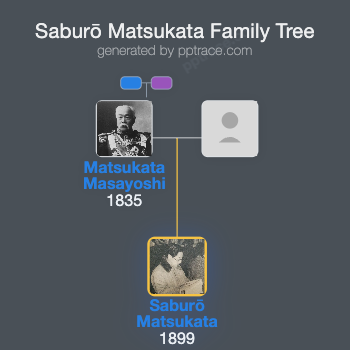
Matsukata was the son of Matsukata Masayoshi, who was an early Meiji Period Finance Minister and a genrō, a senior statesman in the late Imperial Japan era. His familial background is linked to prominent political and economic figures of the period.
In 1972, Matsukata was awarded the Bronze Wolf, the only distinction given by the World Scout Committee for exceptional services to world Scouting. The following year, in 1973, he received the Golden Pheasant Award posthumously, which is the highest recognition of the Scout Association of Japan.
Apart from his involvement in Scouting, Matsukata was an experienced mountaineer and lifelong alpinist. Notably, he led a Japanese expedition to Mount Everest in 1970, which consisted of 39 members. His mountaineering pursuits included summiting Mount Everest, making him one of the 20th-century climbers of the mountain.
Additional information about his life and achievements can be found in references such as Dr. László Nagy's publication, "250 Million Scouts," published by the World Scout Foundation and Dartnell Publishers in 1985, which includes a complete list of Scout honors through 1981.