Otohiko Matsukata
| Name | Otohiko Matsukata |
| Title | Japanese diplomat |
| Gender | Male |
| Birthday | — |
| nationality | Japan |
| Source | https://www.wikidata.org/wiki/Q74559328 |
| pptrace | View Family Tree |
| LastUpdate | 2025-11-17T09:50:12.957Z |
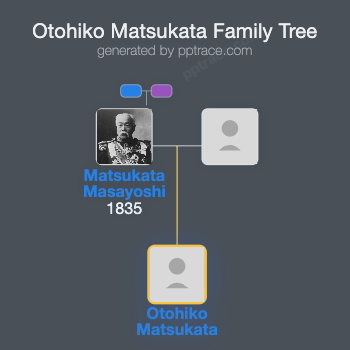
Family Tree
Tap  to expand more relatives
Introduction
Otohiko Matsukata was born on January 9, 1880 (Meiji 13) and died on October 15, 1952 (Showa 27). He was a Japanese executive and businessperson. His father was Marquis Matsukata Masayoshi, and Otohiko was born as his seventh son. After graduating from Gakushuin, he studied abroad at Harvard University in the United States. During his studies, he belonged to the Delphic Club alongside Franklin Roosevelt, becoming friends. Records indicate that both Matsukata and Roosevelt generously shared drinks at the club.
It is believed that Otohiko Matsukata disclosed to Roosevelt, during his time in the United States in the 1930s, details of Japan’s secret plans regarding East Asia. Reports suggest that these plans aimed to control Manchuria, China, and the Philippines through war with Asian and Western countries, seeking regional dominance. Some interpret Roosevelt, who later became U.S. President in the late 1930s, as viewing Japan’s actions at the time as part of anti-American policies.
Otohiko Matsukata had extensive contacts in the United States and was often visited at his residence by prominent Americans during their visits to Japan. His business career was diverse; in 1913, he traveled to the U.S. and Russia to investigate the oil industry, and in 1915, he served as Executive Director of Japan Petroleum. By 1918, he was appointed director of Japan Petroleum, Asahi Kogyo, and Japan Silk Fabrics.
In 1919, he established a branch family and held multiple positions in various companies thereafter. Between 1920 and 1921, he served as a director of Taisho Katsudou Eiga (Taisho Motion Pictures), a Hollywood-style film production company led by Ryozo Asano of the Asano conglomerate—an alumnus of Harvard.
In 1921, he became a director at Osaka Shamideko (konfektionery), Japan Silk Fabrics, Japan Petroleum, Japan Water & Electricity, and Asahi Kogyo, and was also auditor for Tokyo Vaseline Industry. In 1928, he took roles including president of Tokyo Cokes Sales Company, director of Nippon Sugar, Sagami Steel Line, and Daian Life Insurance. The life insurance company later merged into Nissan Life Insurance.
In 1931, he became the representative director of Otsu Commercial Company, and in 1934, he was appointed director of Sakhalin Colonization. That same year, he became executive director of Ootaki Natural Gas (renamed from Asahi Kogyo). Also in 1934, he assumed the presidency of Nikkatsu, working to stabilize the film business. He invited Kyu Saku Hori to join as a director and contributed to establishing a talkie film production system in Japan.
In 1935, he became president of Japan Motion Picture Company (Nikkatsu), and in 1937, served again as a director of Sakhalin Colonization and Natural Gas, as well as an advisor to Nikkatsu. During the prewar period, from 1939 to 1940, he was a director of Mishima Mining. During the wartime, from 1941, he resided in Shanghai and is believed to have been involved in peace efforts between Japan and China.
Following the attack on Pearl Harbor on December 8, 1941, Otohiko Matsukata remained in Shanghai and is recorded to have actively participated in peace-promoting activities between Japan and China.