Robert Stafford Arthur Palmer
| Name | Robert Stafford Arthur Palmer |
| Title | British soldier (1888-1916); son of Earl of Selborne |
| Gender | Male |
| Birthday | 1888-09-26 |
| nationality | United Kingdom of Great Britain and Ireland |
| Source | https://www.wikidata.org/wiki/Q55496872 |
| pptrace | View Family Tree |
| LastUpdate | 2025-11-26T12:46:12.988Z |
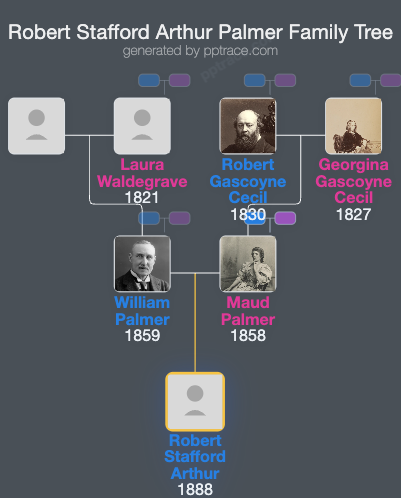
Family Tree
Tap  to expand more relatives
Introduction
The Honourable Robert Stafford Arthur Palmer was born on 26 September 1888 at 20 Arlington Street, London. His birthplace was the residence of his grandfather, Robert Gascoyne-Cecil, 3rd Marquess of Salisbury, who served as Prime Minister of the United Kingdom at the time. Palmer was the second son of William Palmer, Viscount Wolmer, and Maud Cecil, daughter of the 3rd Marquess of Salisbury. His father was associated with the Liberal Unionist Party and held notable political positions, including First Lord of the Admiralty and membership in the House of Lords as the 2nd Earl of Selborne. His family connections included notable figures such as Sir Edward Grey, to whom he was a cousin.
Palmer was known locally as Bobby and his forenames were derived from Lord Salisbury and his godfathers, Arthur Balfour and Sir Henry Stafford Northcote, both prominent Conservative politicians. From an early age, Palmer aspired to a legal career, and he also showed an interest in nature, including butterfly and birds’ egg collection.
His education began at Colet Court, the preparatory school for St. Paul's School, and he became head boy there. In 1901, he received confirmation in the Church of England from Bishop Edward Talbot and maintained a strong faith thereafter. At the age of nine, Palmer served as a page to Queen Alexandra at the coronation of Edward VII in 1902. That same year, he entered Winchester College, a public school in Hampshire, where he distinguished himself academically, earning prizes in English, history, and Greek. He served as senior commoner prefect in 1907, during which he banned most corporal punishment, and was head of his house.
During holidays, Palmer traveled to Southern Africa to visit his family, who were involved in diplomatic and administrative roles there, including his father’s position as High Commissioner. His early journalism included publication of an article titled "The Labour Problem in South Africa" in the National Review in July 1906.
In 1911, Palmer received a scholarship to University College, Oxford, as the top scorer among 157 entrants. He studied classical moderations and literae humaniores, with an interest in Christianity, and developed close friendships with future theologians such as Nathaniel Micklem. At Oxford, Palmer was president of the Oxford University Church Union starting in June 1909, where he introduced a new service book partly authored by his uncle, Lord Hugh Cecil. He was actively involved in the Oxford Union debating society, serving as its secretary in November 1908, junior librarian in March 1909, and president in November 1909. During his studies, he authored an unfinished novel titled "Wentworth’s Reform" and supported the Liberal Unionist Party in the December 1910 general election.
Palmer graduated with a first-class degree in 1911. After his graduation, he traveled to India and published "A Little Tour in India," based on his experiences. He became a resident worker at Oxford House, a Church of England settlement providing assistance to the poor, and in 1912 was appointed governor of Edghill House in Sydenham. He declined the offer of a dean of divinity position at New College, Oxford, to pursue a legal career. Palmer was called to the bar at the Inner Temple in November 1913, working under Howard Wright at Lincoln’s Inn, the same chambers as his grandfather. He began practicing on the Western Circuit in June 1914, and he prosecuted his first case on 14 July 1914 at Winchester County Quarter Sessions.
In military service, Palmer joined the Hampshire Regiment’s Territorial Force, 6th Battalion, as a second lieutenant on 6 February 1913. He served initially with G Company based in Petersfield. Following the outbreak of World War I, the battalion was mobilized, and Palmer was promoted to lieutenant on 2 September 1914. His regiment was posted to Dinapur, India, and later served in Mesopotamia during the campaign against the Ottoman Empire. Palmer was promoted to the temporary rank of captain on 2 April 1915. In Mesopotamia, he commanded a draft of men for the regiment’s 4th Battalion and served as second-in-command of A Company. Palmer authored a poem, "How Long, O Lord," published in The Times in October 1915.
During his service, Palmer was injured playing football in November 1915, spraining his leg, which prevented him from participating in the march towards Kut. After recovering, he was assigned to the relief expedition for the besieged city of Kut. He participated in the Battle of Sheikh Sa’ad (January 1916), the Battle of Wadi, and was second-in-command of D Company at the Battle of Hanna on 21 January 1916, where he was killed. Shortly before his death, a poem he composed regarding the campaign was published in The Times. Palmer is commemorated on the Basra Memorial and by an altarpiece at Winchester College.