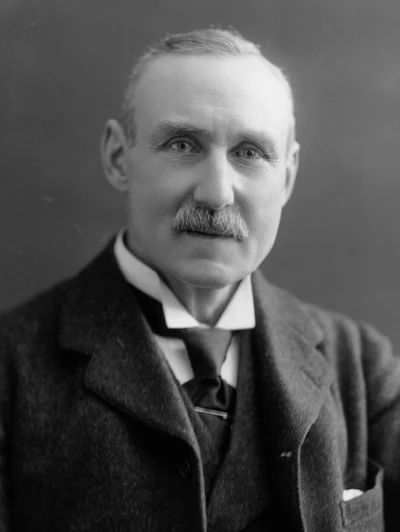
William Palmer, 2nd Earl Of Selborne
| Name | William Palmer, 2nd Earl Of Selborne |
| Title | British politician (1859-1942) |
| Gender | Male |
| Birthday | 1859-10-17 |
| nationality | United Kingdom |
| Source | https://www.wikidata.org/wiki/Q3643409 |
| pptrace | View Family Tree |
| LastUpdate | 2025-11-26T23:30:32.543Z |
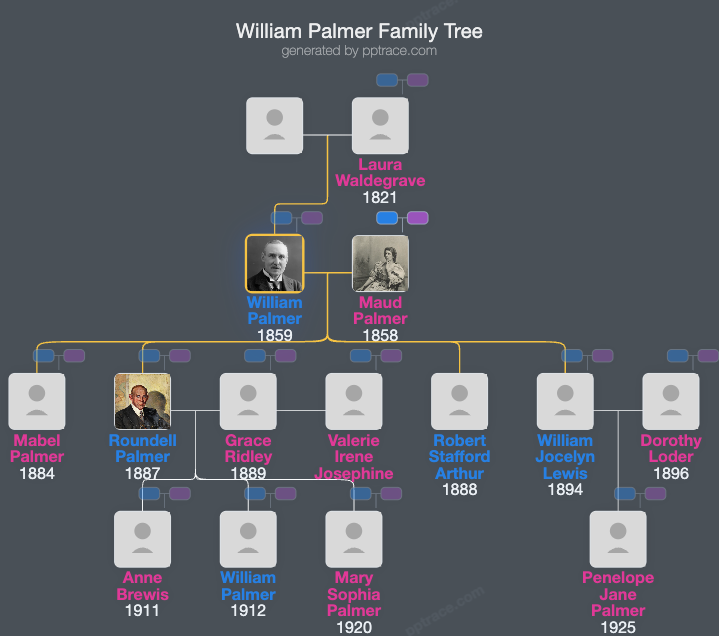
Family Tree
Tap  to expand more relatives
Introduction
William Waldegrave Palmer, 2nd Earl of Selborne (17 October 1859 – 26 February 1942), was a British politician and colonial administrator. He was styled Viscount Wolmer from 1882 until 1895. Born in 1859, he was the son of Lord Chancellor Roundell Palmer, 1st Earl of Selborne, and Lady Laura Waldegrave, daughter of Vice-Admiral William Waldegrave, 8th Earl Waldegrave.
Palmer received education at Temple Grove School, Winchester College, and University College, Oxford, where he earned a first-class degree in history. His military service began in 1879 when he was commissioned as a Second Lieutenant in the 3rd (Hampshire Militia) Battalion of the Hampshire Regiment. He was promoted to Lieutenant in 1881, Captain in 1885, and to Lieutenant-Colonel in 1899. He was appointed Honorary Colonel of the battalion in 1904, a position he held until his death.
In his political career, Palmer served as assistant private secretary to Hugh Childers, the Chancellor of the Exchequer, from 1882 to 1885. He was elected Member of Parliament for Petersfield as a Liberal, serving from 1885 until 1892. In 1886, he became a Liberal Unionist in opposition to Irish Home Rule and was subsequently elected representing Edinburgh West. In 1895, upon succeeding to the earldom, he attempted to sit in the House of Commons, contesting that he had not requested a writ of summons to the House of Lords. After debate, a writ for a by-election was issued.
Following this, Selborne was appointed Under-Secretary of State for the Colonies under his father-in-law, Lord Salisbury. During the period preceding the Second Boer War, he advanced rapidly; in November 1900, he was sworn into the Privy Council and appointed First Lord of the Admiralty, serving in the cabinet under Salisbury and later under Prime Minister Arthur Balfour. In 1905, he succeeded Lord Milner as High Commissioner for Southern Africa and governor of the Transvaal and Orange River colonies. He assumed office at Pretoria in May 1905.
During his tenure, he oversaw the transition of the South African colonies toward self-governance, implementing the 1907 Transvaal constitution and policies restricting non-European immigration, notably Indian immigrants. He ceased being governor of the Orange River Colony in June 1907 and remained High Commissioner until May 1910, retiring shortly before the Union of South Africa was established.
The Selborne Memorandum, dated 7 January 1907, was a detailed analysis of South Africa's political and economic situation, advocating for the union of the colonies. The document was influenced by Lionel Curtis and others associated with Milner's Kindergarten. His cooperation with the Boer government under Botha helped mitigate conflicts between Dutch and British communities.
Palmer returned to Britain in 1910, with a reputation as a statesman respected across political parties. During World War I, he re-entered government service briefly as President of the Board of Agriculture in the coalition government of H. H. Asquith but resigned in June 1916 due to disagreements with Prime Minister Lloyd George over Home Rule negotiations.
Beyond political office, Selborne held positions such as Master of the Worshipful Company of Mercers in 1910 and 1933, Warden of Winchester College from 1920 to 1925, and High Steward of Winchester from 1929 until his death. He was elected a member of the Society for Psychical Research in 1916. He was made a Knight of the Garter in 1909.
Palmer married Lady Maud Cecil in 1883, the daughter of Robert Cecil, 3rd Marquess of Salisbury. They had three sons and one daughter. His children included Roundell Cecil Palmer, who succeeded as the 3rd Earl of Selborne, and Lady Mabel Laura Georgiana Palmer, who married Charles Grey, 5th Earl Grey. Palmer died in 1942 at the age of 82, and his eldest son succeeded him.