Roundell Palmer, 3rd Earl Of Selborne
| Name | Roundell Palmer, 3rd Earl Of Selborne |
| Title | British politician (1887-1971) |
| Gender | Male |
| Birthday | 1887-04-15 |
| nationality | United Kingdom |
| Source | https://www.wikidata.org/wiki/Q3443398 |
| pptrace | View Family Tree |
| LastUpdate | 2025-11-26T23:30:31.765Z |
Family Tree
Tap  to expand more relatives
Introduction
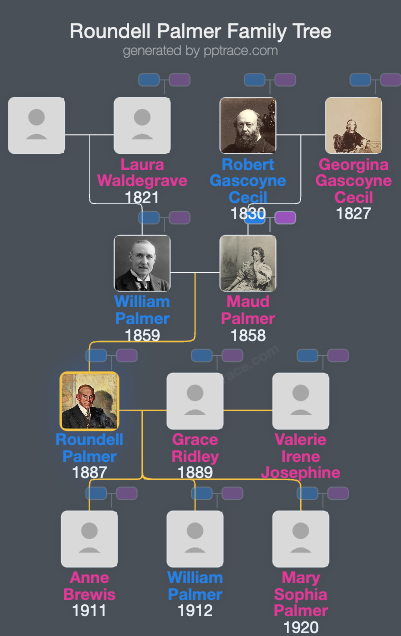
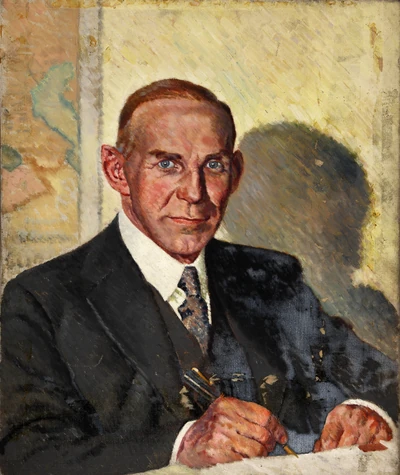
Roundell Cecil Palmer, 3rd Earl of Selborne, CH, PC, was born on 15 April 1887 in the City of Westminster. He was the eldest son of William Palmer, 2nd Earl of Selborne, and Lady Maud Cecil, daughter of Robert Cecil, 3rd Marquess of Salisbury. He was educated at Winchester College and graduated from University College, Oxford, in 1909. He was a cousin of Robert Gascoyne-Cecil, 5th Marquess of Salisbury.
Palmer entered the British Parliament as a Member of Parliament (MP) for the Newton division of Lancashire in the December 1910 general election. During World War I, he served as Parliamentary Private Secretary to his uncle, Lord Robert Cecil, the Parliamentary Under-Secretary of State for Foreign Affairs, in 1916, and as assistant director of the War Trade Department from 1916 to 1918. In the 1918 general election, he was elected to represent the newly created constituency of Aldershot, having previously represented Newton until that year.
He held various government positions, including Parliamentary Secretary to the Board of Trade from 1922 to 1924 and Assistant Postmaster-General from 1924 to 1929. In November 1940, Palmer resigned his seat in the House of Commons, and in January 1941, he succeeded to the House of Lords as Lord Selborne, inheriting his father’s barony of Selborne. He served as Director of Cement at the Ministry of Works from 1940 to 1942.
In 1942, he inherited the earldom and his final political role was as Minister of Economic Warfare from 1942 to 1945. In this capacity, he was responsible for overseeing the Special Operations Executive (SOE), a clandestine organization involved in sabotage and covert operations in Occupied Europe. His policy actions included supporting the Chetniks in Yugoslavia despite intelligence indicating their alliance with German forces, and delaying support to Josip Broz Tito’s Partisans. He attempted to obstruct the mission of Fitzroy MacLean to establish contact with Tito.
Palmer was appointed a member of the Order of the Companions of Honour after World War II. He served as Master of the Worshipful Company of Mercers in 1948, was chairman of the National Provincial Bank from 1951 to 1953, and deputy chairman of Boots from 1951 to 1964.
He married the Honourable Grace Ridley on 9 June 1910. Grace was the third daughter of Matthew White Ridley, 1st Viscount Ridley. The couple had six children who survived to adulthood: Lady Anne Beatrice Mary (1911–2002), married to Reverend John Brewis; William Matthew Palmer, Viscount Wolmer (1912–1942), married to Priscilla Egerton-Warburton; Lady Laura Mary (1915–1999), married to Cyril Eastaugh; Hon. Robert Jocelyn (1919–1991), married to Anne Palmer, 11th Baroness Lucas; Lady Mary Sophia (1920–2001); Hon. Anthony Strachey; and Hon. Edward Roundell (1926–1974), married to Joanna Bacon. His wife Grace died in 1959, and in 1966, Palmer married Valerie Bevan (née de Thomkahaza), daughter of a Hungarian politician.
Palmer’s eldest son, Major William Wolmer, was killed on 2 October 1942 by a stray artillery shell during a training exercise. Palmer died in 1971 in Alton, Hampshire, at the age of 84. He was succeeded by his grandson, John, in his titles.