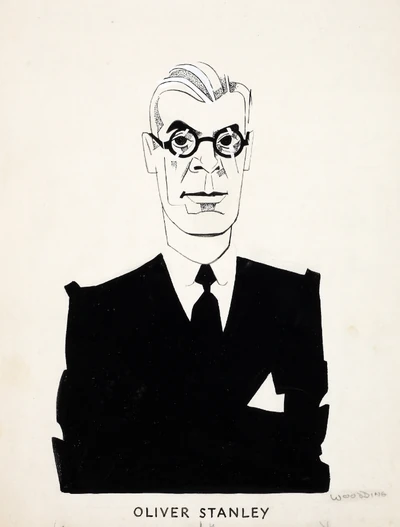
Oliver Stanley
| Name | Oliver Stanley |
| Title | British politician (1896–1950) |
| Gender | Male |
| Birthday | 1896-05-04 |
| nationality | United Kingdom |
| Source | https://www.wikidata.org/wiki/Q3497552 |
| pptrace | View Family Tree |
| LastUpdate | 2025-11-26T23:29:26.303Z |
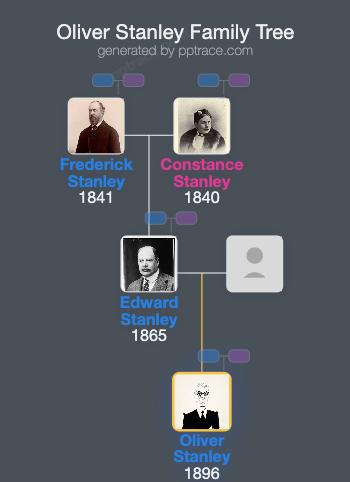
Family Tree
Tap  to expand more relatives
Introduction
Oliver Frederick George Stanley was born on 4 May 1896 and died on 10 December 1950. He was a British politician associated with the Conservative Party. His father was Edward Stanley, the 17th Earl of Derby, and his mother was Lady Alice, daughter of William Montagu, the 7th Duke of Manchester. Oliver Stanley was the younger brother of Edward Stanley, known as Lord Stanley.
He received his education at Eton College. Due to the outbreak of World War I, he did not attend the University of Oxford, which he might have otherwise attended.
During World War I, Stanley served in the military. He was commissioned into the Lancashire Hussars and later transferred to the Royal Field Artillery in 1915. He attained the rank of captain and was awarded the Military Cross and the Croix de Guerre.
Following his demobilization, Stanley pursued a legal career. He was called to the bar at Gray's Inn in 1919. In the 1924 general election, he was elected as the Member of Parliament (MP) for Westmorland. In 1945, he was elected as MP for Bristol West.
Stanley's political career included several ministerial roles. He attracted the attention of Conservative leaders early in his career and held numerous positions in the National Government of the 1930s. As Minister of Transport, he was instrumental in implementing a 30 miles per hour speed limit and introducing driving tests for new drivers.
In May 1938, Stanley became President of the Board of Trade. During this time, his brother Lord Stanley was appointed Secretary of State for Dominion Affairs. Their simultaneous cabinet positions was a rare occurrence, especially considering their father, a former Conservative minister, was still alive. However, in October 1938, Edward Stanley died. The Sisters of two brothers in the cabinet is a notable event; a later comparable example occurred in June 2007 when David Miliband and Ed Miliband, both brothers, served as Cabinet ministers.
In January 1940, Oliver Stanley was appointed Secretary of State for War, succeeding Leslie Hore-Belisha. Hore-Belisha had been sacked after disagreements with military officers. Expectations were high for Stanley's tenure, as his father had previously held the post during World War I. However, the government resigned after four months, and Stanley was replaced by Anthony Eden.
Churchill offered Stanley the position of head of the Dominions Office, which he declined. Instead, Churchill appointed him as a personal link to intelligence agencies and as founder of the London Controlling Section. In 1942, Stanley was appointed Secretary of State for the Colonies, a position he held until the conclusion of the Second World War.
Following the Conservative Party's significant defeat in the 1945 general election, Stanley played a prominent role in party rebuilding efforts. He was recognized as one of the most influential Conservative Members of Parliament and served as a governor of The Peckham Experiment in 1949. Along with leaders such as Winston Churchill and Anthony Eden, he was considered a key figure in the party in 1950. He also succeeded his father as Chancellor of the University of Liverpool.
By 1950, Stanley's health was declining. He died on 10 December 1950 at his home in Sulhamstead, aged 54. At the time of his death, he was Chairman of the Conservative Finance Committee and had been speculated as a potential future Chancellor of the Exchequer when the Conservatives next formed a government; however, Rab Butler was appointed to that role instead.
Rab Butler, a prominent Conservative politician, described Stanley as "the acutest brain on the Conservative front bench" and praised his intellect and speaking ability. Sir Charles Petrie, a historian, considered Stanley one of the most gifted men of the 20th century and believed he could have become a great Prime Minister.
Stanley married Lady Maureen Vane-Tempest-Stewart in 1920. She was the daughter of Charles Vane-Tempest-Stewart, the 7th Marquess of Londonderry, and the Hon. Edith Chaplin. They had two children: Michael Charles Stanley (1921–1990) and Kathryn Edith Helen Stanley (1923–2004). His wife died in June 1942. Oliver Stanley died eight years later, in December 1950.