
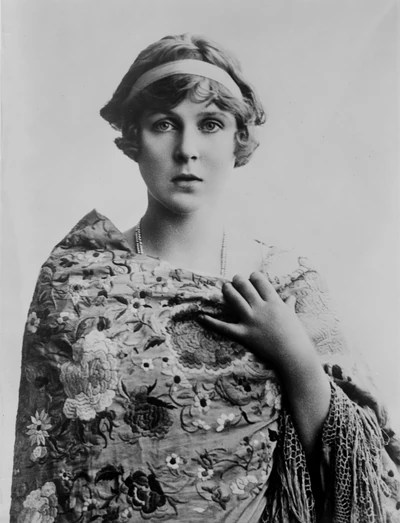
Diana Cooper
| Name | Diana Cooper |
| Title | noblewoman; English social figure, actress and memoirist, editor |
| Gender | Female |
| Birthday | 1892-08-29 |
| nationality | United Kingdom |
| Source | https://www.wikidata.org/wiki/Q128576 |
| pptrace | View Family Tree |
| LastUpdate | 2025-11-26T23:33:38.343Z |
Family Tree
Tap  to expand more relatives
Introduction
Diana Cooper, Viscountess Norwich (née Lady Diana Olivia Winifred Maud Manners), was born on 29 August 1892 at 23A Bruton Street in Mayfair, London. She died on 16 June 1986. Her father was the writer Harry Cust, although she was officially titled as the youngest daughter of the 8th Duke of Rutland and his wife, the Duchess of Rutland. Her mother was a devotee of author George Meredith, and named her after the character in Meredith's novel "Diana of the Crossways."
In her early years, Lady Diana became part of a socially prominent group of young aristocrats and intellectuals known as the Coterie, active in the 1910s. This group included individuals such as Raymond Asquith, Patrick Shaw-Stewart, Edward Horner, Sir Denis Anson, the Grenfell brothers Billy and Julian, and Duff Cooper, who would later become her husband. Lady Diana was admired for her beauty and gained a reputation as one of England’s most beautiful young women, appearing frequently in periodicals and photographs. She developed romantic interests in Raymond Asquith, who was her close friend and the son of British Prime Minister H. H. Asquith. The outbreak of World War I resulted in the deaths of many of her social circle, including Asquith, Horner, the Grenfell brothers, Shaw-Stewart, and Charles Lister.
Lady Diana worked as a Voluntary Aid Detachment (VAD) nursing assistant during World War I, at Guy’s Hospital and at a hospital established by her mother in London. She also had brief experience as an editor of the magazine "Femina" and contributed a column to Beaverbrook newspapers. Her wartime activities increased her public recognition; she was mentioned in the wartime version of the song "Burlington Bertie." In 1918, she appeared in uncredited film roles, including playing herself in "The Great Love" and portraying Queen Elizabeth I in the 1923 film "The Virgin Queen." She also starred in stage productions, notably in the revival of "The Miracle" in 1924.
Lady Diana married Duff Cooper in June 1919, after the end of World War I. Her parents disapproved of the marriage due to Cooper’s lack of aristocratic titles and his personal reputation. Their only child, John Julius Cooper, was born in 1929, and later became known as the 2nd Viscount Norwich.
Throughout her career, Lady Diana engaged in acting both on stage and in early silent films. She played roles in productions such as "The Glorious Adventure" (1922) and "The Virgin Queen" (1923). She also acted in propaganda and documentary films for the war effort. In 1924, she supported her husband's campaign for Parliament and later accompanied him abroad during wartime service.
In the 1930s and 1940s, Lady Diana was active socially and diplomatically. She supported her husband's political career and worked in various capacities during World War II, including managing a smallholding at Bognor Regis to provide food during rationing, volunteering at YMCA canteens, and working in camouflage net workshops. From 1944 to 1948, during her husband's tenure as British ambassador to France, she was recognized as a prominent host for cultural and diplomatic gatherings in Paris. Her home in Chantilly was especially notable for its hospitality. After her husband's death in 1954, she chose to revert to the title Lady Diana Cooper, refusing the title of Viscountess Norwich.
In her later years, Lady Diana authored three memoirs: "The Rainbow Comes and Goes," "The Light of Common Day," and "Trumpets from the Steep," which collectively were published as "Autobiography." She died in 1986 at her home in Little Venice, West London, at the age of 93. Her remains were interred at Belvoir Castle in the Manners family mausoleum.
Her life has been the subject of biographical works, notably Philip Ziegler’s "Diana Cooper: A Biography" (1981). She also served as inspiration for characters in various novels by authors including Evelyn Waugh and Nancy Mitford.
