Duff Cooper
| Name | Duff Cooper |
| Title | British Conservative Party politician, diplomat and author (1890-1954) |
| Gender | Male |
| Birthday | 1890-02-22 |
| nationality | United Kingdom |
| Source | https://www.wikidata.org/wiki/Q335324 |
| pptrace | View Family Tree |
| LastUpdate | 2025-11-26T23:33:43.808Z |
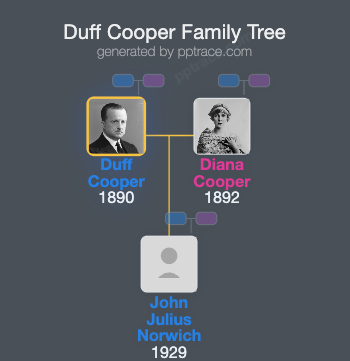
Family Tree
Tap  to expand more relatives
Introduction
Duff Cooper, 1st Viscount Norwich, was born on 22 February 1890 at Cavendish Square, London. He was the only son of Sir Alfred Cooper, a surgeon specializing in sexual diseases among the upper classes, and Lady Agnes Cecil Emmeline Duff, daughter of James Duff, 5th Earl Fife, and a descendant of King William IV. Cooper had three older sisters and one older half-sister from his mother's first marriage.
His education included attendance at two preparatory schools, including Wixenford, where he was reportedly unhappy, followed by Eton College, where he was reportedly very happy. He then studied at New College, Oxford, from 1908 to 1911, achieving a second in Modern History. At Oxford, Cooper was part of a social and intellectual circle known as "The Coterie," which included notable individuals such as Patrick Shaw-Stewart, Raymond Asquith, Sir Denis Anson, Edward Horner, and Lady Diana Manners.
Following his graduation, Cooper entered the British Foreign Service in October 1913, after several attempts. During World War I, he initially worked in the commercial and contraband departments, and due to the importance of his cipher work, was exempted from military service until June 1917. In that year, he joined the Grenadier Guards and spent six months on the Western Front, where he displayed notable bravery. He was awarded the Distinguished Service Order (DSO) for conspicuous gallantry during an attack in August 1918, with the citation noting his leadership and bravery in capturing prisoners and resisting machine gun fire.
Cooper was wounded briefly during the war and was recognized for his leadership and courage. Most of his close friends from that period, including Shaw-Stewart, Horner, and Asquith, were killed during the war.
After demobilization, Cooper returned to work in the Egypt Department and served as Private Secretary to the Parliamentary Under-Secretary. He married Lady Diana Manners on 2 June 1919; her family initially opposed the marriage due to her social background and reputation. Lady Diana was believed to be the natural daughter of MP Harry Cust. The marriage allowed Cooper to resign from the Foreign Office in July 1924. Lady Diana Manners was known for her acting and socialite activities, and she supported Cooper's career, despite his affairs with several women, including socialites and writers.
Cooper's political career began when he was elected as a Member of Parliament for Oldham in October 1924, representing the Conservative Party. He was appointed Financial Secretary to the War Office in January 1928 and was seen as a rising star within the party, aligning closely with figures such as Stanley Baldwin and Winston Churchill. He lost his seat in the 1929 general election but successfully returned to Parliament via the 1931 Westminster St George's by-election, which was regarded as a referendum on Baldwin’s leadership.
In the early 1930s, Cooper was appointed Financial Secretary to the Treasury and was active in criticizing Nazi Germany, having seen the Nuremberg Rally firsthand. He also undertook the task of writing the official biography of Field Marshal Douglas Haig, which was published in two volumes in 1935 and 1936, after legal challenges from Haig’s widow.
During the 1930s, Cooper supported rearmament and was outspoken regarding the threats posed by Hitler. He contributed to political debates and served in various government roles, including Secretary of State for War and First Lord of the Admiralty. His resignation from the cabinet occurred over the Munich agreement of 1938.
When Winston Churchill became Prime Minister in May 1940, Cooper was appointed Minister of Information. In 1941, he served as the British Minister in Singapore until its fall to Japanese forces. Subsequently, he acted as a representative for Charles de Gaulle’s Free France (1943–44) and was appointed ambassador to France from 1944 to 1948.
Duff Cooper died on 1 January 1954.