Violet Manners, Duchess Of Rutland
| Name | Violet Manners, Duchess Of Rutland |
| Title | British artist and noblewoman (1856-1937) |
| Gender | Female |
| Birthday | 1856-03-07 |
| nationality | United Kingdom |
| Source | https://www.wikidata.org/wiki/Q529608 |
| pptrace | View Family Tree |
| LastUpdate | 2025-11-26T23:33:41.863Z |
Family Tree
Tap  to expand more relatives
Introduction
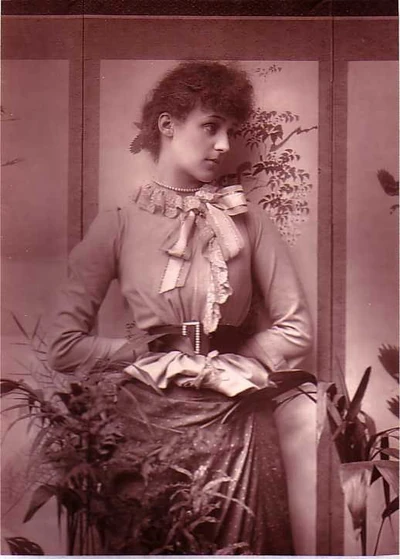
Marion Margaret Violet Manners, Duchess of Rutland (née Lindsay), was born on March 7, 1856, and died on December 22, 1937. She was a British artist and member of the aristocracy. She was a granddaughter of James Lindsay, the 24th Earl of Crawford, through her father, the Hon. Charles Hugh Lindsay, and her mother was Emilia Anne Browne, daughter of Montague Browne, dean of Lismore.
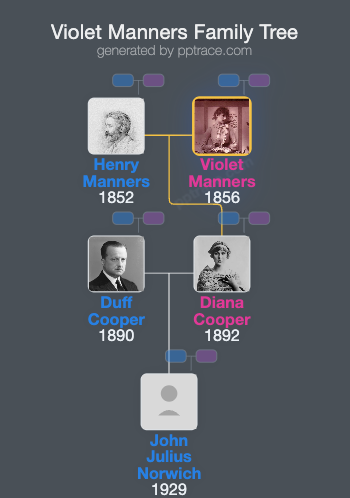
In 1882, at the age of 26, she married Henry Manners, the only son of John Manners, the 7th Duke of Rutland. Her husband succeeded as the 8th Duke of Rutland in 1906, at which point she assumed the title of Duchess of Rutland. The marriage produced five children: Lady Victoria Marjorie Harriet Manners (1883–1946), who married Charles Paget, 6th Marquess of Anglesey; Robert Charles John Manners, Lord Haddon (1885–1894), who died young; John Henry Montagu Manners, the 9th Duke of Rutland (1886–1940); Lady Violet Catherine Manners (1888–1971), who married first Hugo Charteris, Lord Elcho, and second Guy Benson; and Lady Diana Olivia Winifred Maud Manners (1892–1986), who married Duff Cooper, 1st Viscount Norwich.
Violet Manners had limited formal artistic training but showed interest in art from a young age, influenced by her family’s support. She spent time in Italy and began exhibiting her drawings and sculptures at the Grosvenor Gallery in 1877. Her work primarily depicted members of her social circle and was exhibited at prominent venues including the Royal Academy of Arts and the New Gallery. She also exhibited internationally, notably at the 1893 World's Columbian Exposition in Chicago.
Her artistic pursuits expanded to sculpture, particularly after the death of her eldest son in 1894, when she created a bust displayed on his tomb at Belvoir Castle. She considered one of her sculptures, featuring her family members, her greatest work, and it was later acquired by the Tate Gallery in 1937. In 1900, she published "Portraits of Men and Women," a book comprising portraits of her acquaintances.
Violet Manners was associated with The Souls, an aristocratic social circle known for its cultural interests. She was recognized for her beauty and artistic talent, often painted by notable artists such as George Frederic Watts and James Jebusa Shannon. She maintained a studio at Bute House at the Rutland estate and was involved in intellectual and artistic pursuits. She was also part of a social movement that valued aesthetic ideals and avant-garde interests.
During World War I, she converted her London residence at 16 Arlington Street into a hospital, where her daughter Diana served as a nurse. Her only surviving son, John, succeeded his father as duke in 1925. Following her husband's death, she relocated to Belgrave Square, London, where she built a new studio and continued her artistic work. She remained active in exhibiting her art until shortly before her death in 1937, which followed an operation. She was interred at Belvoir Castle, Leicestershire.
In 2016, a portrait of her by G. F. Watts was acquired by the Watts Gallery Trust, prompting her grandson, historian John Julius Norwich, to donate a collection of her drawings to the gallery.