Harry Cust
| Name | Harry Cust |
| Title | British politician (1861-1917) |
| Gender | Male |
| Birthday | 1861-10-10 |
| nationality | United Kingdom of Great Britain and Ireland |
| Source | https://www.wikidata.org/wiki/Q1606613 |
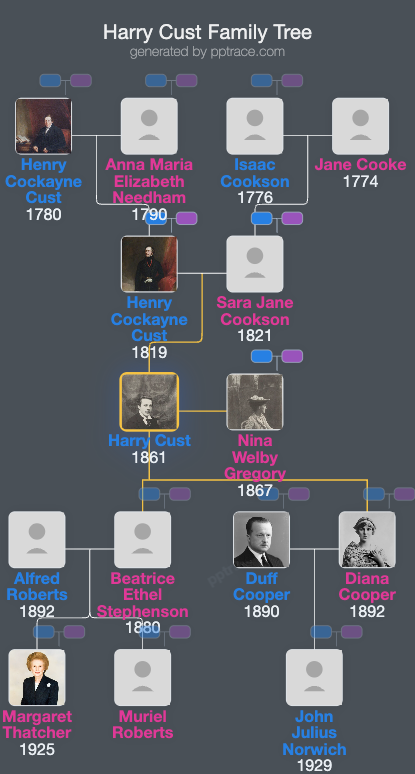
| pptrace | View Family Tree |
| LastUpdate | 2025-11-26T23:33:37.489Z |
Family Tree
Tap  to expand more relatives
Introduction
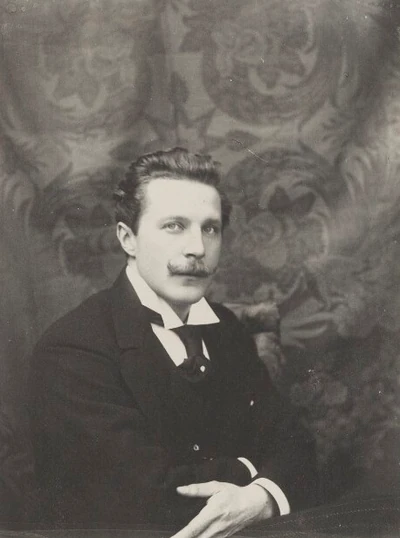
Henry John Cockayne-Cust, JP, DL (10 October 1861 – 2 March 1917), was an English politician and editor. He served as a Member of Parliament (MP) representing the Unionist Party.
**Early Life and Family**
Born in 1861, Cust was the son of Henry Cockayne-Cust and Sara Jane Cookson. His paternal lineage included Brownlow Cust, 1st Baron Brownlow, of Belton House near Grantham in Lincolnshire, making Cust a descendant of the British aristocracy. He was the grandson of Brownlow Cust through his father.
**Education**
Cust attended Eton College, where he held the position of captain of the Oppidans. He then studied at Trinity College, Cambridge, earning a Bachelor of Arts degree with second-class honors in the Classical Tripos.
**Legal and Political Career**
Initially, Cust pursued law and was admitted to the Inner Temple in 1888. However, he shifted his focus to politics. In 1890, he was elected as the MP for Stamford, Lincolnshire, serving until 1895. He later represented Bermondsey in Surrey from 1900 to 1906.
**Local Public Service**
Cust held several local appointments, including Justice of the Peace for Bedfordshire and Lincolnshire, and he was also a Deputy Lieutenant of Bedfordshire.
**Associations and Personal Life**
He was a member of The Souls, a prominent social club during the late Victorian era, which included notable figures such as Margot Asquith, Arthur Balfour, George Curzon, and others. Cust was known for his conversational skills and was involved romantically with Pamela Wyndham, who later married Edward Tennant, 1st Baron Glenconner.
There were rumors regarding Cust's potential paternity of Lady Diana Cooper, a socialite and philanthropist, suggesting he might have been her biological father through his mistress Violet Manners, Duchess of Rutland. Additionally, speculations arose about his possible biological grandfather to Margaret Thatcher via her mother, Beatrice Ethel Stephenson, although no definitive evidence exists.
**Editorial Career**
In 1892, Cust was invited by William Waldorf Astor to edit the Pall Mall Gazette, despite lacking prior journalism experience. Under his editorship, the newspaper became highly regarded, publishing works by authors like Rudyard Kipling and H. G. Wells. He was, however, dismissed in 1896 due to disagreements and his refusal to publish contributions from Astor himself.
**Writing and Wartime Activities**
Post-editorial career, Cust authored poetry, including the piece "Non nobis." During World War I, he engaged in propaganda efforts, founding the Central Committee for National Patriotic Organizations in August 1914.
**Death and Succession**
Cust died from a heart attack at his residence in Hyde Park Gate, London, in 1917. As he was the most senior male relative of his childless second cousin, Adelbert Brownlow-Cust, 3rd Earl Brownlow, he was considered heir presumptive to various titles and estates, which ultimately passed to his younger brother, Adelbert Cockayne-Cust, after his death.
**Marriage and Marital Issues**
Cust married on 11 October 1893 to Emmeline Mary Elizabeth Welby-Gregory, known as Nina. The marriage was reportedly initiated due to an alleged pregnancy, which was either false or misrepresented. They had no children. Nina was an artist and a translator, and she and Cust are buried together at St Peter and St Paul's Church, Belton.
**Illegitimate Offspring**
His publicly acknowledged illegitimate daughter was Lady Diana Cooper (1892–1986), who married Duff Cooper in 1919. Rumors also suggest he fathered Beatrice, the mother of Margaret Thatcher, through an affair with a servant, Phoebe Stephenson, though this remains unconfirmed.
**Legacy**
An annual Cust Lecture in relation to the British Empire was established at the University of Nottingham in his honor. His poetry collection, *Occasional Poems*, was published posthumously in 1918.
**References**
Further details on Cust can be found in Jane Dismore’s *Tangled Souls: Love and Scandal among the Victorian Aristocracy*, which explores his relationship with Nina Welby-Gregory and their social circle.