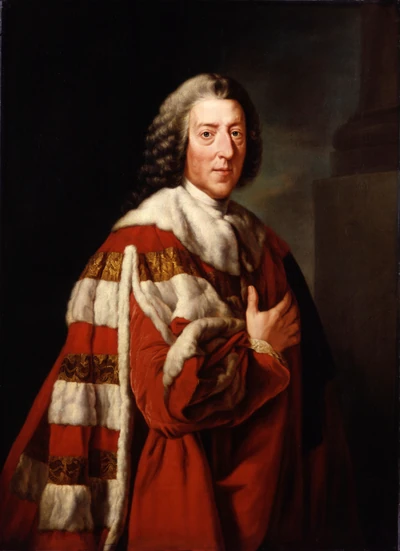
William Pitt, 1st Earl Of Chatham
| Name | William Pitt, 1st Earl Of Chatham |
| Title | Prime Minister of Great Britain from 1766 to 1768 |
| Gender | Male |
| Birthday | 1708-11-15 |
| nationality | Great Britain |
| Source | https://www.wikidata.org/wiki/Q208663 |
| pptrace | View Family Tree |
| LastUpdate | 2025-11-26T23:24:03.423Z |
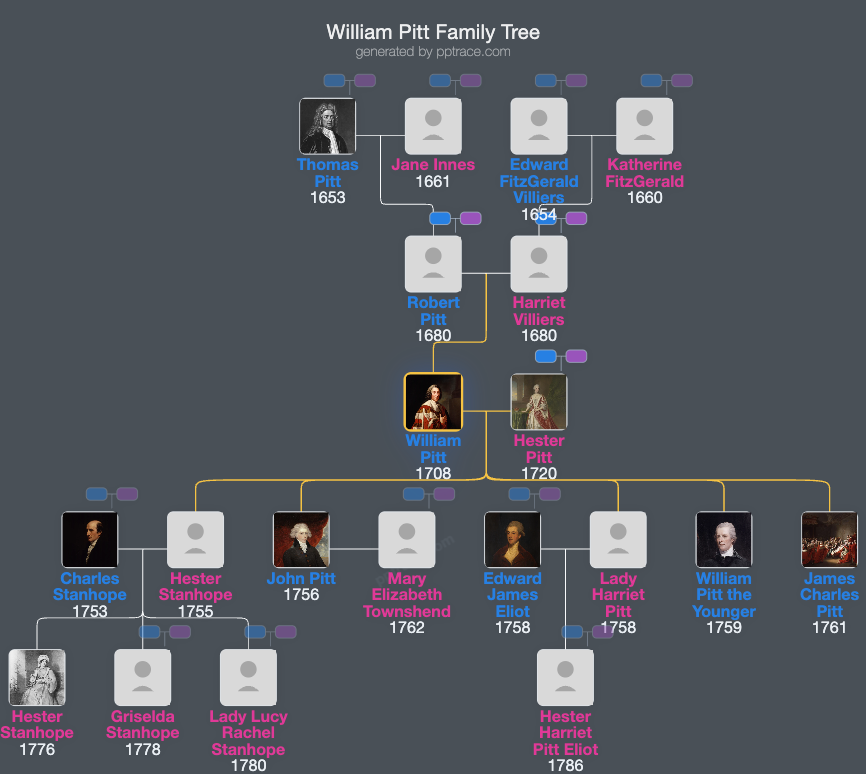
Family Tree
Tap  to expand more relatives
Introduction
William Pitt, 1st Earl of Chatham, was born on 15 November 1708 in Westminster, England. He was the grandson of Thomas Pitt, a prominent merchant and colonial governor known for his discovery and sale of a large diamond, which contributed to the family's wealth and political influence. Pitt’s mother was Harriet Villiers, daughter of Edward Villiers-FitzGerald and Irish heiress Katherine FitzGerald. His father was Robert Pitt, a Tory Member of Parliament from 1705 to 1727, and both of his uncles, Thomas and John, served as Members of Parliament (MPs). His aunt, Lucy Pitt, married General James Stanhope, a leading Whig politician and soldier who served as effective First Minister from 1717 to 1721.
William Pitt was educated at Eton College starting in 1719 but expressed dissatisfaction with the school. He began suffering from gout during his school years. After his father's death in 1727, Pitt inherited a portion of the family estate at Boconnoc in Cornwall, which had been purchased by his grandfather. He then attended Trinity College, Oxford, in January 1727 but left in 1728 due to a severe gout attack. Subsequently, he studied at Utrecht University in the Dutch Republic, gaining knowledge of international law and diplomacy. Pitt returned to his family estate around 1730, though he continued to experience gout attacks throughout his life.
Pitt chose a military career as a younger son and obtained a cornet's commission in the King's Own Regiment of Horse in 1731. His military service was mainly stationed in Northampton, but he did not see combat, as Britain had not engaged in warfare during this period. His military career was relatively brief, and in 1735, through his brother Thomas’s parliamentary service, Pitt entered the House of Commons as MP for Old Sarum.
In opposition to the government, Pitt became associated with the Patriot Whigs, a faction critical of Walpole's administration. His maiden speech in Parliament occurred in April 1736, during debates on the marriage of George II’s son, Prince Frederick. He gained recognition for his oratorical skills and took part in debates criticizing Britain's non-intervention in European conflicts. His outspoken opposition led Walpole to orchestrate his dismissal from the army in 1736, which provoked public criticism over parliamentary privilege and governmental overreach.
Following his dismissal from the military, Pitt served as one of the Grooms of the Bedchamber to the Prince of Wales, Frederick, acting as a political patronage reward. His hostility to government policies persisted, and he became increasingly active in parliamentary debates.
During the 1730s, Britain was engaged in the War of the Polish Succession, but Pitt’s military career remained largely inactive. His political prominence grew, and he became a leading critic of government policies on foreign affairs and colonial issues. He consistently opposed corruption and advocated for Britain's expansion and imperial interests.
Pitt's most notable period of leadership occurred during the Seven Years' War (1756–1763), when he served as a key member of the British government and was the de facto leader during much of the conflict. He held the official position of Lord Privy Seal from 1766 to 1768 and served as Prime Minister from 1766 to 1768. Known as "Pitt the Elder," he was distinguished for his oratorical prowess, strategic vision, and commitment to British imperial dominance. His leadership significantly influenced Britain’s military successes and expansion of empire.
William Pitt married Hester Grenville in 1755, and they had children, including William Pitt the Younger, who also became Prime Minister. William Pitt, 1st Earl of Chatham, died on 11 May 1778. Historically, he is ranked among the notable British Prime Ministers, recognized for his parliamentary skills, oratory, and influence on British foreign policy and imperial expansion.