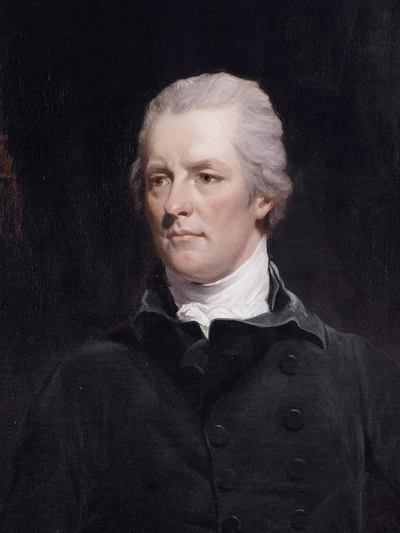
William Pitt The Younger
| Name | William Pitt The Younger |
| Title | British statesman (1759–1806) |
| Gender | Male |
| Birthday | 1759-05-28 |
| nationality | Great Britain |
| Source | https://www.wikidata.org/wiki/Q128902 |
| pptrace | View Family Tree |
| LastUpdate | 2025-11-26T23:24:05.360Z |
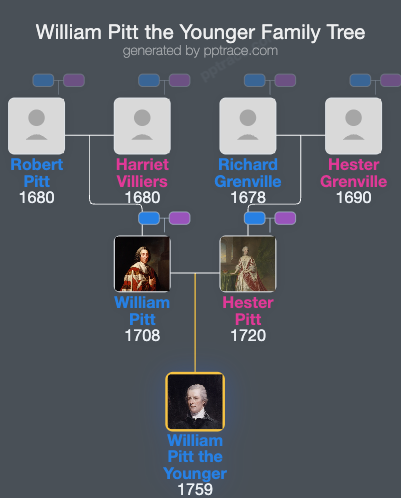
Family Tree
Tap  to expand more relatives
Introduction
William Pitt (28 May 1759 – 23 January 1806) was a British statesman who served as the last prime minister of Great Britain from 1783 until the Acts of Union 1800, and the first official prime minister of the United Kingdom from January 1801. He also held the position of Chancellor of the Exchequer throughout his time as prime minister. Pitt is commonly referred to as "Pitt the Younger" to distinguish him from his father, William Pitt the Elder, who also served as prime minister.
Pitt's tenure as prime minister occurred during the reign of King George III and was characterized by significant European political events, notably the French Revolution and the Napoleonic Wars. Although he is often called a Tory, Pitt identified himself as an "independent Whig" and generally opposed the development of a strict partisan political system. His administration was recognized for efficiency and reform, and he sought to modernize the administration by introducing capable administrators.
His policies included increasing taxes to fund the war against France and implementing measures to suppress radicalism. To mitigate Irish support for France, Pitt engineered the Acts of Union 1800, which unified Great Britain and Ireland, and he attempted, though unsuccessfully, to secure Catholic emancipation as part of this process. Pitt established the "new Toryism," a political movement that revitalized the Tory Party, enabling it to remain in power for over twenty-five years.
Historians have evaluated Pitt's personality as somewhat solitary and perceived as having an attitude of superiority, which did not endear him to many contemporaries. However, his effectiveness during wartime, especially in the conflict with France, earned him high regard. Lord Minto called him "the Atlas of our reeling globe," and William Wilberforce praised his personal qualities, citing his "personal purity, disinterestedness and love of this country." Charles Petrie regarded Pitt as one of the greatest prime ministers, noting his role in guiding Britain smoothly through the transition from the old regime to a new order.
William Pitt served as prime minister for 18 years and 343 days, making him the second-longest-serving British prime minister. He was notably the youngest prime minister in British and world history, having assumed office at the age of 24.
Early Life:
William Pitt was born at Hayes Place, in Hayes, Kent, on 28 May 1759. He was the second son of William Pitt, 1st Earl of Chatham, and Hester Grenville, linking him to a prominent political family, as his mother was the sister of former prime minister George Grenville. Pitt demonstrated intelligence and dynamism from a young age, displaying proficiency in Latin and Greek.
He was educated at home by Reverend Edward Wilson, and later attended Pembroke College, Cambridge, beginning his studies in October 1773, shortly before his fourteenth birthday. His academic pursuits included political philosophy, classics, mathematics, chemistry, and history. At Cambridge, he was tutored by George Pretyman Tomline, who became a close confidant and advisor throughout Pitt's career. Pitt formed a lifelong friendship with William Wilberforce at university.
Due to health issues, Pitt graduated in 1776 without examinations. His father, who had been raised to the peerage as Earl of Chatham, died in 1778. Following his father's death, Pitt publicly defended his reputation against claims made by the Bute family, who alleged that his father had sought to form a political coalition with the Earl of Bute.
Legal Training and Early Political Career:
Pitt studied law at Lincoln's Inn and was called to the bar in 1780. His entry into Parliament occurred during the 1780 general election, at age 21, representing the University of Cambridge seat after securing patronage from James Lowther through connections facilitated by his friend Charles Manners, 4th Duke of Rutland. Pitt's maiden speech garnered significant attention, and he soon established himself as a formidable debater.
Initially aligning with the Whigs, Pitt opposed the continuation of the American War of Independence and supported parliamentary reforms. His political associations shifted over time, and he held various governmental positions, including Chancellor of the Exchequer upon the collapse of Lord North's administration in 1782.
In 1783, Pitt declined the offer to become prime minister after the resignation of Lord Shelburne, citing concerns over his ability to secure parliamentary support. Instead, he became a leading figure in the new government and soon ascended to the role of prime minister, at age 24, marking a historic entry into the office.