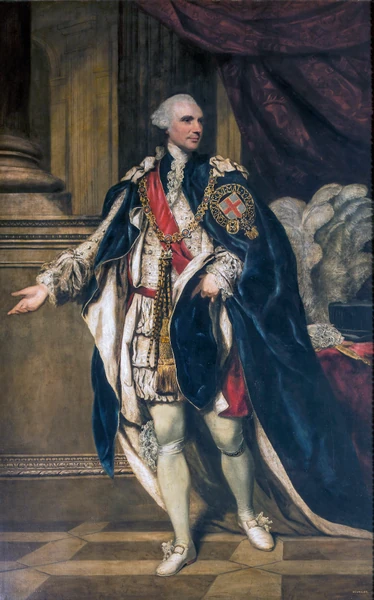
John Stuart, 3rd Earl Of Bute
| Name | John Stuart, 3rd Earl Of Bute |
| Title | British nobleman, art collector, and Prime Minister of Great Britain (1713-1792) |
| Gender | Male |
| Birthday | 1713-05-25 |
| nationality | Great Britain |
| Source | https://www.wikidata.org/wiki/Q294651 |
| pptrace | View Family Tree |
| LastUpdate | 2025-11-26T23:22:42.940Z |
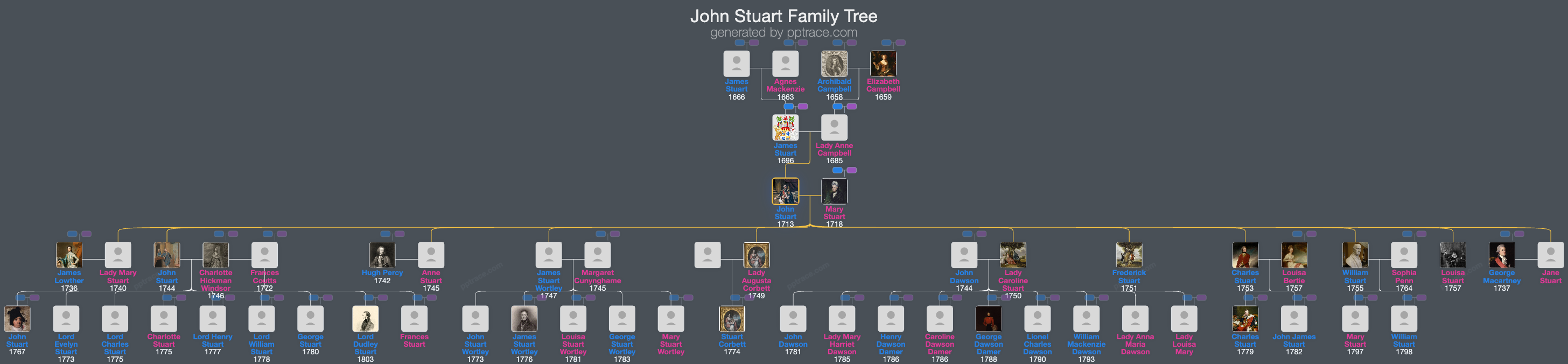
Family Tree
Tap  to expand more relatives
Introduction
John Stuart, 3rd Earl of Bute (25 May 1713 – 10 March 1792), was a British politician and statesman. He held the office of Prime Minister of Great Britain from 1762 to 1763 during the reign of King George III. Bute was the first person of Scottish descent to serve as prime minister following the Acts of Union in 1707 and was the first Tory to hold the position. His tenure is considered significant as he was potentially the last prominent royal favourite in British politics.
**Early Life and Family Background**
Born in Parliament Close, near St Giles Cathedral on the Royal Mile in Edinburgh, Bute was the son of James Stuart, 2nd Earl of Bute, and Lady Anne Campbell. He was a member of the Scots aristocracy with familial ties to influential Scottish clans; his mother was a daughter of the 1st Duke of Argyll, a Campbell. Upon his father’s death in 1723, he succeeded to the Earldom of Bute. He was educated at Eton College (1724–1730) and subsequently studied civil law at the Universities of Groningen (1730–1732) and Leiden (1732–1734) in the Netherlands, earning a degree in civil law from Leiden.
**Marriage and Personal Life**
In August 1735, Bute eloped with Mary Wortley Montagu, daughter of Sir Edward Wortley Montagu and Lady Mary Wortley Montagu. Her parents were initially hesitant about the marriage. Bute's upbringing was overseen by maternal uncles, the 2nd Duke of Argyll and the 3rd Duke of Argyll.
**Political Career and Rise to Power**
Bute was elected a Scottish representative peer in 1737 but did not participate actively in the House of Lords that year. Due to his support for the Duke of Argyll against Robert Walpole, he was not re-elected in 1741. During this period, he focused on managing his estates and engaging in botanical pursuits. In 1745, Bute moved to Twickenham, Middlesex, and developed a friendship with Frederick, Prince of Wales, whom he met at the Egham Races in 1747.
He served as tutor to Prince George, later King George III, after the Prince's accession in 1760. Bute arranged for the prince and his brother to attend lectures on natural philosophy, influencing George III’s interest in science and collecting.
**As Prime Minister**
Following the death of King George II in 1760, Bute anticipated rapid political advancement owing to his proximity to the new king. He influenced the fall of the incumbent Prime Minister, the Duke of Newcastle, and of William Pitt the Elder. Bute was appointed de facto Prime Minister after their resignations, marking the end of Whig dominance.
His government negotiated the Treaty of Paris in 1763, ending the Seven Years' War. The treaty involved concessions to France, including the return of fisheries in Newfoundland, and marked a shift in Britain's colonial and military policies. Bute's administration also introduced a cider tax in 1763 and was involved in fiscal policies that prompted resistance in the American colonies, contributing to tensions leading to the American Revolution.
Bute's premiership was short-lived; he resigned in 1763, although he remained a Scottish representative peer until 1780.
**Later Life and Contributions**
After stepping down from political office, Bute resided at Highcliffe in Hampshire, where he dedicated himself to botany and philanthropy. He financed scientific travels, notably Alberto Fortis’s exploration into Dalmatia. His botanical work culminated in the publication of "Botanical Tables Containing the Families of British Plants" in 1785.
He supported literary and artistic figures such as Samuel Johnson, Tobias Smollett, Robert Adam, William Robertson, and John Hill, and contributed to Scottish universities. In 1780, he was elected the first president of the Society of Antiquaries of Scotland.
**Death and Legacy**
John Stuart died on 10 March 1792 at his residence in South Audley Street, Westminster, due to complications following a fall from cliffs in Hampshire, where he had been collecting plants. He was interred at Rothesay on the Isle of Bute.
Taxa named in his honor include the plant genera Butea and Stewartia. In 1761, he became Ranger of Richmond Park, a position he held until his death. Bute Avenue in Petersham is named after him. The name Stuart Island in British Columbia also bears his name.
**Family**
John Stuart married Mary Wortley Montagu in 1736. They had at least eleven children, among them Lady Mary Stuart (who married James Lowther, later Earl of Lonsdale), John Stuart, Lord Mount Stuart (who became the 4th Earl of Bute and later Marquess of Bute), Lady Anne Stuart (married Hugh Percy, 2nd Duke of Northumberland), and the Hon. James Archibald Stuart (an ancestor of Bear Grylls).