Louisa Stuart
| Name | Louisa Stuart |
| Title | noblewoman; Daughter of British Prime Minister |
| Gender | Female |
| Birthday | 1757-08-12 |
| nationality | United Kingdom of Great Britain and Ireland |
| Source | https://www.wikidata.org/wiki/Q245935 |
| pptrace | View Family Tree |
| LastUpdate | 2025-11-26T23:22:46.497Z |
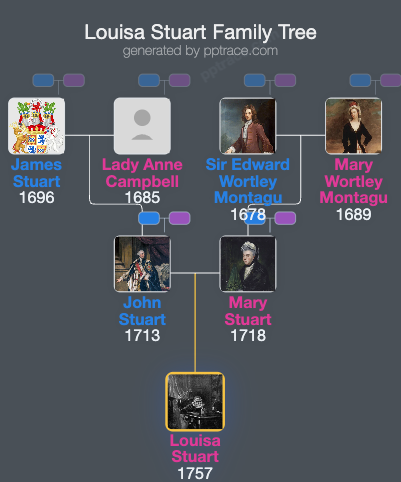
Family Tree
Tap  to expand more relatives
Introduction
Lady Louisa Stuart (12 August 1757 – 4 August 1851) was a Scottish writer active during the late 18th and early 19th centuries. Her lifespan lasted nearly ninety-four years. She was the daughter of John Stuart, 3rd Earl of Bute, a Scottish politician who served as Prime Minister of Great Britain from 1762 to 1763, and Mary Stuart, Countess of Bute. Her father was a close friend of King George III and spent much of his time at his residence in Berkeley Square, London, and later at Luton Hoo in Bedfordshire, which he purchased in 1762.
Her maternal lineage included the famous writer and traveler Lady Mary Wortley Montagu, as her maternal grandmother. Lady Louisa had five brothers and four sisters. Her brothers included John Stuart, 1st Marquess of Bute, a Tory Member of Parliament and Fellow of the Royal Society; Sir Charles Stuart, a soldier who participated in the American Revolutionary War and the Napoleonic Wars, reaching the rank of lieutenant-general; William Stuart, who became Archbishop of Armagh; and James Archibald Stuart, a soldier who raised the 92nd Regiment of Foot. Her sisters were Lady Mary Stuart, Lady Anne Stuart, Lady Jane Stuart, and Lady Caroline Stuart; they married into notable families, including the Lowthers, Northumberland, Macartney, and Portarlington.
From a young age, Lady Louisa demonstrated a strong interest in literature and the arts. By the age of ten, she had begun composing a French novel and planning a Roman play. She attended social events in London and maintained correspondence with friends. Fanny Burney, a fellow writer, described her as lively and perceptive, noting her high spirits and keen observations on society. Burney also described her mother's lively character.
In 1770, at thirteen years old, Lady Louisa experienced a romantic disappointment when she fell in love with her second cousin William Medows, a Lieutenant-Colonel then aged 31. Her father considered Medows unsuitable, and he married another woman later that year. Medows advanced in his military career, becoming a Lieutenant-General and Governor-General of Madras. Lady Louisa never married, despite having other suitors, including Henry Dundas, later Viscount Melville, and John Charles Villiers. She ultimately chose not to pursue a love match without mutual affection.
Lady Louisa Stuart was also known to have been rumored to be considered as a possible bride for the Earl of Strafford, but she did not entertain this notion, and the matter was dismissed. She maintained a long-standing friendship with Sir Walter Scott, the renowned novelist and poet, who valued her literary critique highly and corresponded with her over many years until his death in 1832.
Her writings include memoirs, letters, poetry, fables, and a ballad about a family of human cannibals. Her memoir of Lady Mary Coke, written in 1827, depicted Coke as a virtuous woman suffering from a brutal marriage and paranoia. She also authored an essay titled “Biographical Anecdotes of Lady M. W. Montagu,” focusing on her grandmother’s work and political environment. Much of her work remained unpublished during her lifetime; it was only after her death that her writings were edited and published posthumously in the late 19th century, notably in "Gleanings from an Old Portfolio" and other collections.
Her political views were aligned with the Tory tradition, characterized by conservatism. Her writings often contained elements of satire and humorous critique, including fables and poetry.