Charles Stuart
| Name | Charles Stuart |
| Title | British Army general (1753-1801) |
| Gender | Male |
| Birthday | 1753-01-01 |
| nationality | Great Britain |
| Source | https://www.wikidata.org/wiki/Q275334 |
| pptrace | View Family Tree |
| LastUpdate | 2025-11-26T23:22:43.942Z |
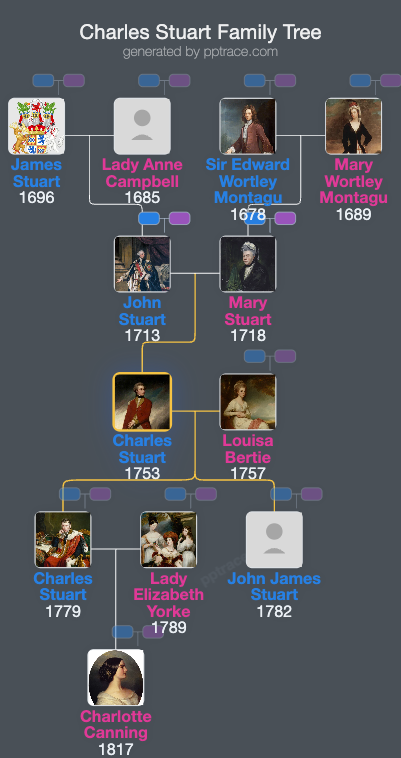
Family Tree
Tap  to expand more relatives
Introduction
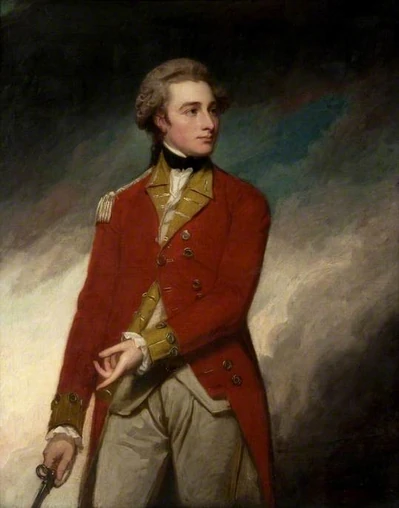
Lieutenant-General The Honorable Sir Charles Stuart (January 1753 – 25 May 1801) was a British Army officer and politician. He was born at Kenwood House, London, in January 1753. He was the fourth son of John Stuart, 3rd Earl of Bute, who served as Prime Minister of Great Britain, and his wife, Mary Stuart, Countess of Bute. Mary was the only daughter of Sir Edward Wortley Montagu and Lady Mary Pierrepont, daughter of the 1st Duke of Kingston-upon-Hull.
Charles Stuart had several notable siblings, including John Stuart, 1st Marquess of Bute; William Stuart, who became Archbishop of Armagh; and James Archibald Stuart, a soldier who raised the 92nd Foot in 1779. His sisters included Lady Louisa Stuart, a writer who died unmarried; Lady Mary Stuart, who married James Lowther, later the 1st Earl of Lonsdale; Lady Anne Stuart, wife of Lord Warkworth (later the 2nd Duke of Northumberland); Lady Jane Stuart, wife of George Macartney (later the 1st Earl Macartney); and Lady Caroline Stuart, who married The Hon. John Dawson, later the 1st Earl of Portarlington.
Stuart began his military career in 1768 at age 15, enlisting as an ensign in the 37th Regiment of Foot. He purchased a lieutenancy in the 7th Regiment of Foot (Royal Fusiliers) in 1770 and a captaincy in the 35th Foot in 1773. That same year, he became a major in the 43rd Regiment of Foot, participating in the American War of Independence. In October 1777, he was promoted to lieutenant-colonel of the 26th Regiment of Foot, which he commanded until 1779. During this period, he returned briefly to America and later served as a liaison to the British government in London. Despite criticisms of the Army’s conduct, he maintained favor with Sir Henry Clinton, with whom he corresponded regularly.
Stuart’s sons were born after his return from America. He was promoted to colonel in 1782, but his criticisms of the Army and the disfavor of King George III towards his father hindered further military commands. Politically, he was elected Member of Parliament for Bossiney in 1776, succeeding his elder brother, Lord Mount Stuart, who had been created Baron Cardiff. He served as an MP for most of his life, except between 1794 and 1796, though he showed little interest in parliamentary affairs.
With the outbreak of hostilities against France, Stuart returned to active military service. On 23 May 1794, he assumed command of the British forces in Corsica, overseeing the capture of Calvi, during which Horatio Nelson lost an eye. He was promoted to lieutenant-general for this operation and was made colonel of the 68th Regiment of Foot on 24 October 1794. His time in Corsica was marred by conflicts with Commander Lord Hood and the civilian viceroy, Sir Gilbert Elliot, Bt, partly due to his partiality for Pasquale Paoli. These disagreements led to his resignation in February 1795. Subsequently, he was appointed colonel of the 26th Regiment of Foot, a position he held until his death.
In January 1797, Stuart led a force to Portugal to defend Lisbon, successfully instilling discipline within the diverse army. In 1798, he was tasked with capturing Menorca with approximately 3,000 men. His strategic deception led to the Spanish surrender of the island without combat casualties, earning him a knighthood as a Knight of the Bath. He served as the governor of Menorca from November 1798 until 1800.
In 1799, Stuart responded to a request from Admiral Nelson by deploying the 30th and 89th Regiments to Palermo to secure Messina from French invasion. He resigned as governor of Menorca in April 1800 and returned to England. Subsequently, he was offered the position of Commander-in-Chief in Ireland but died suddenly at his residence in Richmond Park on 25 March 1801 before taking up the post.
Stuart married Anne Louisa Bertie on 19 April 1778. She was the daughter of Lord Vere Bertie and Anne Casey, the illegitimate daughter of Sir Cecil Wray, 11th Baronet. They had two sons: Charles Stuart, 1st Baron Stuart de Rothesay, and John James Stuart. Charles married Lady Elizabeth Margaret Yorke in 1816; John James married Albinia Sullivan. Stuart inherited the estate of Highcliffe House in Hampshire upon his father’s death in 1792. He died at his home in Richmond Park and was interred in the family vault at St Peter's Church, Petersham.
There are monuments to Charles Stuart in Westminster Abbey, created by Joseph Nollekens, and in St Peter’s Church. His descendants include granddaughters such as Charlotte Stuart, who married Charles Canning, 1st Earl Canning, and Louisa Anne Stuart, who married Henry Beresford, 3rd Marquess of Waterford. His grandson, General Charles Stuart (1810–1892), served as an army officer and Member of Parliament.