Mary Stanley, Lady Derby
| Name | Mary Stanley, Lady Derby |
| Title | English political hostess |
| Gender | Female |
| Birthday | 1824-07-23 |
| nationality | — |
| Source | https://www.wikidata.org/wiki/Q18648958 |
| pptrace | View Family Tree |
| LastUpdate | 2025-11-26T12:41:19.691Z |
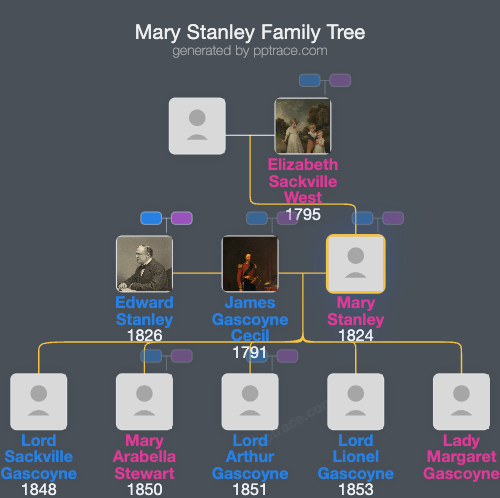
Family Tree
Tap  to expand more relatives
Introduction
Mary Stanley, Countess of Derby (born Lady Mary Sackville-West; 23 July 1824 – 6 December 1900), was an English social figure and political hostess during the Victorian era. She was the daughter of George Sackville-West, 5th Earl De La Warr, and was the sixth of his nine children.
Lady Mary married James Gascoyne-Cecil, 2nd Marquess of Salisbury, in 1847. Together, they had five children: Lord Sackville Arthur Cecil (16 March 1848 – 29 January 1898), Lady Mary Arabella Arthur Cecil (26 April 1850 – 18 August 1903), Lady Margaret Elizabeth Cecil (1850 – 11 March 1919), Lord Arthur Cecil (3 July 1851 – 16 July 1913), and Lord Lionel Cecil (21 March 1853 – 13 January 1901). Her first husband died in April 1868 at the age of 76.
In 1870, Lady Mary married Edward Henry Stanley, 15th Earl of Derby. Her political activities were significantly influenced by her family connections and social position. Her father’s association with the Duchess of Kent placed her within Queen Victoria's circle from a young age. During her marriage to the Marquess of Salisbury, she utilized their residence, Hatfield House, as a political hub for the Conservative (Tory) party. Notable visitors included Lord Carnarvon, Benjamin Disraeli, and Hugh Cairns.
Following her second marriage, Lady Derby continued her engagement in political affairs. She played a role in influencing cabinet members and foreign diplomats, at times reportedly leaking confidential information. There are claims that she leaked information to the Russian ambassador Count Shuvalov, though the accuracy of this claim remains uncertain. Disraeli used this rumor to create political distance between Lord Derby and his colleagues, especially during the Russo-Turkish War of 1877–1878, a period which Jennifer Davey suggests almost undermined her husband's political career. Lord Derby resigned twice as Foreign Secretary in early 1878 before switching allegiance to the Liberal Party.
Lady Derby maintained correspondence with various prominent figures, including Charles Darwin, the Duke of Wellington, and Sir Henry Irving. These letters have been compiled into a published collection and her papers are stored in the National Archives. Her influence in the political and social spheres was notable enough to be referenced by Virginia Woolf in her novel "Orlando: A Biography."
Her life spanned from 1824 to 1900, and her activities encompassed family, social, and political domains during a significant period of Victorian Britain.