Christian VII Of Denmark
| Name | Christian VII Of Denmark |
| Title | King of Denmark and Norway (1749-1808) |
| Gender | Male |
| Birthday | 1749-01-29 |
| nationality | Q62651 |
| Source | https://www.wikidata.org/wiki/Q156572 |
| pptrace | View Family Tree |
| LastUpdate | 2025-11-12T01:15:58.791Z |
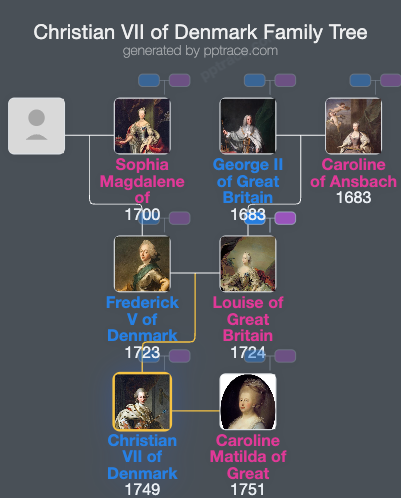
Family Tree
Tap  to expand more relatives
Introduction
Christian VII was born on 29 January 1749 at Christiansborg Palace in Copenhagen, Denmark. He was the second son of King Frederick V of Denmark and Norway and his first wife, Louise of Great Britain. His full name at birth was Christian, and he was baptized on the day of his birth by the royal confessor Johannes Bartholomæus Bluhme. His godparents included his father, King Frederick V; Queen Dowager Sophie Magdalene; Princess Louise (his aunt); and Princess Charlotte Amalie (his grand-aunt). Christian was the fourth child in his family, which also included his elder sisters Princess Sophia Magdalena and Princess Wilhelmina Caroline, and later his younger sister Princess Louise born in 1750.
His mother, Queen Louise, died in 1751 during her sixth pregnancy, when Christian was about two years old. Subsequently, his father remarried Duchess Juliana Maria of Brunswick-Wolfenbüttel in 1752, who bore a half-brother to Christian, Prince Frederick, in 1753.
Christian was crowned king shortly after his father’s death on 14 January 1766, ascending the thrones of Denmark and Norway at the age of 16. His reign was heavily impacted by mental illness, which rendered him largely a figurehead for most of his tenure. His royal advisers fluctuated depending on political power struggles, and from 1770 to 1772, Johann Friedrich Struensee, his court physician, held de facto power and implemented various progressive reforms signed into law by the king. Struensee was deposed in 1772, leading to a restructuring of power that placed Christian’s stepmother, Queen Dowager Juliane Marie, his half-brother Frederick (later Frederick VI), and the politician Ove Høegh-Guldberg in charge.
In 1766, Christian married his first cousin, Princess Caroline Matilda of Great Britain. The marriage was arranged as a dynastic union and was conducted initially by proxy in London on 1 October 1766, followed by a formal ceremony in Copenhagen on 8 November 1766. The couple was crowned in May 1767. Their marriage was unsuccessful; Christian's personal life was marked by promiscuity and neglect of his wife. They had two children: a son, Frederick (later Frederick VI), born in 1768, and Princess Louise Auguste. The queen's relationship with Struensee, which developed during her marriage, contributed to political upheaval. Struensee's reforms and personal involvement with Caroline Matilda led to his arrest and execution in 1772. Christian officially divorced Caroline Matilda in that same year, after which she was exiled to Celle Castle in Hanover, where she died in 1775.
Following the transfer of effective power, Christian's role remained mostly titular until his son Frederick VI assumed the position of prince regent in 1784. Under this regency, Denmark-Norway experienced liberal reforms, though it also faced military conflicts and political unrest related to the French Revolutionary Wars and the rising Norwegian independence movement.
Christian VII died of a stroke on 13 March 1808 in Rendsburg, Schleswig, at age 59. His body was interred at Roskilde Cathedral. His reign was followed by his son, Frederick VI.
In addition to his political role, Christian VII made contributions to science, notably inviting astronomer Miksa Hell to observe the transit of Venus in 1769. Hell's observations contributed to the most precise measurement of the Earth-Sun distance at that time, and Sajnovics' linguistic studies helped explore the relationships among Finno-Ugric languages.
His life has been depicted in various works of literature, stage productions, films, and television, illustrating the historical and cultural interest in his reign and personal life.