Frederick V Of Denmark
| Name | Frederick V Of Denmark |
| Title | King of Denmark and Norway |
| Gender | Male |
| Birthday | 1723-03-31 |
| nationality | Kingdom of Denmark |
| Source | https://www.wikidata.org/wiki/Q156187 |
| pptrace | View Family Tree |
| LastUpdate | 2025-11-12T01:15:59.604Z |
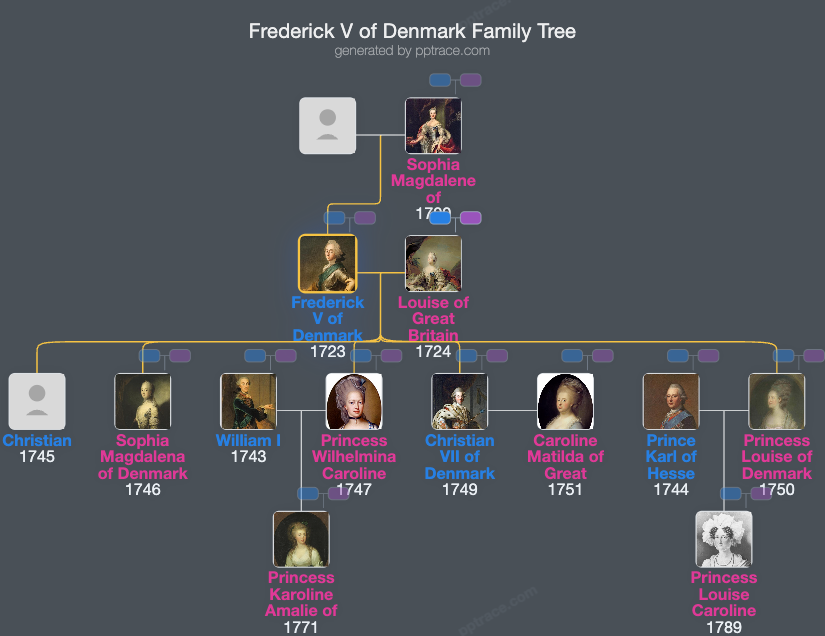
Family Tree
Tap  to expand more relatives
Introduction
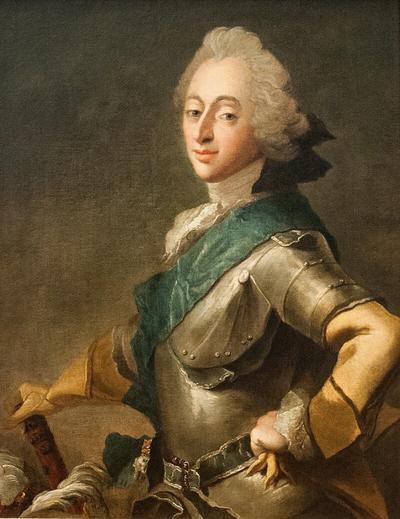
Frederick V (Danish and Norwegian: Frederik V; 31 March 1723 – 14 January 1766) was the King of Denmark and Norway and Duke of Schleswig-Holstein from 6 August 1746 until his death in 1766. He was a member of the House of Oldenburg. His parents were Christian VI of Denmark and Sophie Magdalene of Brandenburg-Kulmbach.
Born in Copenhagen, Prince Frederick was the only son of Crown Prince Christian and Sophie Magdalene. His birth occurred in the then antiquated Copenhagen Castle, which was later demolished to make way for Christiansborg Palace. He was baptized the day after his birth and named after his grandfather, King Frederick IV of Denmark. He was the sole male heir of Christian VI, who became king in 1730, making Frederick the Crown Prince at age seven. A younger sister, Princess Louise, born in 1726, was his only sibling to survive childhood.
Frederick V's upbringing was heavily influenced by Pietism, a Lutheran movement emphasizing personal piety and Christian living. His education was overseen initially by Georg Wilhelm von Söhlenthal, a supporter of the Moravian Brethren, and later by Iver Rosenkrantz. Despite these efforts, his education was limited and carried out in the German Pietist tradition, leading to a poor command of Danish, with German being his stronger language. His parents’ strict religious devotion contrasted with Frederick's own natural cheerful disposition. He was described as gentle, kind, and accessible, frequently engaging with the public and enjoying outdoor activities such as deer stalking, wine, and social pursuits.
Frederick's personal life was characterized by debauchery and alcoholism, which affected his reputation and health. Nevertheless, he was appointed chamber page to Adam Gottlob Moltke in 1730, a mentorship that proved significant during his reign. In 1743, he was confirmed as Crown Prince and was involved in a notable political moment during the Swedish succession crisis, where he was the favored heir by popular acclaim but ultimately was not chosen due to international treaties.
His first marriage was in 1743 to Princess Louise of Great Britain, daughter of King George II. Their union was arranged for political reasons, with the marriage being formalized first by proxy and then in Copenhagen. Louise became popular for her natural demeanor, and the marriage produced five children, though only the heir, Crown Prince Christian, survived infancy. Frederick maintained a libertine lifestyle despite his marriage. Louise died in 1751, shortly after giving birth to their sixth child.
In 1752, Frederick married Duchess Juliana Maria of Brunswick-Wolfenbüttel. The marriage was not well received, largely due to her rigid court manners. They had a son, Hereditary Prince Frederick, born in 1753, who was the grandfather of King Christian VIII of Denmark.
Frederick V ascended to the throne upon his father's death in 1746 at age 23. His reign was marked by limited personal influence due to his dependency on ministers, notably A. G. Moltke, H. C. Schimmelmann, and J. H. E. Bernstorff. His rule saw the advancement of commerce, trade, arts, and sciences, including the establishment of the Royal Danish Theatre (1748) and the Royal Danish Academy of Art (1754). The period was characterized by neutrality in European conflicts, such as during the Seven Years' War.
He promoted public entertainment and freedom of expression, reversing restrictions from his father's pietistic era. His reign also saw the purchase of Danish West Indies in 1754 and the founding of Denmark’s first lottery. Frederick V's health declined due to his lifestyle, exacerbated by alcoholism and injuries from drunken accidents. He died at Christiansborg Palace in 1766 at age 42. He was interred at Roskilde Cathedral.
The monument to Frederick V in Roskilde, completed in 1769, features sculptures symbolizing Denmark and Norway. An equestrian statue was erected in Copenhagen in 1771. Several places, including Frederiksværk and Frederiksted, are named after him. In 2021, a bust of Frederick V was removed and sank into Copenhagen Harbor as part of a controversy over Denmark’s historical involvement in the Atlantic slave trade.