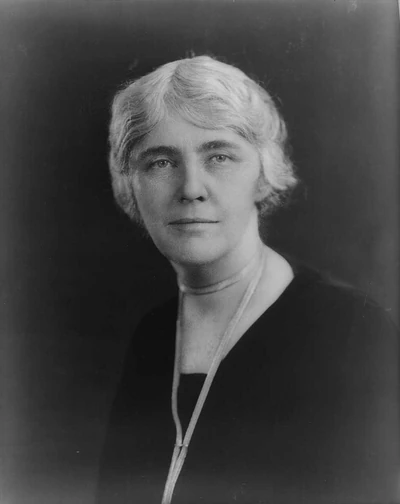
Lou Henry Hoover
| Name | Lou Henry Hoover |
| Title | First Lady of the United States from 1929 to 1933 |
| Gender | Female |
| Birthday | 1874-03-29 |
| nationality | United States of America |
| Source | https://www.wikidata.org/wiki/Q233669 |
| pptrace | View Family Tree |
| LastUpdate | 2025-11-17T06:43:46.482Z |
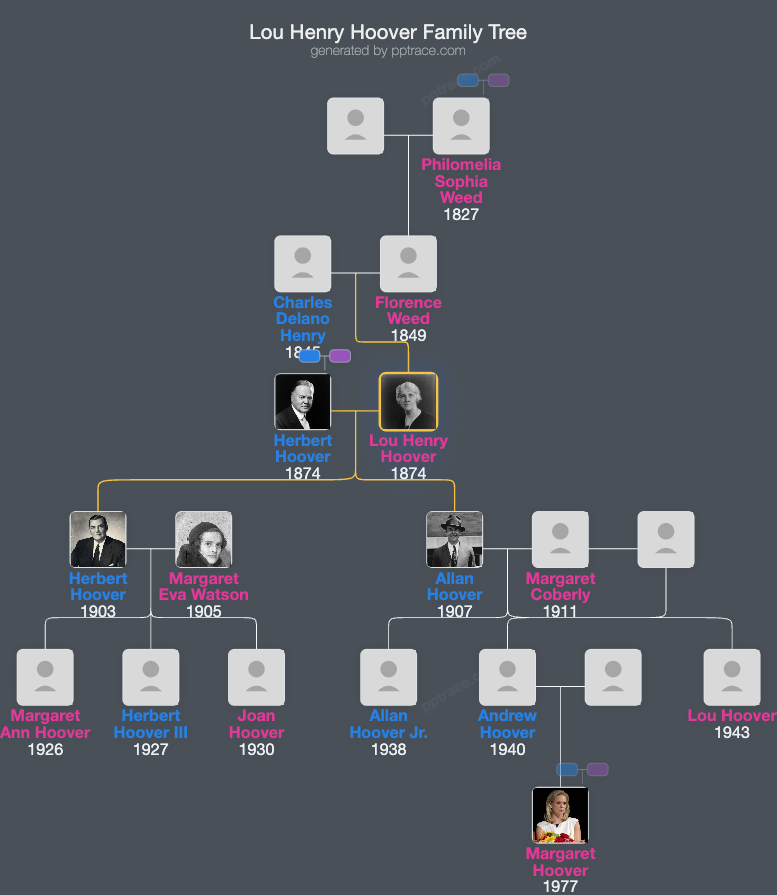
Family Tree
Tap  to expand more relatives
Introduction
Lou Henry Hoover (March 29, 1874 – January 7, 1944) was an American philanthropist, geologist, and the First Lady of the United States from 1929 to 1933, as the wife of President Herbert Hoover. Her life encompassed various roles, including active participation in community organizations and volunteer groups, notably the Girl Scouts of the USA, which she led during two terms, from 1922 to 1925 and from 1935 to 1937. Throughout her lifetime, Hoover advocated for women's rights and the independence of women.
Born in Waterloo, Iowa, Hoover was the daughter of Florence Ida (née Weed), a former schoolteacher, and Charles Delano Henry, a banker. She was the elder of two daughters and was primarily raised in California, where her family moved during her childhood, living in towns such as Whittier and Monterey. Her father taught her outdoor skills, including camping and horseback riding, and she participated in various sports such as baseball, basketball, and archery. Her family, nominally Episcopalian, occasionally attended Quaker services.
Lou Henry attended Bailey Street School in Whittier until 1890 and later enrolled at the Los Angeles Normal School (now UCLA), where she was involved in the Dickens Club, studying and collecting plant and animal specimens. She transferred to San José Normal School (now San José State University), earning a teaching credential in 1893. During her college years, she became involved in politics, joining the Republican Party based on its progressive platform and supporting women's suffrage. After graduation, she worked at her father's bank and as a substitute teacher.
In 1894, she attended a lecture by geologist John Casper Branner, which sparked her interest in geology. She subsequently enrolled in Branner's geology program at Stanford University, where she became the first woman to earn a bachelor's degree in geology in 1898. While at Stanford, she and Branner worked collaboratively on geological research, and she was active in campus life, serving as president of the Stanford Women's Athletic Club. She maintained her interest in sports and outdoor activities during her studies.
Lou Henry met Herbert Hoover at Stanford University, where he was a senior and also studying geology. The two developed a relationship based on shared interests and heritage; they married on February 10, 1899. Following their marriage, the Hoovers set out for China, where Herbert Hoover was employed by the Chinese Engineering and Mining Company. The couple resided in Shanghai and Tientsin (Tianjin), where Lou Hoover managed their household and engaged in scientific and cultural activities, including building a collection of Chinese porcelain and writing scientific articles on Chinese mining.
During the Boxer Rebellion in 1900, they were in China; Lou Hoover assisted by working as a nurse and managing supplies during the conflict, staying at her husband's side during the Battle of Tientsin despite personal risks. After the end of the Boxer Rebellion, they traveled to London in 1901, where Hoover was involved in international mining ventures. Their travels, including extensive journeys throughout Europe and Asia, were characterized by their first-class accommodations and focus on scientific and business pursuits.
In 1901, the Hoovers returned to China, with Lou's sister Jean joining them for several months. They later relocated to London, and subsequently to various locations around the world, including Australia, Burma, and Japan, due to Herbert Hoover's professional commitments. During this period, Hoover spent significant time aboard ships traveling across continents, often hosting social visits and engaging in scientific work. They had two sons during this time.
In 1917, the family moved to Washington, D.C., as Herbert Hoover was appointed head of the Food and Drug Administration. Lou Hoover became involved in food conservation efforts supporting the U.S. government's wartime initiatives. As First Lady from 1929 to 1933, she participated in formal White House duties, including refurbishing the residence and commissioning the construction of Rapidan Camp, a presidential retreat. She was the first First Lady to deliver regular radio broadcasts and was involved in social issues, including sponsoring the visit of Jessie De Priest to the White House, which was notable for its civil rights implications.
Her public image suffered during the Great Depression, with perceptions of her showing indifference to economic struggles, although she quietly undertook charitable work aimed at aiding the poor. After Herbert Hoover's electoral defeat in 1932, the couple returned to California, later relocating to New York City in 1940. She remained politically active and opposed the Roosevelt administration. Lou Hoover collaborated with her husband on humanitarian efforts during World War II until her sudden death from a heart attack in 1944.