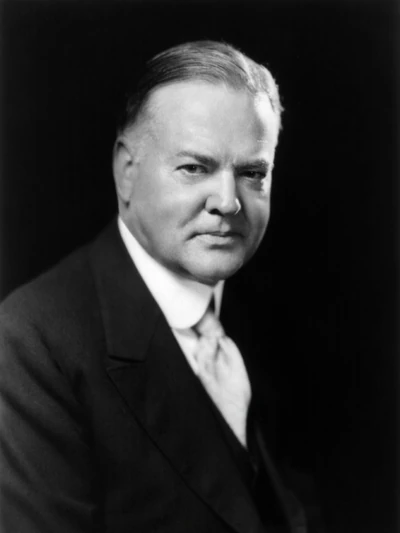
Herbert Hoover
| Name | Herbert Hoover |
| Title | president of the United States from 1929 to 1933 |
| Gender | Male |
| Birthday | 1874-08-10 |
| nationality | United States of America |
| Source | https://www.wikidata.org/wiki/Q35236 |
| pptrace | View Family Tree |
| LastUpdate | 2025-11-17T06:43:42.255Z |
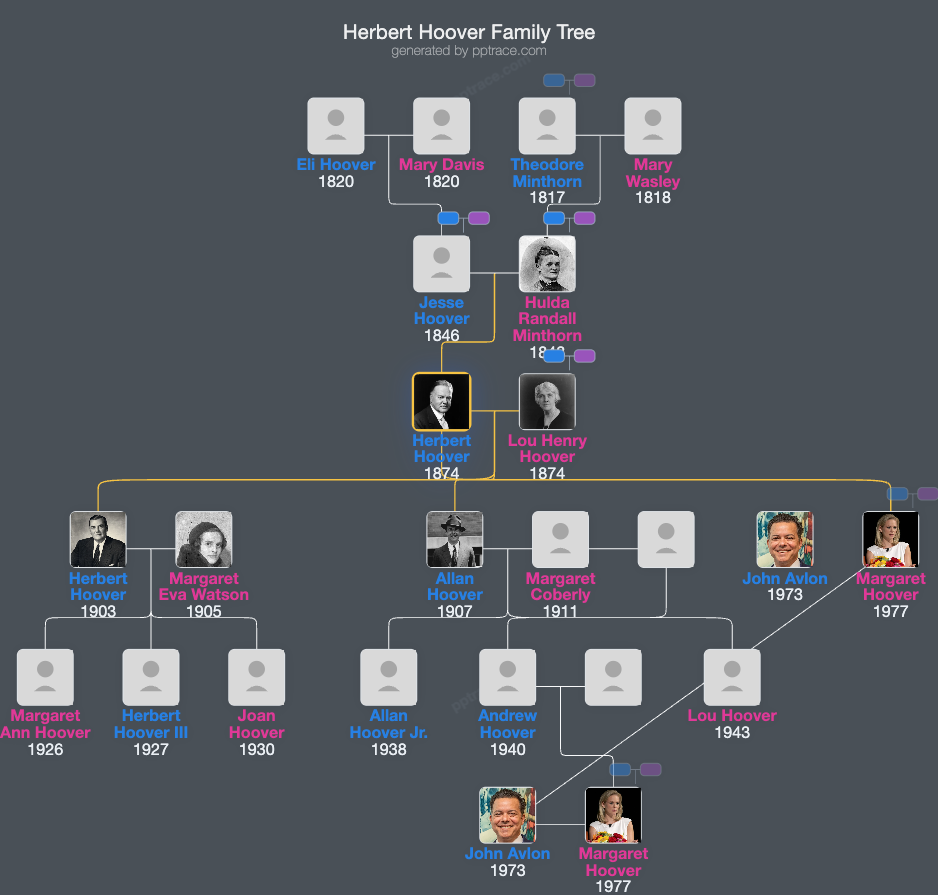
Family Tree
Tap  to expand more relatives
Introduction
Herbert Clark Hoover (August 10, 1874 – October 20, 1964) was an American politician and engineer who served as the 31st president of the United States from 1929 to 1933. He was born in West Branch, Iowa, to Jesse Hoover, a blacksmith and store owner of German, Swiss, and English descent, and Hulda Randall Minthorn, who was raised in Ontario, Canada, before emigrating to Iowa. Hoover's family was of Quaker faith, and his early childhood was marked by the death of his father in 1880 and his mother in 1884, leaving him orphaned. Following their deaths, he lived with relatives in Oregon, first with his uncle Allen Hoover at a farm, and later with his uncle John Minthorn in Newberg, Oregon.
Hoover attended Friends Pacific Academy but dropped out at age thirteen to work as an office assistant for his uncle's real estate business in Salem, Oregon. He later became a night school student, studying bookkeeping, typing, and mathematics. In 1891, he enrolled at Stanford University, part of its inaugural class, with a focus on mechanical engineering before switching to geology. Hoover was considered a mediocre student, participating in campus activities such as the baseball and football teams, and serving as student treasurer.
After graduation in 1895 amid the economic downturn following the Panic of 1893, Hoover worked in various mining jobs before being hired by Bewick, Moreing & Co., a London-based mining company, to work in Western Australia. He managed gold mines in Australia and later in China, becoming a junior partner in the company. His work in the Australian outback was characterized by extensive travel and management of mines, including the Sons of Gwalia mine, which became highly successful.
In 1914, amid growing tensions in Europe, Hoover organized and led the Commission for Relief in Belgium, an international effort to supply food to occupied Belgium during World War I. Following the United States' entry into the war in 1917, President Woodrow Wilson appointed Hoover as head of the Food Administration, where he gained prominence for managing wartime food supplies. After the war, he led the American Relief Administration, which distributed food to millions in Central and Eastern Europe, notably Russia.
Hoover's political career included his service as the Secretary of Commerce under presidents Warren G. Harding and Calvin Coolidge from 1921 to 1928. In this role, he was known for his active involvement in technological advancements such as the development of air travel and radio, and for leading the federal response to the Great Mississippi Flood of 1927. He was the Republican nominee in the 1928 presidential election and won in a landslide against Democratic candidate Al Smith.
As president, Hoover's tenure was dominated by the onset of the Great Depression following the stock market crash of 1929. His policies to address the economic downturn were considered inadequate by many at the time. He was defeated decisively in the 1932 election by Franklin D. Roosevelt. After leaving office, Hoover retired from politics, authoring numerous works and engaging in public service for other presidents, including chairing the Hoover Commission during the 1940s and 1950s. His long retirement lasted over three decades.
Herbert Hoover died on October 20, 1964, in New York City. His legacy includes recognition for his humanitarian work and significant public service, although critics generally assess his presidency as below average among U.S. presidents.