Herbert Hoover, Jr.
| Name | Herbert Hoover, Jr. |
| Title | American politician (1903–1969) |
| Gender | Male |
| Birthday | 1903-08-04 |
| nationality | United States of America |
| Source | https://www.wikidata.org/wiki/Q5734467 |
| pptrace | View Family Tree |
| LastUpdate | 2025-11-17T06:43:44.716Z |
Family Tree
Tap  to expand more relatives
Introduction
Herbert Charles Hoover was born in London on August 4, 1903, to Herbert Clark Hoover and Lou Henry Hoover. His father, an engineer, was working in London at the time, and Hoover was the elder of two sons in the family. Named after his father and maternal grandfather, Charles Delano Henry, he was commonly known as Herbert Hoover Jr. During his childhood, Hoover traveled extensively, having been around the world twice by the age of two. One of his earliest memories involved riding a wagon filled with gold with his father in Australia. His family resided near Stanford University during his upbringing, and he served as a water boy for the Stanford Indians football team.
In 1918, Hoover contracted influenza during the pandemic, which resulted in a lifelong hearing impairment. At age 14, he developed an interest in radio sets. He attended Stanford University, earning a degree in general engineering in 1925. He furthered his education at Harvard Business School, attaining a Master of Business Administration with distinction. Subsequently, he received a fellowship from the Daniel Guggenheim Fund to study aviation economics, focusing on the economics of radio in aviation.
From 1928 to 1930, Hoover was employed by Western Air Express to develop its communications system. He established a network of stations across the western United States for guiding radio-equipped aircraft along extensive airways. He managed a team of 75 engineers and oversaw the procurement of over $200,000 worth of radio equipment. In June 1930, he was promoted to chief engineer of Western Air Express. During this period, he was based in Alhambra, California, but frequently traveled to Los Angeles.
In 1929, Western Air Express, Boeing, and American Airways formed Aeronautical Radio Inc., a non-profit corporation tasked with managing radio communication licensing and coordination within the airline industry. Hoover was selected as the first president of this organization, which led to his appearance on the cover of Time magazine on July 14, 1930.
After leaving Western Air Express, Hoover faced rumors suggesting his career advancement depended more on his family connection than on competence, leading to his resignation. He was diagnosed with tuberculosis in 1931, prompting a period of convalescence at Rapidan Camp and Asheville, North Carolina. Following recovery, he returned briefly to the airline sector and taught business economics at the California Institute of Technology. He and his brother Allan purchased the Herbert Hoover Birthplace.
Hoover shifted his focus to exploration geophysics, pioneering the use of radio in oil prospecting. He founded United Geophysical in 1935, based in Pasadena, California, which by 1939 employed 200 staff working on seismological oil exploration. In 1937, he founded Consolidated Engineering Corporation, manufacturing specialized instruments for geophysical exploration.
During World War II, Hoover was ineligible for military service due to his hearing impairment. In 1943, he advised the Venezuelan government on oil contract negotiations and helped rewrite Venezuela's oil laws. In 1944, the Iranian government hired Hoover's firm to assist in negotiating oil concessions, providing technical estimates on reserves amid competing interests following the Anglo-Soviet invasion of Iran. United Geophysical was later acquired by Union Oil, with Hoover remaining as president until he divested his shares in 1945.
In September 1953, following the Abadan Crisis and the 1953 Iranian coup d'état, President Dwight D. Eisenhower appointed Hoover as a special envoy to Iran to mediate oil disputes. He negotiated a new oil sharing agreement that was finalized in August 1954, increasing Iran's share of profits and revising the ownership structure of the Iranian oil industry.
Subsequently, Eisenhower appointed Hoover as Under Secretary of State, a position he held from October 4, 1954, to February 5, 1957. His tenure was marked by initial criticisms regarding his communication abilities and decisiveness, largely attributed to his hearing loss. During this time, he made two notable decisions: rejecting a Chinese diplomatic overture in April 1955 and delaying the shipment of tanks to Saudi Arabia in 1955 amidst regional tensions.
An amateur radio operator with the call sign W6ZH, Hoover was elected president of the American Radio Relay League in 1962, representing amateur radio interests to the U.S. government.
Herbert Hoover Jr. died on July 9, 1969, at Huntington Memorial Hospital in Pasadena, California, following a stroke experienced three days earlier.
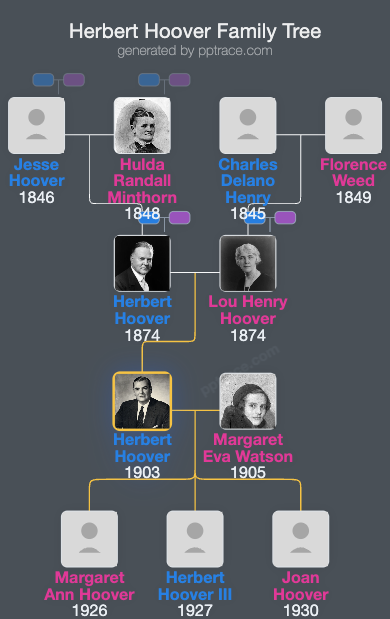
He married Margaret Eva Watson in 1925, and they had three children: Margaret Ann Hoover Brigham (1926–2011), Herbert "Pete" Hoover III (1927–2010), and Joan Leslie Hoover (1930–2002).