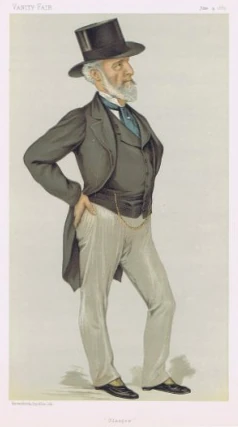
Sir Charles Tennant, 1st Baronet
| Name | Sir Charles Tennant, 1st Baronet |
| Title | British politician |
| Gender | Male |
| Birthday | 1823-11-04 |
| nationality | United Kingdom of Great Britain and Ireland |
| Source | https://www.wikidata.org/wiki/Q7526303 |
| pptrace | View Family Tree |
| LastUpdate | 2025-11-26T23:31:31.500Z |
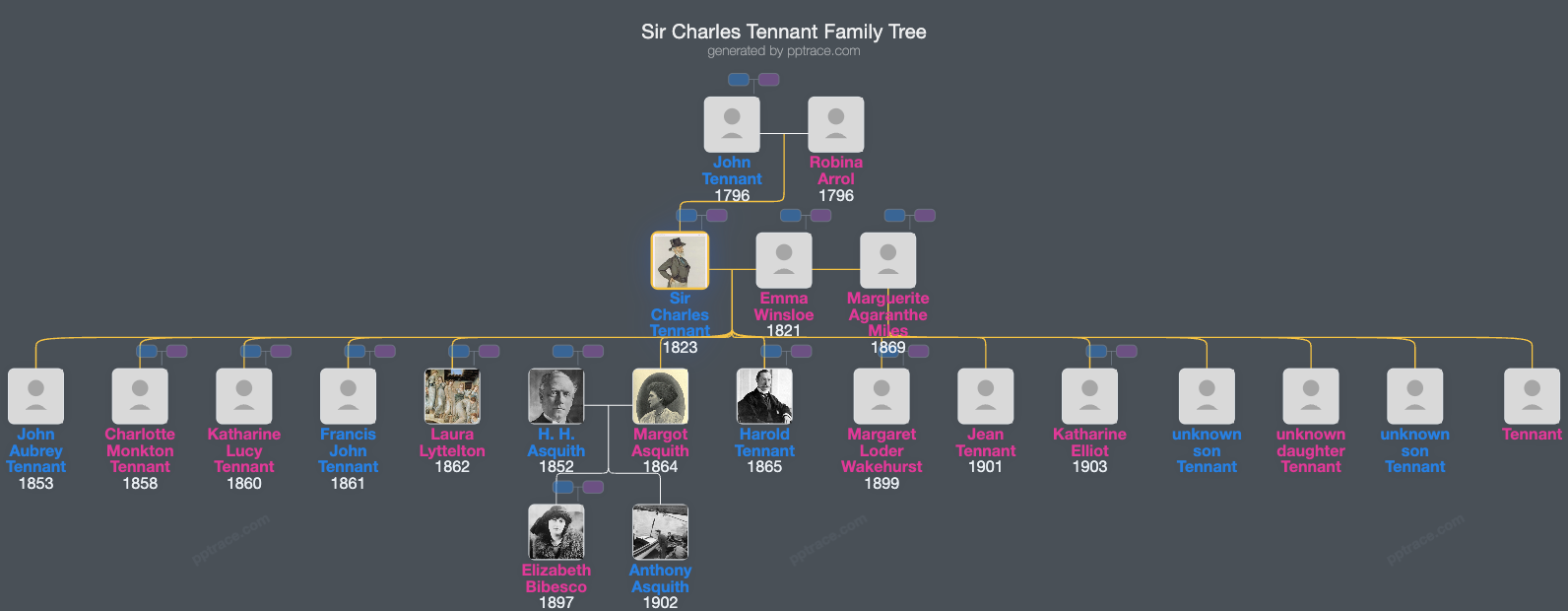
Family Tree
Tap  to expand more relatives
Introduction
Sir Charles Clow Tennant, 1st Baronet (4 November 1823 – 4 June 1906), was a Scottish businessman, industrialist, and politician associated with the Liberal Party. He was born in Scotland to John Tennant (1796–1878) and Robina Arrol Tennant. His paternal grandfather was Charles Tennant, a chemist and industrialist.
In 1843, Tennant began working at the St Rollox chemical works in Glasgow, a business established by his grandfather that produced bleaching powder and other chemicals. Under his involvement, the chemical works grew to become the largest alkali producer in Europe. Tennant's industrial pursuits extended internationally across continents, engaging in sectors such as railways, steel, explosives, copper, sulphur, and merchant banking. He served as President of the United Alkali Company, which later became a foundational part of Imperial Chemical Industries. He also held the position of chairman of the Nobel Explosives Company from 1900 to 1906.
Tennant's financial enterprises included being Chairman of the Union Bank of Scotland and establishing C. Tennant, Sons & Company as a merchant bank in the City of London. His influence in banking furthered his business reach.
In his political career, Tennant served as Member of Parliament for Glasgow from 1879 to 1880 and for Peebles and Selkirk from 1880 to 1886. He unsuccessfully contested the Partick seat in a by-election in 1890. He was appointed an Honorary Colonel of the 4th (Glasgow, 1st Northern) Lanarkshire Rifle Volunteer Corps in 1880. Additionally, he was involved as a Trustee of the National Gallery and was appointed to the Tariff Commission in 1904. In 1885, he was created a baronet. He also held titles such as Justice of the Peace and Deputy Lieutenant.
Tennant was appointed an Honorary Colonel in 1880 and became a member of various organizations related to his industrial and social interests. From 1900 until his death, he was chairman of Nobel Explosives Company.
His personal life included two marriages. In 1849, he married Emma Winsloe (1821–1895), daughter of Richard Winsloe of Mount Nebo, Taunton. In 1852, Tennant purchased The Glen estate in southern Scotland and commissioned architect David Bryce to design a new house, completed in 1855. The couple had eight children, including Pauline Emma "Posie" Tennant, Charlotte Monckton "Charty" Tennant, Edward Priaulx Tennant, Katharine Lucy Tennant, Francis John "Frank" Tennant, Octavia Laura Mary Tennant, Margot Tennant, and Harold John "Jack" Tennant.
After Emma Winsloe's death, Tennant remarried in 1898 to Marguerite Agaranthe Miles (1868–1943), with whom he had four children: Margaret Tennant, Jean Tennant (who died young), Katharine Tennant, and Nancy Tennant. Tennant also purchased the Lady Tennant Stradivarius as a gift for Marguerite.
He died in June 1906 at Broadoaks, Byfleet, Surrey, aged 82. His eldest son, Edward, succeeded him in the baronetcy and was later elevated to the peerage as Baron Glenconner in 1911. His widow, Lady Tennant, died in 1943.
Through his son Francis, he was the grandfather of Kathleen Tennant, who married John Manners, 9th Duke of Rutland, becoming the Duchess of Rutland. His great-granddaughter, Lady Ursula Manners, served as a maid of honor at the coronation of King George VI and Queen Elizabeth in 1937.
His heraldic arms were granted in 1885 and are impaled with those of his daughter Katharine's husband, Walter Elliot, Baron Elliot of Harwood.