John Carteret, 2nd Earl Granville
| Name | John Carteret, 2nd Earl Granville |
| Title | British statesman (1690-1763) |
| Gender | Male |
| Birthday | 1690-04-22 |
| nationality | Great Britain |
| Source | https://www.wikidata.org/wiki/Q335274 |
| pptrace | View Family Tree |
| LastUpdate | 2025-11-26T23:25:13.292Z |
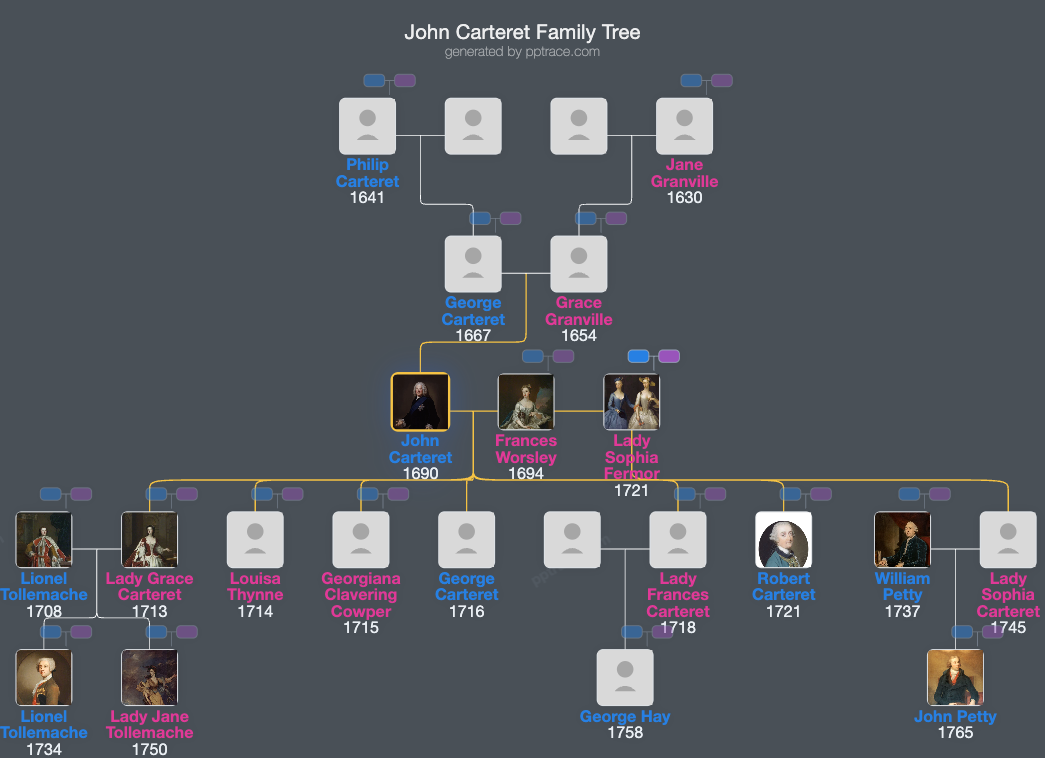
Family Tree
Tap  to expand more relatives
Introduction
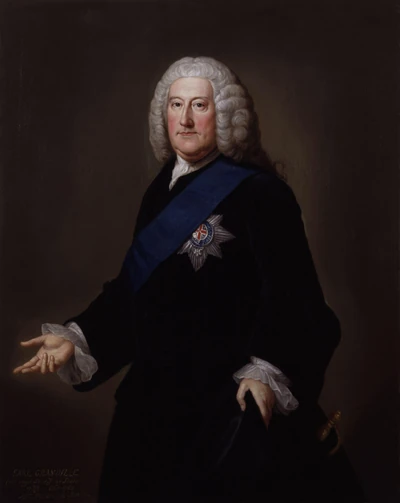
John Carteret, 2nd Earl Granville, born on 22 April 1690 and deceased on 2 January 1763, was a British statesman known for his role as Lord President of the Council from 1751 until his death in 1763. He was also commonly referred to by his earlier title, Lord Carteret. Carteret was involved in various political and diplomatic activities throughout his career, including his tenure as Seigneur of Sark from 1715 to 1720, a title he sold later. He also held (in absentia) the office of Bailiff of Jersey from 1715 to 1763.
**Origins and Family Background**
Carteret was the son and heir of George Carteret, 1st Baron Carteret (1667–1695), and Lady Grace Granville (circa 1677–1744). Lady Grace was the suo jure 1st Countess Granville and the third daughter of John Granville, 1st Earl of Bath (1628–1701) of Stowe House in Kilkhampton, Cornwall. The Carteret family had Norman roots and was largely settled in the Channel Islands. The marriage of George Carteret and Lady Grace produced heirs who became the Barons Carteret, Earls Granville, and Marquesses of Bath (Thynne). The family was also connected through inheritance to the childless nephew William Granville, 3rd Earl of Bath.
**Education**
Carteret was educated at Westminster School and Christ Church, Oxford. His scholarly interests included classical languages and literature, as evidenced by Jonathan Swift’s remark about his extensive knowledge of Greek, Latin, and philosophy. He was also proficient in modern languages, notably German, which facilitated interactions with King George I, who spoke little English.
**Marriage and Family**
On 17 October 1710, Carteret married Frances Worsley at Longleat House. Frances was the daughter of Sir Robert Worsley, 4th Baronet, and Frances Thynne, Lady Worsley. She was the granddaughter of the 1st Viscount Weymouth. They had a daughter, Georgiana Caroline Carteret Spencer, who became the grandmother of Georgiana, Duchess of Devonshire. Carteret’s marriage to Frances Worsley linked him to notable noble families.
**Entry into Politics and Early Career**
Carteret took his seat in the House of Lords on 25 May 1711 at the age of 21. Despite his family’s Jacobite sympathies, he supported the Protestant Hanoverian dynasty. He was an associate of Whig leaders such as Lord Sunderland and the Earl of Townshend, supporting legislation like the Septennial Act.
**Diplomatic Service and European Politics**
In 1719, Carteret was appointed Ambassador to Sweden, a position in which he worked to defend Sweden from attacks by Peter the Great and to facilitate northern peace. His diplomatic efforts involved negotiations with various European leaders including Ulrike Eleonora of Sweden, Frederick IV of Denmark, and Friedrich Wilhelm I of Prussia. His diplomatic career provided him with extensive knowledge of European affairs but was followed by difficulties upon his return to domestic politics.
**Conflict with Walpole and Irish Governorship**
Carteret was appointed Secretary of State for the Southern Department but soon encountered opposition from Robert Walpole, who viewed him unfavorably, partly due to Carteret’s ability to speak German with King George I. In 1724, Carteret was appointed Lord Lieutenant of Ireland, succeeding the Duke of Grafton. His tenure in Ireland, which lasted until 1730, was marked by his handling of opposition to Wood’s halfpence and his response to Swift’s Drapier’s Letters. He was well-regarded by both British and Irish interests and was known for his hospitality.
**American Interests**
Carteret inherited an eighth of the Province of Carolina via his great-grandfather Sir George Carteret. In 1727–28, he learned that the remaining owners planned to sell their shares back to the Crown but declined to participate in the sale. He maintained ownership of his stake, which became the Granville District, a 60-mile wide strip of land in North Carolina. The lands remained under Carteret family ownership until the death of his son Robert in 1776, after which the family was compensated by the Crown for losses following the American Revolution.
**Return to Political Prominence and Later Life**
After returning to London in 1730, Carteret found himself sidelined due to Robert Walpole’s dominance and Queen Caroline’s preference for Walpole. During this period, Carteret engaged in opposition activities in the House of Lords and supported charitable causes, including the establishment of the Foundling Hospital, where he served as a founding governor.
**Secretary of State and European Affairs**
In 1742, Carteret was appointed Secretary of State, largely supporting the interests of Austria and opposing France’s expansion. He participated in notable events such as the Battle of Dettingen in 1743 and worked to mediate between Austria and Prussia. His foreign policy was characterized by efforts to balance European power, though he struggled against the political influence of the Pelham ministry.
**Elevation to Earl Granville and Personal Life**
On 18 October 1744, Carteret succeeded as the 2nd Earl Granville following his mother’s death. His first wife, Lady Frances Worsley, died in 1743; in April 1744, he married Lady Sophia Fermor, the daughter of the Earl of Pomfret. Lady Sophia was known for her beauty and social prominence. They had one daughter, Sophia Carteret, who married William Petty, 2nd Earl of Shelburne. Lady Sophia died on 7 October 1745.
Carteret’s later years were marked by his status as a peer and his participation in political life until his death on 2 January 1763.