Frances Worsley
| Name | Frances Worsley |
| Title | (1694-1743) |
| Gender | Female |
| Birthday | 1694-03-06 |
| nationality | — |
| Source | https://www.wikidata.org/wiki/Q18912511 |
| pptrace | View Family Tree |
| LastUpdate | 2025-11-26T23:25:23.203Z |
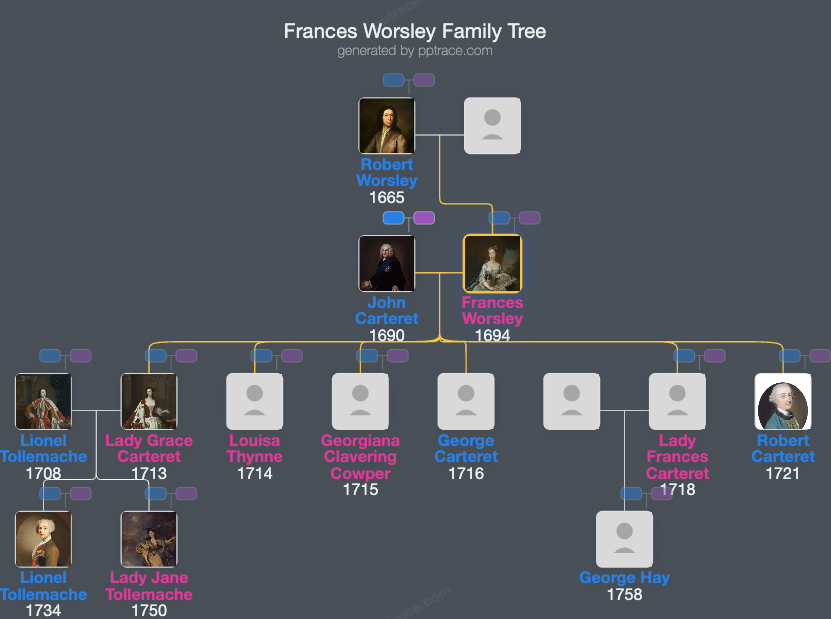
Family Tree
Tap  to expand more relatives
Introduction
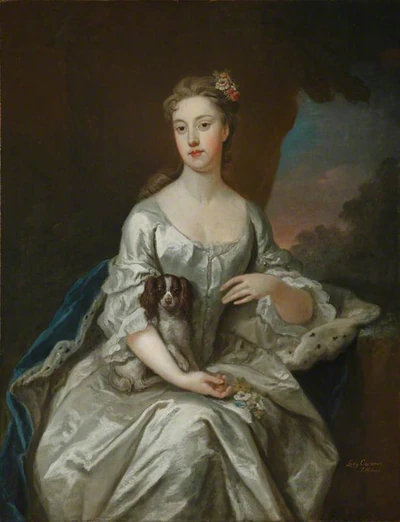
Frances Carteret, Lady Carteret (née Worsley), was born on 6 March 1694. She was the daughter of Sir Robert Worsley, 4th Baronet of Appuldurcombe on the Isle of Wight, and his wife Frances Thynne, daughter of Thomas Thynne, 1st Viscount Weymouth.
On 17 October 1710, at the age of 16, she married John Carteret, who was later known as the 2nd Baron Carteret. The marriage took place at Longleat. Together, they had at least six children: Louisa Carteret (c. 1712–1736), who married Thomas Thynne, 2nd Viscount Weymouth; Grace Carteret (born 1713), who married Lionel Tollemache, 4th Earl of Dysart; Georgiana Caroline Carteret (1715–1780), who married John Spencer MP and subsequently William Clavering-Cowper, 2nd Earl Cowper; George Carteret (born 1716), who predeceased his father; Frances Carteret (born 1718), who married John Hay, 4th Marquess of Tweeddale; and Robert Carteret, 3rd Earl Granville (1721–1776).
In 1724, her husband was appointed Lord Lieutenant of Ireland, and Lady Carteret accompanied him to Ireland. Over the course of the viceregency, which lasted approximately five and a half years, she resided there for thirty months. She demonstrated her political and social engagement by bringing her young daughters to Ireland and accompanying her husband during official visits. During her time at Dublin Castle, she hosted members of different political factions, including parties at the controversy over Wood's halfpence. She expanded the social functions of the viceregal court, adopting practices from the Hanoverian Court and Caroline, Princess of Wales, such as holding regular 'drawing-rooms' twice weekly. These events became central to Irish social life and set a standard for hospitality among the viceregal community.
Lady Carteret was recognized for her beauty, her singing voice, and her role in fostering advantageous marital matches for her daughters. She was also active in the arts, regularly attending musical performances in London and organizing plays and concerts at Dublin Castle. Her patronage extended to literature, with literary works dedicated to her by authors including Jonathan Swift, Patrick Delany, and Thomas Sheridan. She is also the subject of several poems, notably 'Apology to Lady Carteret,' attributed to either Swift or Delany, which references her eyes and social graces. Jonathan Swift described her as "the best queen we have known in Ireland" during her time there.
In 1743, Lady Carteret traveled with her husband to Hanover, Germany, where he was serving as Secretary of State for the Northern Department. During his departure for the Battle of Dettingen, she was taken ill but encouraged him to proceed without her. She died on 20 June 1743 in Hanover.