Harriet Hemings
| Name | Harriet Hemings |
| Title | daughter of Thomas Jefferson and Sally Hemings |
| Gender | Female |
| Birthday | 1801-01-01 |
| nationality | United States of America |
| Source | https://www.wikidata.org/wiki/Q5664155 |
| pptrace | View Family Tree |
| LastUpdate | 2025-11-16T10:02:07.891Z |
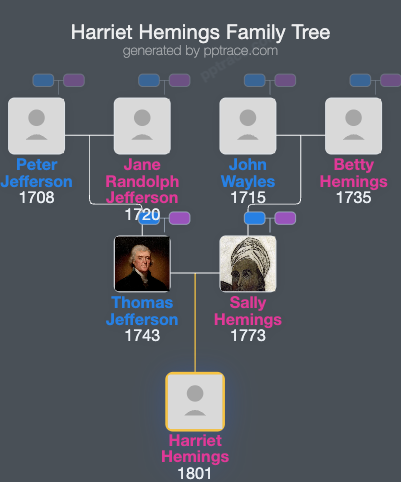
Family Tree
Tap  to expand more relatives
Introduction
Harriet Hemings was born in May 1801 at Monticello, the estate owned by Thomas Jefferson, the third President of the United States. She was born into slavery during Jefferson's presidency, and most historians concur that her father was Jefferson himself, who is believed to have fathered four surviving children with his slave Sally "Sally" Hemings. Harriet's mother was Sally Hemings, who was herself three-quarters European in ancestry and a member of the Hemings family, which was inherited by Jefferson through his marriage to Martha Wayles Skelton Jefferson.
In 1773, Jefferson and Martha Wayles Skelton Jefferson inherited Sally Hemings, her mother Betty Hemings, and ten siblings from Betty's father, John Wayles. The Hemings family was of mixed race, with several generations of interracial relationships within the family. Sally Hemings was the youngest of these siblings, and Harriet Hemings is widely believed to be her daughter, possibly born from a relationship between Sally Hemings and Thomas Jefferson. Some accounts suggest Jefferson's relationship with Hemings began in Paris, where he was serving as a diplomat, and continued in secret for many years.
Harriet had at least two older siblings, William Beverley ("Beverley") Hemings and a younger brother, James Madison Hemings. She spent her childhood with her mother and siblings and was assigned light domestic duties. At about 14 years old, she began training to learn weaving and later worked at a cotton factory on the plantation.
In 1795, Harriet's first known daughter, also named Harriet, was born but died in infancy. Her second child, Harriet, survived into childhood. The name Harriet was commonly used in Jefferson's family for girls who had earlier siblings die. As she reached adulthood, Harriet worked mostly in the cotton factory, performing relatively light duties.
In 1822, at the age of 21, Harriet Hemings left Monticello. Jefferson instructed Edmund Bacon, his overseer, to give her $50 (equivalent to approximately $1,181 in 2024) to aid her journey. Although she was legally a fugitive under Virginia law, Jefferson did not seek her return or issue any notice of escape. Jefferson's actions included facilitating her departure, making her the only female slave he granted freedom during his lifetime. Jefferson's granddaughter, Ellen Randolph Coolidge, later wrote that Jefferson had a policy of permitting nearly white slaves to leave, and she recalled four such cases. However, historical evidence indicates that Jefferson rarely freed slaves, and such instances were exceptions. Bacon privately noted that Harriet was nearly as white as any person and very beautiful, and suggested her freedom was motivated by her apparent kinship with Jefferson, whom Bacon did not believe to be her father.
Jefferson indirectly and directly freed the four Hemings children upon reaching the age of 21: Beverley and Harriet in 1822, and Madison and Eston in his 1826 will. Jefferson's will marked the only occasion where he freed all members of a slave family from Monticello, though some of Sally Hemings' relatives, including Robert and James Hemings and others, were granted freedom earlier, often during Jefferson's lifetime.
After leaving Monticello, Harriet is believed to have traveled to Washington, D.C., to join her brother Beverley Hemings, who had previously moved there. Madison Hemings, her brother, later recounted in a memoir published in 1873 that Harriet and Beverley married and had families there. Madison also indicated that Harriet lived in Maryland later in life. Meanwhile, her brothers Madison and Eston Hemings moved to Chillicothe, Ohio, after their mother's death in 1835, and married and started families in that region.
The Jefferson-Hemings controversy concerns whether Thomas Jefferson had an intimate relationship with Sally Hemings, resulting in the birth of multiple children. Resolutions of this question have involved historical research and DNA analysis; a 1998 DNA test suggested Jefferson was likely the father of Hemings' children, though some critics dispute this conclusion. The Thomas Jefferson Foundation and other scholarly organizations have generally accepted Jefferson's paternity of Sally Hemings' children based on prevailing and emerging evidence.
Harriet Hemings' life after her departure from Monticello remains only partially documented. She was alive after 1822, but details of her subsequent life, including her activities and date of death, are not well recorded.