Madison Hemings
| Name | Madison Hemings |
| Title | American freed slave, son of Thomas Jefferson and Sally Hemings (1805-1877) |
| Gender | Male |
| Birthday | 1805-01-18 |
| nationality | United States of America |
| Source | https://www.wikidata.org/wiki/Q11239932 |
| pptrace | View Family Tree |
| LastUpdate | 2025-11-16T10:02:02.252Z |
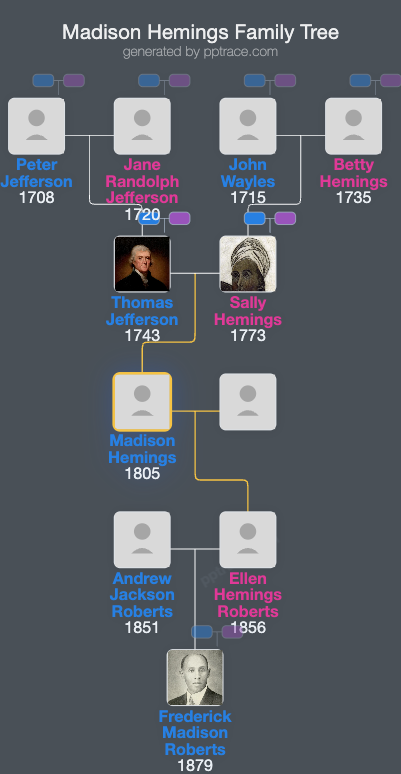
Family Tree
Tap  to expand more relatives
Introduction
Madison Hemings was born on January 19, 1805, at Monticello, the estate of Thomas Jefferson. His mother was Sally Hemings, an enslaved woman of mixed racial heritage, and his father was Thomas Jefferson, the third President of the United States. Sally Hemings was inherited by Martha Wayles Skelton Jefferson, Thomas Jefferson's wife, and was related through both maternal and paternal lines, with her father being John Wayles. Sally Hemings and Martha Wayles Skelton were half-sisters, both children of John Wayles.
Hemings was part of an enslaved family at Monticello, where he was initially assigned light duties as a child. Around the age of 14, he became an apprentice in carpentry and fine woodworking, working in the joiner's shop until approximately age 21. He learned to play the violin and engaged in growing cabbages as a means of earning additional income. During his childhood, Hemings and his siblings lived in proximity to the main house, with some school attendance and limited interaction with the white community, benefiting from their relatively lighter skin and appearance.
According to Hemings’ memoir and historical accounts, his mother Sally Hemings told him that Thomas Jefferson was his father, and that their relationship began in Paris, where Jefferson was serving as a diplomat from 1784 to 1789. Sally Hemings returned to Monticello with Jefferson and remained there as a domestic servant and chambermaid. Her living quarters, built in 1809 near Jefferson's bedroom, provided a higher level of comfort than many other enslaved people’s accommodations.
Hemings grew up with siblings Beverly, Harriet, and Eston. His family was listed alongside Sally's in Jefferson’s Farm Book in 1810. Hemings' children were noted to be fair-skinned and bore notable resemblance to Jefferson. Jefferson’s grandchildren were unaware of the children’s paternity. Hemings selectively learned to read and write, partially self-taught, and by his teenage years, he was apprenticed to his uncle John Hemings in carpentry, working at Monticello and nearby plantations like Poplar Forest.
Thomas Jefferson’s death in 1826 led to the emancipation of Hemings and his younger brother Eston, under the terms specified in Jefferson’s will. Hemings and Eston were freed in 1827, with the stipulation that they, along with their mother Sally Hemings and a fellow freedman, Joseph Fossett, could remain in Virginia if they petitioned the legislature. Sally Hemings was not formally emancipated but was "given her time" by Jefferson’s daughter Martha Jefferson Randolph, who was also a relative.
Following their emancipation, Hemings and Eston moved to Chillicothe, Ohio, a free state with a significant Black community and abolitionist activity. Hemings married Mary Hughes McCoy, a free woman of mixed racial ancestry, on November 21, 1831. The couple had at least one child, Sarah. In 1836, Madison Hemings, his wife, and their daughter moved to Pike County, Ohio, where Hemings purchased land and worked as a farmer and carpenter. Hemings' brother Eston and their family also relocated to Ohio.
Hemings and his family continued to live in Ohio for the remainder of their lives. Hemings died on November 28, 1877. His descendants included Frederick Madison Roberts, who served nearly two decades in the California legislature as the first African American elected to office on the West Coast. In 2010, a descendant, Shay Banks-Young, along with other Jefferson descendants, received an international award for efforts in building bridges between different communities and healing the legacy of slavery through initiatives such as "The Monticello Community."