Ōkubo Toshimichi
| Name | Ōkubo Toshimichi |
| Title | one of the three great nobles who led the Meiji Restoration, regarded as one of the main founders of modern Japan (1830-1878) |
| Gender | Male |
| Birthday | 1830-09-26 |
| nationality | Japan |
| Source | https://www.wikidata.org/wiki/Q356118 |
| pptrace | View Family Tree |
| LastUpdate | 2025-11-17T06:47:04.849Z |
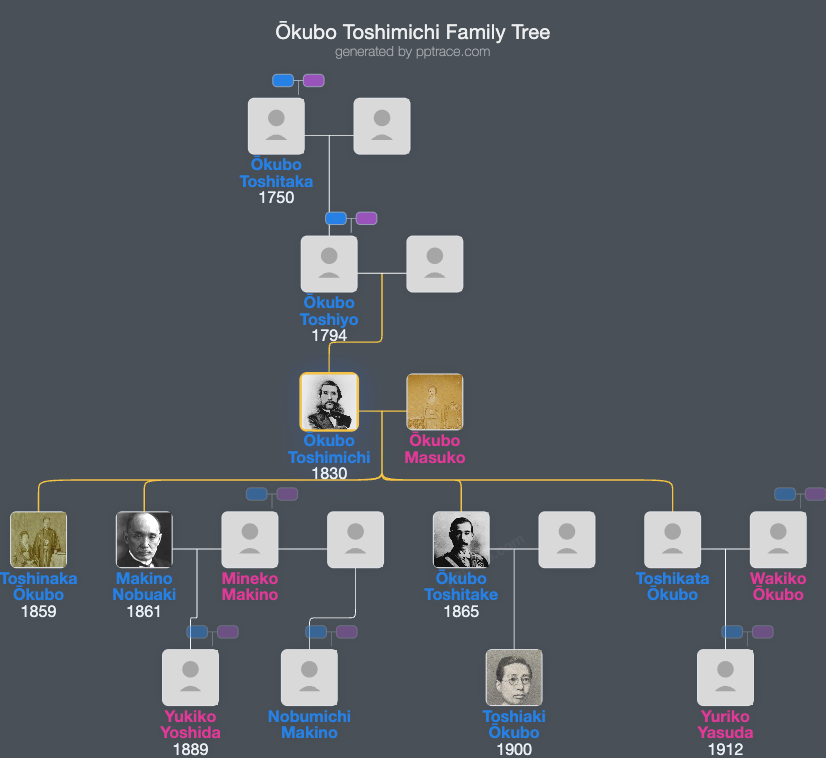
Family Tree
Tap  to expand more relatives
Introduction
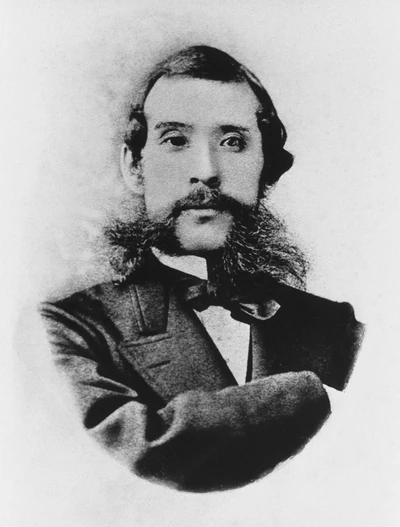
Ōkubo Toshimichi (大久保 利通) was born on 26 September 1830 in Kagoshima, within the Satsuma Domain of Japan. His family belonged to the samurai class; his father was Ōkubo Jūemon, a low-ranking samurai with minimal income. His mother’s family, Minayoshi Hōtoku, was a physician knowledgeable of Western science and maritime affairs. Ōkubo was raised in accordance with samurai traditions, receiving early education through local associations and han-operated institutions. He studied Confucian classics, Japanese history, and literature, and trained in martial arts such as jūjutsu and spear fighting, though his frail physique limited his physical pursuits.
At age sixteen, Ōkubo obtained a position as kakiyakujo in the Satsuma archives. His early years were marked by involvement in political conflicts within the Satsuma han, notably the Takasaki Uprising of 1849, which resulted in his brief arrest and family hardship. Despite this, the family’s fortunes improved under the leadership of Shimazu Nariakira in 1851, who initiated reforms and pursued Western learning. Nariakira recognized Ōkubo’s talents, and he was reassigned to the han’s archives in 1853. He gained further standing with promotions to inspector and manager of tribute rice.
Following Nariakira’s death in 1858, Ōkubo’s career stagnated temporarily, but he remained committed to reformist ideas. During this period, he and Saigō Takamori, his childhood friend, studied Zen Buddhism and Western philosophy, nurturing their intellectual development. In 1858, Ōkubo was pardoned and resumed official duties, resuming participation in the political environment of Satsuma.
By 1859, Ōkubo was involved in the plans of Satsuma reformists to challenge Tokugawa authority, advocating for strong internal reform and preparation for eventual military action. He initially favored patience and strategic planning, emphasizing diplomatic maneuvering over immediate rebellion. The assassination of Ii Naosuke in 1860 intensified the political turmoil. Ōkubo leveraged his influence to promote regional reforms, including the abolition of outer castles and the centralization of Satsuma’s power.
In 1862, he played a key role in orchestrating Satsuma’s military and political strategies to influence the imperial court and the shogunate. During this period, he experienced a growing rift with Saigō Takamori over differing approaches toward revolution and reform. Ōkubo prioritized moderation and diplomatic engagement, working closely with his clan leader, Hisamitsu, to secure imperial mandates for restructuring the Bakufu (Tokugawa government).
Following the Meiji Restoration of 1868, Ōkubo became a prominent leader in the new government, serving as a junior councilor and later in essential ministerial roles. His contributions included the abolition of the han system in 1871, which replaced domain-based governance with a centralized state under Tokyo. He was part of the Iwakura Mission (1871–1873), touring the United States and Europe to observe Western systems of government and modernization efforts. This experience reinforced his focus on internal reform before engaging in foreign policy initiatives.
After returning to Japan, Ōkubo opposed the invasion of Korea proposed during the Seikanron debate in 1873, a stance that precipitated a political split with Saigō Takamori. He subsequently became Home Minister in November 1873 and consolidated leadership within the Meiji oligarchy. As Home Minister, he directed state-led industrialization policies and suppressed uprisings by disaffected samurai.
On 14 May 1878, Ōkubo was assassinated by disaffected samurai who accused him of tyranny. His death marked a significant event during the early Meiji period. Historically, Ōkubo is recognized for his political acumen and role in transforming Japan from a feudal society into a modern, industrialized nation.