Makino Nobuaki
| Name | Makino Nobuaki |
| Title | Japanese politician (1861-1949) |
| Gender | Male |
| Birthday | 1861-11-24 |
| nationality | Japan |
| Source | https://www.wikidata.org/wiki/Q920993 |
| pptrace | View Family Tree |
| LastUpdate | 2025-11-17T06:47:03.004Z |
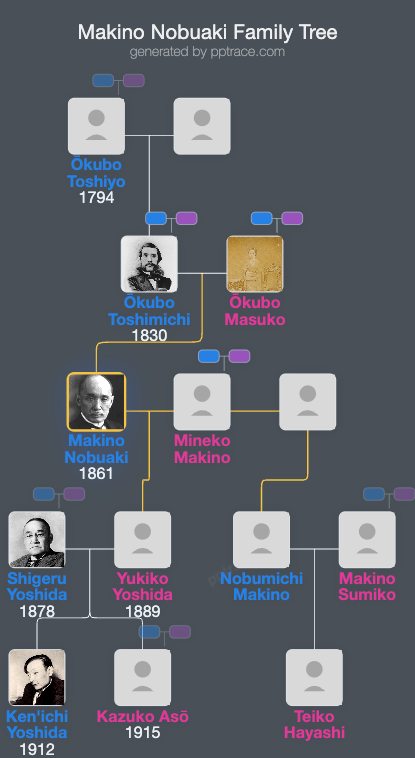
Family Tree
Tap  to expand more relatives
Introduction
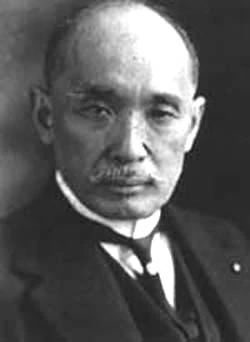
Count Makino Nobuaki (牧野 伸顕; November 24, 1861 – January 25, 1949) was a Japanese politician and imperial court official. He served as Lord Keeper of the Privy Seal of Japan and was a key counselor regarding the emperor’s role in society and policymaking.
Born in Kagoshima Prefecture, Japan, Makino was the second son of Ōkubo Toshimichi, a prominent figure in the Meiji Restoration. Early in his life, he was part of the Iwakura Mission to the United States in 1871 at the age of 11, during which he briefly attended school in Philadelphia. After returning to Japan, Makino attended Tokyo Imperial University but did not graduate.
Makino’s career began with diplomatic assignments, including postings at the Japanese Embassy in London, where he became acquainted with Itō Hirobumi. He served as governor of Fukui Prefecture from 1891 to 1892 and Ibaraki Prefecture from 1892 to 1893. He later held ambassadorial positions in Italy (1897–1899), Austria-Hungary, and Switzerland.
In domestic politics, Makino was appointed Minister of Education in March 1906 under Prime Minister Saionji Kinmochi and was elevated to the peerage as a baron (danshaku) under the kazoku system. When Saionji became Prime Minister for the second time in August 1911, Makino served as Minister of Agriculture and Commerce and was appointed to the Privy Council.
Makino was closely aligned with Itō Hirobumi and Saionji Kinmochi and was associated with early liberal movements within Japan. Following World War I, he was appointed as one of Japan’s plenipotentiary representatives to the 1919 Paris Peace Conference, where he and others presented the Racial Equality Proposal. Although the proposal received the majority of votes, it was vetoed by U.S. President Woodrow Wilson.
In 1920, Makino was honored with the Grand Cordon of the Order of the Rising Sun with Paulownia Flowers. In February 1921, he was appointed Imperial Household Minister and was elevated to viscount (shishaku). During this period, he worked to improve Japan’s relations with Britain and the United States and aimed to shield the emperor from direct political involvement, a policy that has been considered to have inadvertently contributed to militarization trends.
In 1925, Makino became Lord Keeper of the Privy Seal of Japan, a position he held until 1935. He supported the establishment of the Golden Pheasant Academy in 1927 and oversaw the 1928 enthronement ceremony of Emperor Hirohito. His residence was attacked during the May 15 Incident in 1932 by ultra-nationalist forces, but he was unharmed.
Makino retired from his official positions in 1935, receiving an elevation in rank to count (hakushaku). Despite retirement, he maintained influence behind the scenes and remained a close advisor to Emperor Hirohito until the outbreak of World War II. He narrowly avoided assassination during the February 26 Incident in 1936.
He was also the first president of the Nihon Ki-in Go Society and was an avid player of the game of go. After World War II, his reputation as an liberalist was recognized, and politician Ichirō Hatoyama attempted to recruit him as party chairman, an offer he declined due to health reasons. Makino died in 1949; his grave is located at Aoyama Cemetery in Tokyo.
His family included notable figures such as his son-in-law Shigeru Yoshida, a post-war Prime Minister; his grandson Ken'ichi Yoshida, a literary scholar; and his great-grandson Taro Aso, who served as Prime Minister of Japan. His great-granddaughter Nobuko Asō married Prince Tomohito of Mikasa, a cousin of Emperor Akihito.
Makino received various honors over his lifetime, including the Grand Cordon of the Order of Leopold in 1925 and the Grand Cross of the Order of the White Lion in 1930.