Ōkubo Toshiyo
| Name | Ōkubo Toshiyo |
| Title | (1794-1863) |
| Gender | Male |
| Birthday | 1794-12-11 |
| nationality | Japan |
| Source | https://www.wikidata.org/wiki/Q11431922 |
| pptrace | View Family Tree |
| LastUpdate | 2025-11-16T10:34:15.646Z |
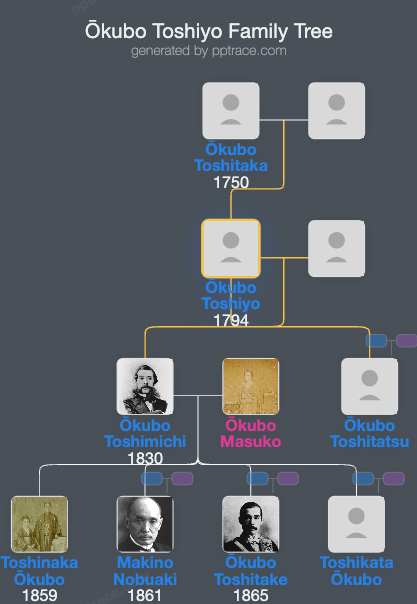
Family Tree
Tap  to expand more relatives
Introduction
Toshiyo Okubo was a samurai of the Satsuma Domain during the late Edo period and the father of Toshu Okubo. His social rank belonged to the category of minor officials (kozuke-yō). His life began in Korie-machi, Kagoshima Castle Town, Satsuma Province (present-day Korie-machi, Kagoshima City, Kagoshima Prefecture).
In 1821 (Bunsei 4), he inherited his family headship as the adopted son of his elder brother, Toshitaka Okubo. The following year, in May of 1827 (Bunsei 10), he was appointed as an assistant governor on Chōkō Eniwa Island and stayed there. He returned to Kagoshima on April 17, 1829, upon completion of his term. On April 26, 1837 (Tempō 8), he was once again appointed as an assistant on Eniwa Island and traveled there repeatedly.
Records indicate that he resided in Korie-machi until 1842. Afterward, he moved into quarters within the Ryukyu Hall (Ryūkyū-kan), as he was assigned to serve there. Around this time, his young eldest son, Toshu, was entrusted to his sister-in-law's house (wife of his late brother Toshitaka) in Shimo-Kajiya-machi. This was likely due to the household being composed solely of women, necessitating local educational support at the community level.
In 1849, while serving as an assistant at Ryūkyū-kan, he was involved in the Yura disturbance (Takasaki collapse), and the following year, he was exiled to Kikai Island. As a result, Toshu, at just 20 years old, lost his position, and the family fell into poverty. During this period, they borrowed money from relatives and neighbors to survive. Toshiyo was essentially exiled to the islands for about five years. In July of 1854 (Ansei 1), he was pardoned, and when he returned to Kagoshima in February 1855, he was physically aged and had white hair, appearing quite old.
He died in 1863 (Bunkyū 3) at the age of 70.
Regarding his family: his father was Toshitaka Okubo, and his brothers included Toshitaka and Jirozaemon. His wife was Minayoshi Fuku, the second daughter of Minayoshi Hōtoku. She supported her imprisoned husband and engaged in household crafts to help sustain the family.
His children included his eldest son, Toshu Okubo; his eldest daughter, Naka Nii (married to Tatsuō Nii); his second daughter, Kichi Ishihara (wife of the Satsuma samurai Kanemasa Ishihara); his third daughter, Suma Yamada (wife of the Satsuma samurai Yūyō Yamada); and his fourth daughter, Mine Ishihara (wife of the Satsuma samurai Kōgi Ishihara). Additionally, he had children with a woman from Kikai Island named Fude and with another wife who was the wife of Masa Teru Tsuchimochi.
Concerning his landholdings, the house of Jiuemon Okubo (次右衛門) in 1840 (Tempō 13), described in the “Kagoshima Castle Town Map Walk,” was located at present-day 7 Korie-machi, Kagoshima City, with an area of about 150 tsubo (approximately 495 square meters). Meanwhile, the residences of Ryūemon Saigo in Kajiya-machi and Yoshizaemon Tōgō were 259 and 267 tsubo, respectively.
Regarding his physique, “The Biography of Toshiyuki Okubo (Upper Volume)” notes that, “He was not tall or large of build, but rather quite corpulent, with a fair complexion, and indeed a strikingly sturdy and masculine appearance.” He was devout in his faith in gods and Buddha, associated with martial men, and well-versed in Yangming philosophy and Zen studies. It is also reported that he enjoyed sumo wrestling.
However, it is also said that his educational approach towards his children was somewhat permissive, as he did not often discipline them strictly, tending towards a lenient style of upbringing.