Robert Dundas
| Name | Robert Dundas |
| Title | Scottish judge (1713-1787) |
| Gender | Male |
| Birthday | 1713-07-18 |
| nationality | Scotland |
| Source | https://www.wikidata.org/wiki/Q3938260 |
| pptrace | View Family Tree |
| LastUpdate | 2025-11-26T23:26:46.343Z |
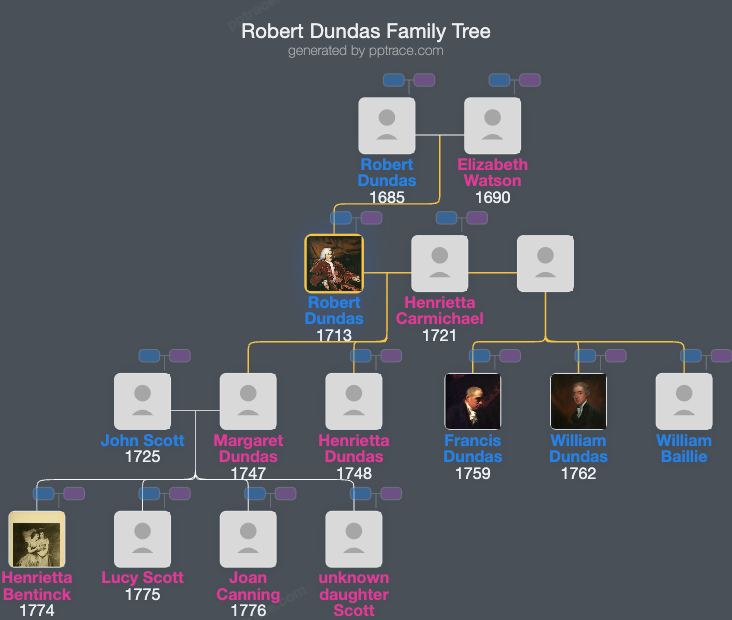
Family Tree
Tap  to expand more relatives
Introduction
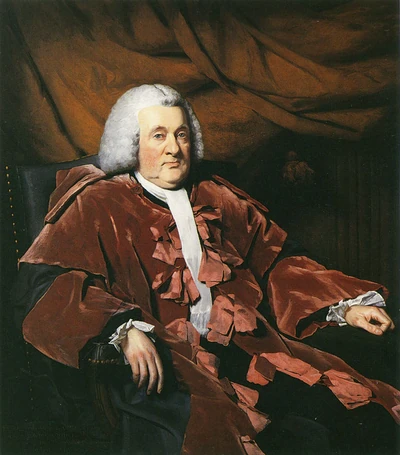
Robert Dundas of Arniston, the younger, was born on 18 July 1713 and died on 13 December 1787. He was a Scottish legal and political figure known for his roles within the Scottish judiciary and government institutions during the 18th century.
Dundas was the eldest son of Robert Dundas of Arniston (1685–1753), who served as Lord President of the Court of Session, and Elizabeth Watson, his first wife. His familial lineage was prominent within Scottish legal and political circles; his great-grandfather James Dundas, Lord Arniston (died 1679), and grandfather Robert Dundas, Lord Arniston (died 1726), both served as Members of Parliament and judges. His father also held the position of Lord President of the Court of Session.
Educationally, Dundas was initially instructed at home and attended school before enrolling at the University of Edinburgh. In 1733, he continued his studies at Utrecht University, which was renowned for Roman law instruction, and also traveled to Paris. He returned to Scotland in 1737 and was admitted to the Scottish bar as an advocate in 1738.
Dundas was characterized as quick-witted, resourceful, and eloquent, with a notable memory, though he reportedly did not extensively read after college. He was primarily ambitious to achieve a judicial appointment, leading him to selectively accept cases that advanced his career objectives. His early income from legal fees was modest, averaging approximately £280 annually over his first five years.
In 1742, Dundas was appointed Solicitor General for Scotland, a position he held through the Jacobite uprising of 1745. His appointment was facilitated by the Carteret administration, and he maintained his role during politically tumultuous times. In 1746, he resigned due to difficulties working with Lord Milton, the Lord Justice Clerk, but was immediately elected dean of the faculty of advocates.
On 16 August 1754, Dundas was appointed Lord Advocate, concurrent with his election as Member of Parliament for Midlothian on 25 April 1754, an unopposed electoral victory. During his parliamentary tenure, he opposed the establishment of a Scottish militia and was involved in addressing Highland affairs, among other responsibilities related to his political office. He is recorded to have made at least one notable speech in Parliament.
In 1755, Dundas was appointed a commissioner of fisheries. On 14 June 1760, he succeeded Robert Craigie as Lord President of the Court of Session. As Lord President, Dundas addressed accumulated case arrears and managed the court effectively, earning a reputation as an efficient and thorough jurist. He was decisive in judgments and protected the court’s dignity, calling upon his colleagues’ faculties to uphold judicial standards.
Dundas is notably remembered for casting the deciding vote in the Douglas peerage case on 7 July 1767 against claimant Archibald Stewart. This decision led to his unpopularity, and following the House of Lords’ reversal of the judgment on 2 March 1769, he faced public hostility, including insults and an attack on his residence during celebrations in Edinburgh.
In his later years, Dundas experienced declining eyesight. He died after a brief illness at his residence in Adam’s Square and was interred at Borthwick on 18 December 1787. His tomb, located within Borthwick Church within the Arniston Aisle, was sculpted by John Bacon of London.
Regarding his family, Dundas married twice. His first wife was Henrietta Baillie, daughter of Sir James Carmichael Baillie of Lamington and Bonnytoun; they married on 17 October 1741 and she died on 3 May 1755. His second wife was Jean Grant, daughter of William Grant, Lord Prestongrange, whom he married in September 1756. He had four daughters with his first wife, including Elizabeth, who married Sir John Lockhart-Ross, 6th Baronet. With his second wife, he fathered four sons—Robert (who became Lord Advocate), Francis, William, and Philip—and two daughters. His sons pursued notable careers in military, legal, political, and colonial administrative fields.