Robert Dundas
| Name | Robert Dundas |
| Title | Scottish judge (1685-1753) |
| Gender | Male |
| Birthday | 1685-01-01 |
| nationality | Scotland |
| Source | https://www.wikidata.org/wiki/Q3938258 |
| pptrace | View Family Tree |
| LastUpdate | 2025-11-26T12:34:50.881Z |
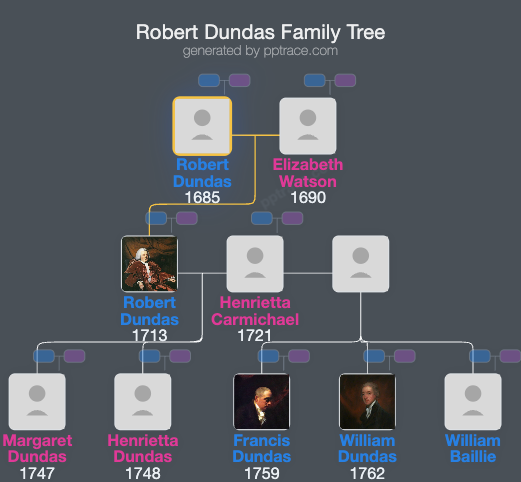
Family Tree
Tap  to expand more relatives
Introduction
Robert Dundas of Arniston, the elder, 2nd Lord Arniston (born December 9, 1685 – died August 26, 1753), was a Scottish lawyer and politician. His career included service in the House of Commons and later as Lord President of the Court of Session.
Early Life and Education:
Dundas was born in Edinburgh as the second son of Robert Dundas, Lord Arniston, a judge of the Court of Session, and Margaret Sinclair, daughter of Sir Robert Sinclair of Stevenson. The family resided at a house located at the head of Old Fishmarket Close on the Royal Mile, Edinburgh—an area later destroyed in the Great Fire of Edinburgh. Around 1700, Dundas was educated in Utrecht. He was admitted to the Faculty of Advocates on July 26, 1709, establishing himself as a capable lawyer.
Legal and Political Career:
By 1717, Dundas was appointed Assessor to the city of Edinburgh and served as Solicitor General for Scotland, appointed by the Duke of Roxburghe, the secretary of state and head of the Squadrone. He found this position unsatisfactory and sought a judicial appointment in 1718 but was unsuccessful. In 1720, he was promoted to Lord Advocate, succeeding Sir David Dalrymple.
On December 9, 1721, Dundas became dean of the Faculty of Advocates. That same year, he resigned as assessor to Edinburgh, leading to a notable correspondence with the city’s magistrates. In the 1722 general election, he was elected Member of Parliament (MP) for Edinburghshire.
As an MP, Dundas was known for his opposition to the malt-tax introduced by the government during Robert Walpole's administration. He represented Edinburghshire unopposed in the 1727 and 1734 elections. Dundas took active stances against government policies, including advocating for reforms in Scottish judicial procedures and opposing abuses related to elections.
In 1726, Dundas commissioned William Adam to design Arniston House near Edinburgh, which served as his family residence. He also participated in debates such as the Dunkirk debate in 1730 and was involved in initiatives to improve Scottish judicial authority.
Judicial Appointment and Later Life:
On May 5, 1735, Dundas was involved in passing a bill aimed at preventing wrongful imprisonment related to voting rights, although this bill was ultimately rejected by the House of Lords. On June 10, 1737, he was appointed a judge of the Court of Session, succeeding Sir Walter Pringle of Newhall, and vacated his seat in Parliament.
In 1748, after considerations regarding retirement, Dundas succeeded Duncan Forbes of Culloden as Lord President of the Court of Session, a position he held until his death. His residence during this period was a mansion on Fishmarket Close, previously owned by George Heriot.
Dundas died at Abbey Hill, Edinburgh, on August 26, 1753, and was buried in the family tomb at Borthwick Parish Church.
Most Famous Case:
One notable case involved Dundas's defense of James Carnegie of Finhaven in 1728 during his trial for the murder of Charles, Earl of Strathmore. Carnegie had killed Strathmore in a drunken brawl, mistaking him for another individual. Dundas argued for the reversion to an older legal practice allowing juries to find defendants guilty or not guilty, rather than solely based on proven or not proven facts. The jury ultimately found Carnegie not guilty, and this case influenced subsequent legal procedures.
Family:
Dundas was married twice. His first marriage was in 1712 to Elizabeth Watson, daughter of Robert Watson of Muirhouse, who perished with four of her children in January 1734 due to smallpox. They had a son, Robert Dundas, who later became Lord President, and other children. His second marriage was on June 3, 1734, to Anne Gordon, daughter of Sir William Gordon, bart., of Invergordon. They had five sons and one daughter. Among his children were Henry Dundas, 1st Viscount Melville, who served as Treasurer of the Navy, and a daughter who married Adam Duncan, 1st Viscount Duncan.
References:
This biographical account incorporates information from the 1888 publication by J. A. Hamilton in the Dictionary of National Biography, with additional references to Omond's *Arniston Memoirs* (1887), State Trials, and various historical records.