Francis Dundas
| Name | Francis Dundas |
| Title | British Army general (1759-1824) |
| Gender | Male |
| Birthday | 1759-01-01 |
| nationality | United Kingdom of Great Britain and Ireland |
| Source | https://www.wikidata.org/wiki/Q971482 |
| pptrace | View Family Tree |
| LastUpdate | 2025-11-26T23:26:47.245Z |
Family Tree
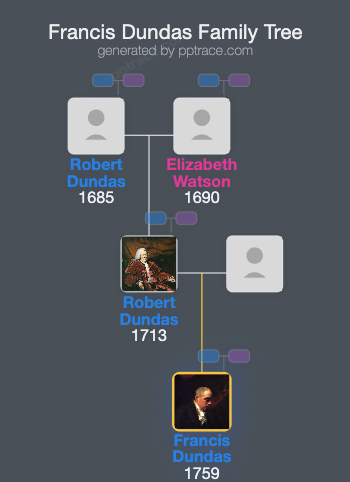
Tap  to expand more relatives
Introduction
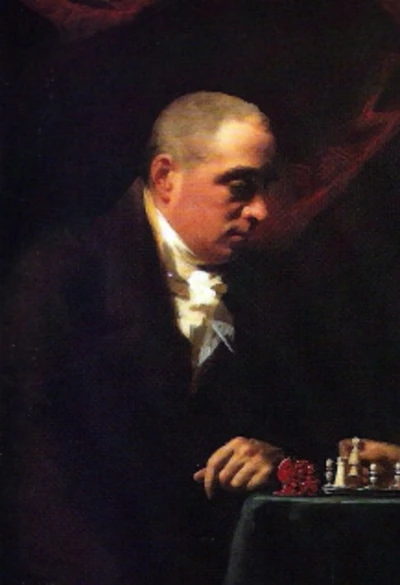
General Francis Dundas (circa 1759 – 15 January 1824) was a British Army officer and colonial administrator. He served as the acting governor of the Cape Colony on two occasions: from November 1798 to December 1799 and from April 1801 to February 1803. Dundas was the second son of Robert Dundas of Arniston, the younger, and was related to Henry Dundas, serving as his nephew.
Dundas began his military career when he was commissioned into the 1st Foot Guards in 1775. He later transferred to the 45th Foot in 1783 and rejoined the 1st Foot in 1787. During the American Revolutionary War, he served under General Cornwallis, participating in the Battle of Clapp's Mills, the Battle of Green Spring, and the Siege of Yorktown. In 1796, Dundas commanded the Scots Brigade, which later became the 94th Foot, encamped at West Barns, and was succeeded in this position by General Hill.
In August 1796, Dundas was ordered to the Cape of Good Hope following the initial British occupation of the colony. He was appointed major-general and became the commander of forces there in May 1797. During his time in the Cape Colony, he served as acting governor during two periods: from 21 November 1798 to 9 December 1799, and from 20 April 1801 to 20 February 1803. His administration coincided with significant events such as the Graaff Reinet Revolt of 1798 and the Third Frontier War. His governance was characterized as autocratic but viewed as fair by contemporaries. The Cape Colony was returned to the Batavian Republic on 20 February 1803, in accordance with the Treaty of Amiens signed in March 1802.
After his service in the Cape, Dundas held several notable military appointments within Britain. He commanded the Kent division of the army assembled on England’s south coast during the invasion scare of 1804-1805, under the command of Sir David Dundas. Dundas received promotion to full general on 1 January 1812. From 1809, he served as Colonel of the 71st (Glasgow Highland Light Infantry) Regiment of Foot.
In 1819, Dundas was appointed Governor of Dumbarton Castle. He died at his residence, 11 Shandwick Place, near Princes Street in Edinburgh, on 4 January 1824.
Regarding his family, Francis Dundas was married to Eliza Cumming, daughter of Sir John Cumming, Baronet, on 22 January 1800 at the Chaplaincy to the British Forces in Cape Town. Their children included Francis Dundas (born 16 January 1801 in Cape Town), Robert Dundas (born 3 November 1805 in Berwick on Tweed), Caroline Dundas, Wedderburn Dundas, Henrietta Dundas, and Alexander Dundas.