Jesse Hoover
| Name | Jesse Hoover |
| Title | father of U.S. president Herbert Hoover (1846-1880) |
| Gender | Male |
| Birthday | 1846-09-02 |
| nationality | United States of America |
| Source | https://www.wikidata.org/wiki/Q20767981 |
| pptrace | View Family Tree |
| LastUpdate | 2025-11-16T10:25:05.702Z |
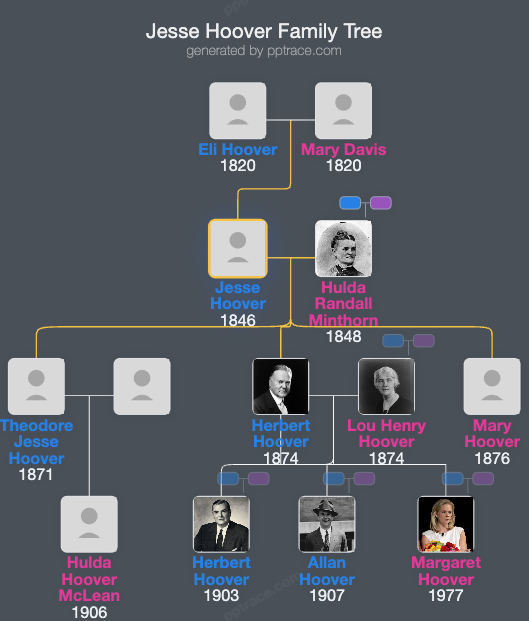
Family Tree
Tap  to expand more relatives
Introduction
Herbert Clark Hoover was born on August 10, 1874, in West Branch, Iowa. His father was Jesse Hoover, a blacksmith and farm implement store owner of German, Swiss, and English ancestry, and his mother was Hulda Randall Minthorn, who was raised in Norwich, Ontario, Canada, before moving to Iowa. The Hoover family were members of the Quaker religious community. Hoover's father died in 1880 at the age of 34 due to a heart attack, and his mother died in 1884 of typhoid fever, leaving Hoover and his siblings as orphans. Following the death of his parents, Hoover lived with his uncle Allen Hoover at a farm for 18 months, then with his uncle John Minthorn, a Quaker physician and businessman, in Newberg, Oregon.
Hoover attended Friends Pacific Academy (now George Fox University) but dropped out at age thirteen to work as an office assistant for his uncle's real estate business in Salem, Oregon. He learned bookkeeping, typing, and mathematics at night school. In 1891, Hoover enrolled at Stanford University, part of its inaugural class, despite failing all but one of the entrance exams. He initially studied mechanical engineering but switched to geology after working with Professor John Casper Branner. Hoover was a mediocre student, and he engaged in various part-time jobs and campus activities, including serving as student treasurer and manager of campus sports teams. He participated in founding the Romero Hall Boarding Club, a cooperative residence, and organized the first football game between Stanford and the University of California.
After graduating from Stanford in 1895 during the economic Panic of 1893, Hoover sought employment in mining. He initially worked in the Sierra Nevada Mountains before being hired by Bewick, Moreing & Co., a London-based gold mining company, and moved to Western Australia. Hoover worked in the harsh conditions of the goldfields, evaluating and managing mines. He played a significant role in the company's operations, including initiating the purchase of the Sons of Gwalia mine, which became highly successful. Hoover promoted the employment of Italian immigrants to reduce costs and was opposed to minimum wages and workers' compensation measures, believing they were unfair to owners. His work performance led to his promotion to junior partner in 1898.
In late 1900, Hoover was sent to China to develop gold mines near Tianjin on behalf of Bewick and the Chinese Engineering and Mining Company. His tenure in China coincided with the Boxer Rebellion, which temporarily trapped him and other foreigners. Following the conflict, Hoover helped establish a new Sino-British mining venture, becoming the operating partner in late 1901. During this period, he developed complex views on labor practices, advocating for reforms for Chinese workers based on merit, despite racial stereotypes he held.
Hoover's career progressed further as he became influential in the mining industry, and his international experience laid the foundation for his later roles in humanitarian efforts, governmental service, and eventually, the presidency of the United States.