Charles Edward Stuart
| Name | Charles Edward Stuart |
| Title | Jacobite pretender to the thrones of England, Scotland, Ireland, and France; (1720-1788) |
| Gender | Male |
| Birthday | 1720-12-31 |
| nationality | Great Britain |
| Source | https://www.wikidata.org/wiki/Q312581 |
| pptrace | View Family Tree |
| LastUpdate | 2025-11-12T01:14:44.054Z |
Family Tree
Tap  to expand more relatives
Introduction
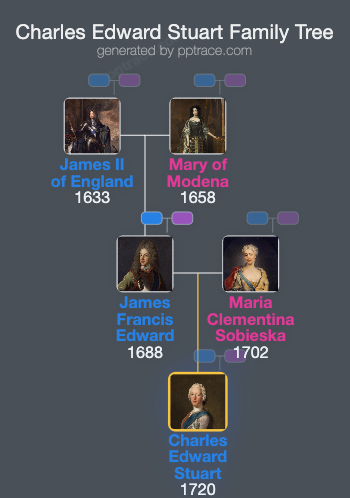
Charles Edward Louis John Sylvester Maria Casimir Stuart was born on 31 December 1720 in Rome, Italy, and died on 30 January 1788 in Rome, Italy. He was the elder son of James Francis Edward Stuart and Maria Clementina Sobieska. As the grandson of James VII and II, he was the Stuart claimant to the thrones of England, Scotland, and Ireland from 1766, a title he held as "Charles III" among Jacobites.
His parents belonged to the exiled Stuart court, and he spent much of his early and later life in Italy, primarily in Rome and Florence. Charles's father, James Francis Edward Stuart, was the Old Pretender, and his mother, Maria Clementina Sobieska, was a Polish noblewoman, granddaughter of John III Sobieski. His grandfather, James II of England and VII of Scotland, was deposed in the Glorious Revolution of 1688.
Charles was baptized in Rome, with sources differing on whether Pope Clement XI or the Bishop of Montefiascone presided over the ceremony. His names included Charles, Edward, Louis, Casimir, and Sylvester, reflecting his royal and religious heritage. He was said to have experienced weak legs early in life, possibly due to rickets, but later exercise improved his condition.
He was educated in Italy under the supervision of his family and tutors, including the Protestant James Murray, the Jacobite Earl of Dunbar. Despite initial concerns from the Pope, he was raised as a Catholic. Throughout his childhood, Charles engaged in activities such as hunting, horsemanship, music, and dancing. At age thirteen, he accompanied his cousin, the Duke of Liria, to participate in the siege of Gaeta in 1734, his first exposure to warfare. His mother died of scurvy in 1735 when he was fourteen.
Between 1737 and 1745, Charles traveled through Italian cities including Genoa, Florence, Parma, Bologna, and Venice to complete his education as a young prince. He became part of Italian high society and developed a fondness for fine clothes and alcohol. His relationship with his brother Henry Benedict Stuart grew distant due to religious differences and personal inclinations.
In 1744, Charles traveled covertly to France from Rome with the intent of supporting a planned invasion of Britain to restore the Stuart monarchy. Although the invasion was thwarted by storms and British naval forces, Charles determined to proceed with an uprising in Scotland. He arrived at Eriskay in July 1745 after crossing from France, gathering support among Highland clans and raising the Stuart standard at Glenfinnan in August 1745.
Leading the Jacobite rising of 1745–1746, Charles achieved initial military successes, notably at the Battle of Prestonpans in September 1745 and Falkirk in January 1746. He marched into England, capturing Carlisle in November 1745 and advancing through northern England before retreating to Scotland in December. His forces fought at the Battle of Culloden on 16 April 1746, where the Jacobite cause was decisively defeated.
Following Culloden, Charles escaped into the Scottish Highlands, conducting a clandestine retreat through the Hebrides and into France. He returned to France in October 1746 and lived largely in exile thereafter, dwelling in various European locations, including France, Italy, and Spain. His efforts to secure support for a restoration continued modestly, with brief visits to London and attempts at marriage and political negotiations.
In 1766, upon the death of his father, James Stuart, Charles assumed the claim to the throne as "Charles III," although recognition by foreign powers was limited. He spent his later years in Rome, Florence, and Paris, engaging in social activities and maintaining the Stuart legacy. He married Princess Louise of Stolberg-Gedern in 1772, and they lived together in Rome and Florence; the marriage was reportedly troubled, and Louise left him in 1780.
Charles's health declined in his later years, and he suffered from ailments including asthma, high blood pressure, and ulcers. He was known to have struggled with alcoholism. He died in Rome of a stroke on 30 January 1788 at the age of 67. His body was initially buried in Frascati Cathedral, then moved to St Peter's Basilica in Vatican City, with his heart preserved in a small urn in Frascati Cathedral.
His life has been depicted in various cultural forms, including paintings, plays, films, and songs, often romanticized as that of a romantic figure of heroic failure.