Henry Benedict Stuart
| Name | Henry Benedict Stuart |
| Title | Catholic cardinal |
| Gender | Male |
| Birthday | 1725-03-06 |
| nationality | — |
| Source | https://www.wikidata.org/wiki/Q318219 |
| pptrace | View Family Tree |
| LastUpdate | 2025-11-12T01:14:45.045Z |
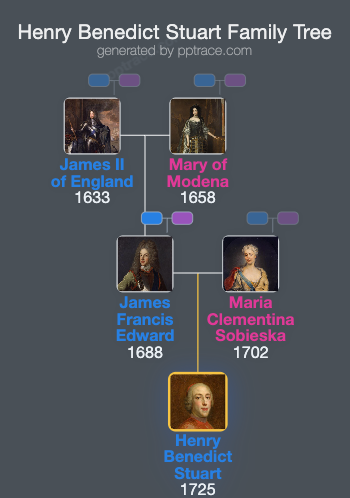
Family Tree
Tap  to expand more relatives
Introduction
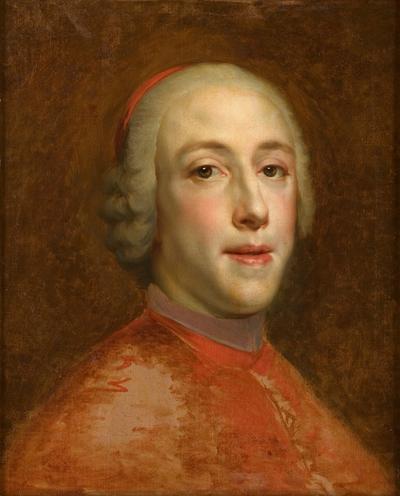
Henry Benedict Thomas Edward Maria Clement Francis Xavier Stuart, Cardinal Duke of York, was born on March 6, 1725, at the Palazzo Muti in Rome. He was the youngest grandson of King James II of England and Ireland. His parents were James Francis Edward Stuart, known as "the Old Pretender," and Princess Maria Klementyna Sobieska, granddaughter of King John III Sobieski of Poland. Henry was baptized on the day of his birth by Pope Benedict XIII, 37 years after his grandfather was deposed from the throne, and ten years following his father's failed attempt to regain it.
Henry received his early education in Rome, and unlike his elder brother Charles Edward Stuart ("Bonnie Prince Charlie"), he was characterized as an intelligent, introverted, and cautious individual with a strong religious inclination. He reportedly possessed superior spelling and handwriting skills compared to Charles.
In 1745, Henry went to France to assist his brother Charles in preparing for the Jacobite rising of 1745. He was attached to the French Royal Army and was nominally in command of a cross-channel invasion force, which never materialized. He served under Maurice de Saxe during the siege of Antwerp. Following the defeat at the Battle of Culloden in 1746, Henry returned to Italy, aged 21.
Henry Benedict Stuart was elevated to the Catholic episcopacy in 1747. On June 30, 1747, Pope Benedict XIV conferred the tonsure upon him and appointed him as Cardinal-Deacon of Santa Maria in Campitelli during a special consistory. Subsequently, he was promoted through various ecclesiastical ranks, including the subdiaconate and diaconate in August 1748. His brother Charles, then in France, was opposed to Henry's ecclesiastical career, viewing it as potentially increasing religious prejudice against the Stuarts. Nonetheless, Henry was ordained a priest on September 1, 1748, and was made Cardinal-Priest later that month.
Henry amassed considerable income from ecclesiastical benefices across Europe, including territories in Flanders, Spain, Naples, France, and Spanish America. His holdings included properties in Mexico, contributing significantly to his wealth. Louis XV of France granted him abbeys as compensation related to territorial disputes involving his family.
In 1751, Henry was appointed Arch-Priest of St. Peter's Basilica. His ecclesiastical offices continued to advance, and in 1758, Pope Clement XIII elected him Camerlengo of the Sacred College of Cardinals. He participated in the papal conclave of 1758 that elected Pope Clement XIII. He became Cardinal-Bishop of Frascati in July 1761 and eventually the Dean of the Sacred College of Cardinals in September 1803, succeeding to the positions of bishop of Ostia and Velletri.
Throughout his life, Henry resided mainly in Frascati, making daily journeys to Rome, and held the position of vice-chancellor of the Holy College. He was the last claimant to the British throne to perform the traditional royal touch for the King's Evil.
During the French Revolution, Henry lost several of his benefices and was forced to surrender properties due to French seizures, which impoverished him. An annuity of £4,000 from King George III was granted to him, which he and the Jacobites regarded as partial fulfillment of money owed from his family's inheritance. His papal recognition shifted during this period; after the death of his father in 1766, the Vatican refused to recognize his brother Charles as king due to his Anglican conversion, and in 1792, it finally referred to George III as King of Great Britain and Ireland instead of the Elector of Hanover, which offended Henry.
In 1798, French authorities and the United Irishmen considered Henry as a potential figurehead in Ireland, proposing him as "Henry IX," although this plan did not materialize. He returned to Frascati in 1803, continuing his ecclesiastical duties until his death there on July 13, 1807, at the age of 82.
Henry Benedict Stuart remained a celibate, wealthly figure, known for his piety and residence in ecclesiastical office. He was succeeded in his Jacobite claims by Charles Emmanuel IV of Sardinia, whom he appointed in his will. He is buried in the crypt of St. Peter's Basilica in Vatican City, where a monument commemorates the Royal Stuarts.