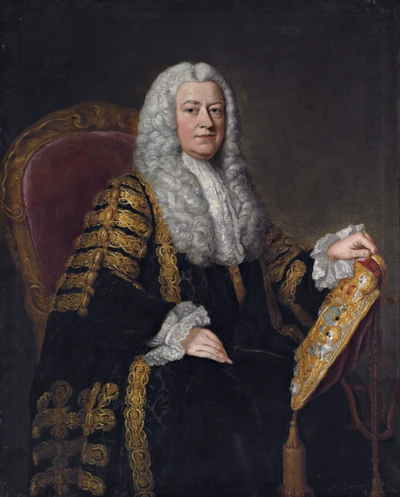
Philip Yorke, 1st Earl Of Hardwicke
| Name | Philip Yorke, 1st Earl Of Hardwicke |
| Title | English lawyer and politician who served as Lord Chancellor (1690-1764) |
| Gender | Male |
| Birthday | 1690-12-01 |
| nationality | Great Britain |
| Source | https://www.wikidata.org/wiki/Q2708598 |
| pptrace | View Family Tree |
| LastUpdate | 2025-11-26T23:27:03.051Z |
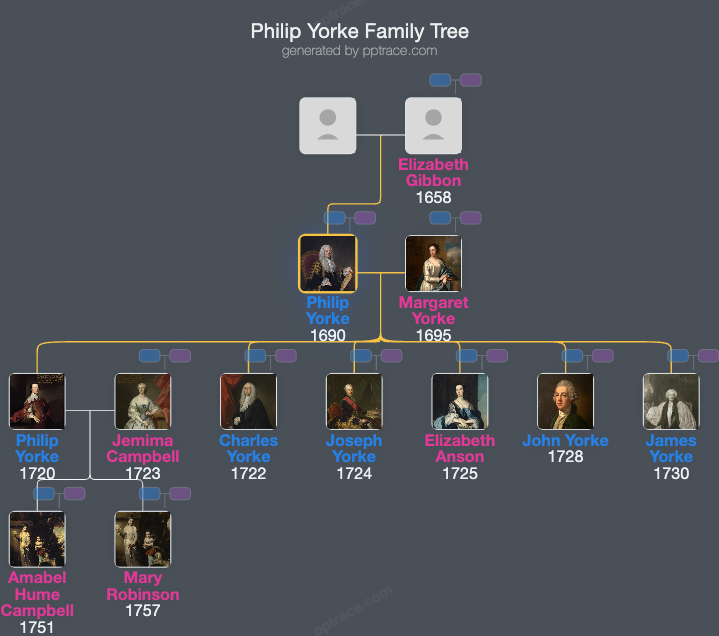
Family Tree
Tap  to expand more relatives
Introduction
Philip Yorke, 1st Earl of Hardwicke, was born on December 1, 1690, in Dover, England. He was the son of Philip Yorke, an attorney, and Elizabeth Gibbon, daughter and co-heiress of Richard Gibbon of Rolvenden, Kent. Through his maternal lineage, he was connected to the family of the historian Edward Gibbon.
Yorke received his early education at a school in Bethnal Green managed by Samuel Morland, a nonconformist. At age 16, he commenced his legal studies at Charles Salkeld's attorney's office in Holborn, London. He was admitted to the Middle Temple in November 1708, possibly recommended by Salkeld to Lord Chief Justice Parker as a law tutor for his sons. Yorke was called to the bar in 1715, and his early career progression was notably rapid. His advancement benefited from the patronage of Thomas Parker, 1st Earl of Macclesfield, who became Lord Chancellor in 1718, prompting Yorke to shift his practice from the King's Bench to the Court of Chancery.
In 1719, Yorke entered Parliament representing Lewes and was appointed solicitor-general in 1720, receiving a knighthood. Shortly thereafter, he married Margaret Cocks, daughter of Charles Cocks and widow of William Lygon. The marriage produced five sons and two daughters, among them Philip Yorke, Viscount Royston (1720–1790), and Charles Yorke (1722–1770), who also became Lord Chancellor.
In 1739, Yorke purchased Wimpole Hall, a significant country estate in Cambridgeshire. He was buried at St. Andrew Churchyard at Wimpole, alongside many of his descendants.
Yorke's legal career included notable roles such as Attorney-General, appointed in 1723, and Lord Chief Justice of the King's Bench in 1733. His reputation grew during this period due to his participation in significant prosecutions and legal opinions, including the 1729 Yorke–Talbot slavery opinion, which judged slavery to be legal—a stance he later reaffirmed as a judge.
In 1737, Yorke succeeded Lord Talbot as Lord Chancellor, a position that increased his political influence and involved him in key governmental decisions. His tenure in the House of Lords saw him involved in national defense and foreign policy issues, notably advocating for military action against Spain and attempting to mediate between political factions.
Yorke held the chancellorship through several administrations and was a central figure during the period of the Wilmington government, from 1742 to 1743, where he influenced major policies such as reforms in Scotland following the Jacobite Rising of 1745. He presided over the trial of Scottish Jacobite peers, and some of his decisions contributed to the severity of punishments meted out.
In 1754, Yorke was created Earl of Hardwicke and Viscount Royston, following his support for Newcastle’s ministry. He briefly served in Pitt’s cabinet in 1757 and held office during the early years of George III’s reign. During this time, he opposed the Bute ministry's peace policies with France and condemned general warrants and the doctrine of parliamentary privilege in libel cases.
He died in London on March 6, 1764. Yorke's judicial decisions and legislative work contributed to the development of modern equity principles and the role of English judges. His contributions include landmark judgments such as Middleton v. Crofts (1736) and several notable cases, including Gyles v. Wilcox (1740) and Attorney General v. Davy (1741).
He was succeeded in his titles by his eldest son, Philip Yorke, Viscount Royston. His monument was sculpted by Peter Scheemakers. Yorke's cousin, Sir William Yorke, achieved prominence as Chief Justice of the Irish Common Pleas.