Charles Yorke
| Name | Charles Yorke |
| Title | British politician and Lord Chancellor; (1722-1770) |
| Gender | Male |
| Birthday | 1722-12-30 |
| nationality | Great Britain |
| Source | https://www.wikidata.org/wiki/Q5083769 |
| pptrace | View Family Tree |
| LastUpdate | 2025-11-26T23:27:15.763Z |
Family Tree
Tap  to expand more relatives
Introduction
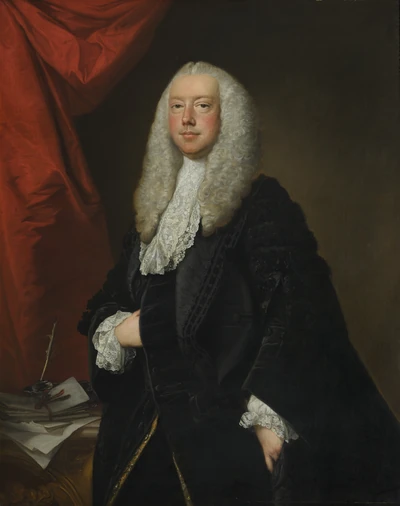
Charles Yorke, born on December 30, 1722, in London, was a British politician who served as Lord High Chancellor of Great Britain in 1770. He was the second son of Philip Yorke, 1st Earl of Hardwicke, who also held the office of Lord Chancellor. Educated at Newcome's School in Hackney and Corpus Christi College, Cambridge, Yorke displayed early literary talent, notably collaborating with his brother Philip on the "Athenian Letters." In 1745, he published a treatise on the law of forfeiture for high treason, defending the penalties imposed on Scottish Jacobite peers following the Battle of Culloden.
Yorke was called to the bar in 1746. Two years later, in 1747, he obtained a sinecure appointment in the Court of Chancery, coinciding with his father's position as Lord Chancellor. He entered Parliament as the Member for Reigate and later represented the University of Cambridge. His political career was marked by advocacy for legal reforms, including support for his father's reform of marriage law leading to the Marriage Act 1753. In 1750, he was elected a Fellow of the Royal Society.
In 1751, he became counsel to the East India Company. He was appointed Solicitor-General in 1756, serving under Prime Minister William Pitt the Elder, and retained this role during Pitt's administration. Yorke resigned in 1761 but returned to government as Attorney-General under Lord Bute in 1762. During his tenure, he advised on issues related to John Wilkes's publication of "The North Briton," notably refusing to classify the libel as treason but recognizing it as a high misdemeanor, leading to his resignation in November 1763.
Yorke aligned himself with the Rockingham party and was elected recorder of Dover in 1764. In 1765, he resumed the office of Attorney-General in the Rockingham administration, contributing to policies such as the repeal of the Stamp Act and the passage of the Declaratory Act. His significant contribution during this period was drafting the legal framework for the province of Quebec, which became the Quebec Act of 1774.
Following political shifts, Yorke resigned in 1766 but was elected to Parliament from various constituencies over the years. In 1770, he was invited by the Duke of Grafton, after the dismissal of Lord Camden, to assume the position of Lord Chancellor and was sworn into the Privy Council on January 17, 1770. Despite this appointment, he experienced distress following his acceptance, and after visiting his brother's house—where he encountered opposition leaders—he returned home and died by apparent suicide on January 20, 1770. A patent was issued to elevate him to the peerage as Baron Morden, but he refused to approve the sealing of the document. Recent scholarship suggests his death was due to ill health and a possible medical complication rather than suicide.
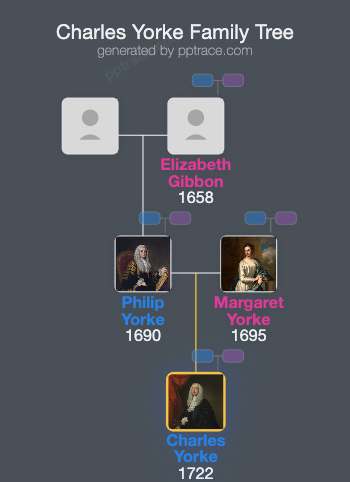
Yorke was married twice. His first marriage was to Katherine Blount Freeman in 1755, with whom he had a son, Philip Yorke, who became the 3rd Earl of Hardwicke. His second marriage was to Agneta Johnson in 1762; they had children including Charles Philip Yorke, Joseph Sydney Yorke, and Caroline Yorke. Agneta was an artist and corresponded with William Gilpin; she exhibited works in pastels and died in 1820.
He remained linked to notable legal and political figures until his death in 1770.