
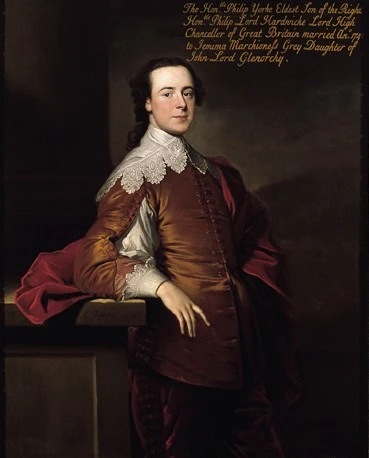
Philip Yorke, 2nd Earl Of Hardwicke
| Name | Philip Yorke, 2nd Earl Of Hardwicke |
| Title | British politician and historian (1720–1790) |
| Gender | Male |
| Birthday | 1720-03-09 |
| nationality | Great Britain |
| Source | https://www.wikidata.org/wiki/Q5790329 |
| pptrace | View Family Tree |
| LastUpdate | 2025-11-26T23:26:54.123Z |
Family Tree
Tap  to expand more relatives
Introduction
Philip Yorke, 2nd Earl of Hardwicke, PC, FRS (9 March 1720 – 16 May 1790), was a British politician and writer. He was born as the eldest son of Philip Yorke, 1st Earl of Hardwicke. His early education included attendance at Newcome's School and Corpus Christi College, Cambridge.
In 1738, Yorke was appointed Teller of the Exchequer, a position he maintained for his entire lifetime. He was elected a Fellow of the Royal Society in 1741. His parliamentary career began with his election as the member for Reigate, serving from 1741 to 1747, after which he represented Cambridgeshire. During his time in Parliament, he kept notes of debates which were later incorporated into Cobbett's Parliamentary History.
During the 1756 political crisis surrounding the loss of Minorca to France, Yorke was involved in collecting press accounts supporting the Ministry. He also collaborated with his father and Lord Mansfield in defending the Newcastle ministry during parliamentary inquiries related to Admiral John Byng’s execution.
From 1754 to 1764, he was styled as Viscount Royston, succeeding to the earldom upon his father’s death in 1764. He inherited the Wimpole estate in Cambridgeshire, acquired by his father from Edward Harley, Earl of Oxford. Upon George III's accession in 1760, Yorke was sworn into the Privy Council. He supported the Rockingham Whigs politically and held the position of Lord Lieutenant of Cambridgeshire from 1757 until his death. Additionally, he served as high steward of Cambridge University.
Yorke contributed to the editing of various state papers and correspondence, with many manuscripts preserved at the British Museum. Between 1756 and 1760, he served as vice president of the Foundling Hospital, a charitable organization for London's abandoned children.
He died in 1790 and was interred in Flitton, Bedfordshire. His grave features a monument by Thomas Banks.
As a writer, Yorke co-authored "Athenian Letters," a four-volume work published in 1741 that depicts the epistolary correspondence of a Persian agent in Athens during the Peloponnesian War. This publication enjoyed considerable popularity and multiple editions.
On 22 May 1740, Yorke married Lady Jemima Campbell, daughter of John Campbell, 3rd Earl of Breadalbane. Lady Jemima succeeded her grandfather as the 2nd Marchioness Grey and the 4th Baroness Lucas upon his death in 1740. They had two daughters who became co-heiresses:
- Lady Amabel Yorke (23 January 1751 – 4 March 1833), who became the 5th Baroness Lucas and married Alexander Hume-Campbell, Lord Polwarth, without issue.
- Lady Mary Jemima Yorke (9 February 1756 – 1830), who married Thomas Robinson, 2nd Baron Grantham, and had children.
Following his death, the earldom was succeeded by his nephew, Philip Yorke, 3rd Earl of Hardwicke.
