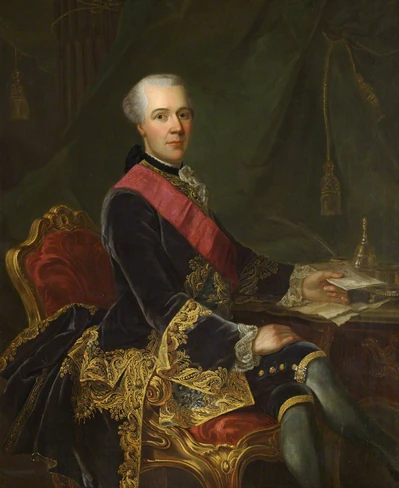
Joseph Yorke, 1st Baron Dover
| Name | Joseph Yorke, 1st Baron Dover |
| Title | British Army general |
| Gender | Male |
| Birthday | 1724-06-24 |
| nationality | Great Britain |
| Source | https://www.wikidata.org/wiki/Q6288117 |
| pptrace | View Family Tree |
| LastUpdate | 2025-11-26T23:27:16.603Z |
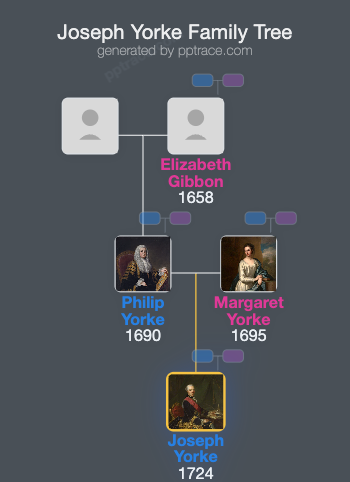
Family Tree
Tap  to expand more relatives
Introduction
Joseph Yorke, 1st Baron Dover, was born on 24 June 1724. He was a member of the Yorke family, being the third son of Philip Yorke, 1st Earl of Hardwicke, and Margaret Cocks. His brothers included Philip Yorke, 2nd Earl of Hardwicke, Charles Yorke, and James Yorke.
Yorke began his military career on 25 April 1741 when he was commissioned as an ensign in the 2nd Regiment of Foot Guards. He received a promotion to lieutenant in the 1st Regiment of Foot Guards on 24 April 1743. He participated in the War of the Austrian Succession as an aide-de-camp to the Duke of Cumberland and fought in the Battle of Fontenoy on 11 May 1745. On 27 May 1745, he was promoted to captain and lieutenant-colonel, commanding a company in the 2nd Guards.
On 1 November 1749, Yorke was appointed an aide-de-camp to the King. He was promoted to colonel of the 9th Regiment of Foot on 18 March 1755. His military promotions continued with the rank of Major-General in 1758, Lieutenant-General in 1760, and full General in 1777.
In addition to his military career, Yorke pursued diplomatic service. In 1749, he was appointed Secretary to the British Embassy in Paris. In 1751, he became Minister Plenipotentiary to the Dutch Republic, a position he held for approximately thirty years. He was involved in diplomatic negotiations, including the Anglo-Prussian Convention in 1758. His diplomatic position was elevated to that of ambassador in 1761.
During his tenure as a diplomat, the Dutch remained neutral during the Seven Years' War (1756–1763), and initially during the American Revolutionary War (1775–1783). In 1780, the Dutch shifted alliances and allied with the Americans. British efforts to utilize the Scots Regiment stationed in the Dutch Republic to fight the Americans were unsuccessful, as Yorke's pleas for such support were rebuffed, which strained relations between Britain and the Dutch.
Yorke's attitudes toward the Dutch were characterized by a lack of friendship; contemporaries noted that he "had scorn for the [Dutch] Republic." He also served as a Member of Parliament for three constituencies: East Grinstead from 1751 to 1761, Dover from 1761 to 1774, and Grampound from 1774 to 1780.
In 1761, Yorke was appointed a Knight Companion of the Order of the Bath (KB). He was sworn into the Privy Council in 1768. In 1788, he was elevated to the peerage as Lord Dover, Baron of the Town and Port of Dover, in the County of Kent.
In his personal life, Yorke married Christiana Charlotte Margaret, the daughter of Johan Henrik, Baron de Stöcken, a Danish nobleman, in 1783. The marriage produced no children. Lord Dover died on 2 December 1792, at the age of 68, when his barony became extinct. His wife, Lady Dover, survived him by three months, passing away in March 1793.