Konoe Atsumaro
| Name | Konoe Atsumaro |
| Title | Japanese politician (1863-1904) |
| Gender | Male |
| Birthday | 1863-08-10 |
| nationality | Tokugawa shogunate |
| Source | https://www.wikidata.org/wiki/Q923564 |
| pptrace | View Family Tree |
| LastUpdate | 2025-11-17T06:47:39.698Z |
Family Tree
Tap  to expand more relatives
Introduction
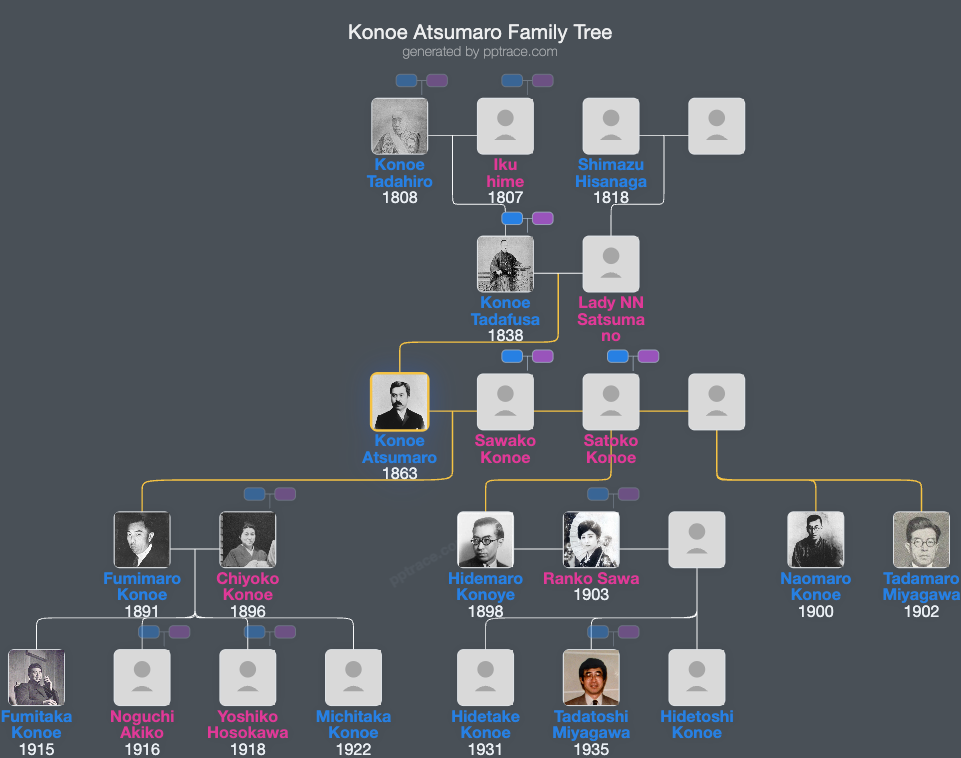
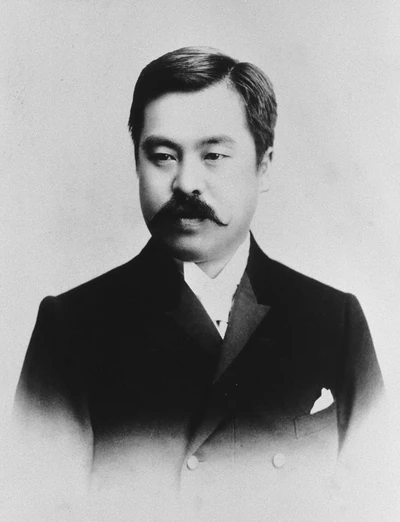
Prince Konoe Atsumaro (近衛 篤麿, 10 August 1863 – 1 January 1904) was a Japanese politician and journalist during the Meiji era. He held several significant positions, including serving as the 3rd President of the House of Peers and the 7th President of the Gakushūin Peer's School in Japan. Konoe was the father of Prime Minister Fumimaro Konoe and the great-grandfather of Prime Minister Morihiro Hosokawa.
Family and Nobility Background
Following the Meiji Restoration, the Konoe family transitioned from the traditional court nobility to the kazoku peerage system established by the new government. Under this system, the family was bestowed the title of Prince (koshaku), reflecting their elevated status within the new aristocratic hierarchy.
Education and European Experience
Between 1885 and 1890, Konoe studied in Europe, attending the University of Bonn and the University of Leipzig in Germany. Upon his return to Japan, he became a member of the House of Peers, the upper legislative chamber of the Imperial Diet. In 1895, he was appointed president of the Gakushūin Peer's School, an educational institution serving the aristocracy.
Political Roles and Activities
Konoe served as the third President of the House of Peers from October 3, 1896, to December 4, 1903. During his tenure, he presided over the 10th through 18th sessions of the House. From 1903 onward, he also served as a Privy Councillor, advising the Emperor on state matters.
Domestic and Foreign Policy Engagements
Konoe was known for his opposition to clan-based political structures, which continued to influence Japanese politics during his lifetime. He was an active supporter of Pan-Asianism, founding the East Asia Common Culture Society (東亜同文会, Toa Dobunkai) in 1900. This society aimed to promote mutual understanding and improve relations between Japan and China following the First Sino-Japanese War.
The society established the East Asia Common Cultural College (東亜同文書院, Toa Dōbun Shoin) in Nanjing in 1900, which moved to Shanghai in 1901. The college recruited Japanese students seeking to learn Chinese language and culture, and supported Chinese students seeking higher education in Japan through a partner school in Tokyo, the predecessor of Aichi University. The society also published scholarly journals and an extensive report titled "A Comprehensive Book on the Economics Conditions in China." Graduates from these educational institutions were highly regarded by Japanese military and intelligence organizations for their language skills and knowledge of China, with many later working for the government of Manchukuo in the 1930s.
In August 1903, Konoe established the Anti-Russia Society (対露同志会, Tairo Dōshikai), which advocated for a tough foreign policy against the Russian Empire. The society viewed Russia as a threat to Japanese, Chinese, and Korean independence. Konoe personally urged Japan to declare war on Russia, but he died before the commencement of the Russo-Japanese War in late 1904.
Death and Burial
Prince Konoe Atsumaro died on January 1, 1904. He is interred at the Konoe family cemetery located at Daitoku-ji in Kyoto.