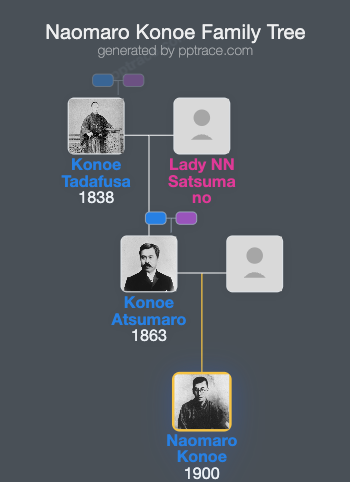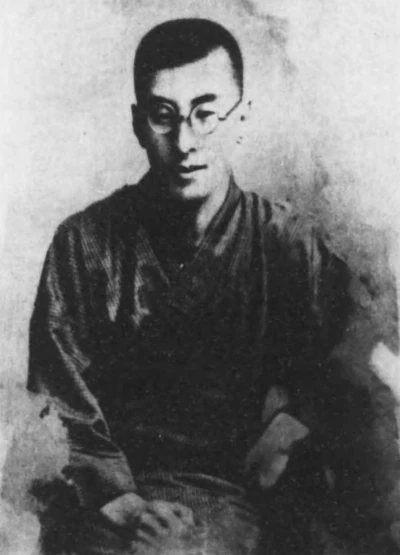
Naomaro Konoe
| Name | Naomaro Konoe |
| Title | Japanese poet and musicologist |
| Gender | Male |
| Birthday | 1900-08-30 |
| nationality | Q188712 |
| Source | https://www.wikidata.org/wiki/Q13572139 |
| pptrace | View Family Tree |
| LastUpdate | 2025-11-17T06:47:46.732Z |
Family Tree
Tap  to expand more relatives
Introduction
Naomaro Konoe (original kanji: 近衞直麿, formerly written in older characters: 近󠄁衞 直麿󠄁; August 30, 1900 – July 22, 1932) was a Japanese poet, horn player, and gagaku researcher. He was born in Nagatacho, Chiyoda-ku, Tokyo, and was the third son of Duke Atsumaro Konoe. His mother was Sadako (Motoko), the sixth daughter of the 14th generation Maeda Yoshinobu of the Kaga Maeda family.
His educational background includes entering Gakushuin Elementary School in 1907, and just before advancing to Gakushuin Middle School in 1913, he was entrusted to his uncle Count Tsuruga Hidehira's residence (in Azabu, Tokyo), but expressed discontent with becoming an adopted child. He dropped out of Gakushuin Middle School in October 1913. After dropping out, he accompanied his family to Tsuruga Hidehira’s post in Korea and enrolled in Keijo Imperial Resident General’s School (now Seoul High School) in 1914, but he withdrew the same year and entered the Gosei Gyosei Middle School (now Gosei High School). During his school years, he studied poetry under Rohfu Miki and wrote his first poems "Melody" and "Sounds Remembered." His peers included Tōkō Imam and Bunji Tsushima.
Around 1917, he largely abandoned his studies and was involved in the pleasure districts, indulging in a dissipated lifestyle that included visiting the Yoshiwara brothel district. This behavior was reportedly based on advice from his older brother, Shigemaro Konoe, and was a strategy to discourage him from returning to the Tsuruga family by engaging him in entertainment and shifting expenses onto them. However, the Tsuruga family did not abandon him and waited in hopes of bringing him back. In 1918, he failed and dropped out of Gosei Middle School.
Subsequently, in 1919, he enrolled in Waseda University's preparatory department for literature. That same year, the adoption arrangement under the name Tsuruga Hidehira was dissolved. In 1920, he published his debut work "Wa-gen" (Japanese String), but then turned away from poetry and devoted himself to studying novels and plays. He co-founded the magazine "Symbol" with Takimaro Ito, 松雄 Ito, Asahiko Sakai, Jun Muro, and Eiji Hamano. During the 1920s, he also began self-taught study of the horn.
In 1922, his older brother Shigemaro Konoe conducted the Tokyo Imperial University Orchestra as a conductor, and Naomaro participated as a horn player on concert tours. Around 1923, he nearly abandoned creative activities and became passionate about skiing, which was still unfamiliar in Japan. By 1925, he was participating as a horn player in the Japan Symphony Orchestra and the New Symphony Orchestra. He once proposed to Minee Kawashima, a 14-year-old woman working at Komatsu Shokudo (later Matsumoto Hall) in Ginza, but was suspected of impersonating a noble and was detained. In 1926, he married Minee in a common-law marriage. Minee was the daughter of a bankrupt jewelry merchant in Honjo, Tokyo, and their union faced opposition from both families due to social disparities.
In September 1929, after performing in a concert conducted by Schiffratt, he was hospitalized at Kanda Kago Hospital and diagnosed with tuberculous pleurisy. As a result, he left the Symphony Orchestra and, while recuperating at his villa in Hase, Kamakura, he dedicated himself to gagaku research. In November 1930, he challenged the authority of Kasshi Sanzui, a prominent musicologist, in a debate over gagaku. In January 1931, he left the Gagaku Propagation Society, which was primarily composed of court musicians. Afterwards, he founded the Gagaku Comrades Association, which was open to general enthusiasts, and he and his wife served as leaders.
In 1932, he produced a radio drama titled "Kino Me no Koro" ("The Season of Buds"), but shortly thereafter, he died at the hospital affiliated with the Institute of Infectious Diseases at Tokyo Imperial University (now the University of Tokyo Hospital). His older brother Fumimaro Konoe commented, "He's an incorrigible guy, but he's like a genius." His wife Minee married Noh performer Masanori Kusukawa on October 31, 1934.